
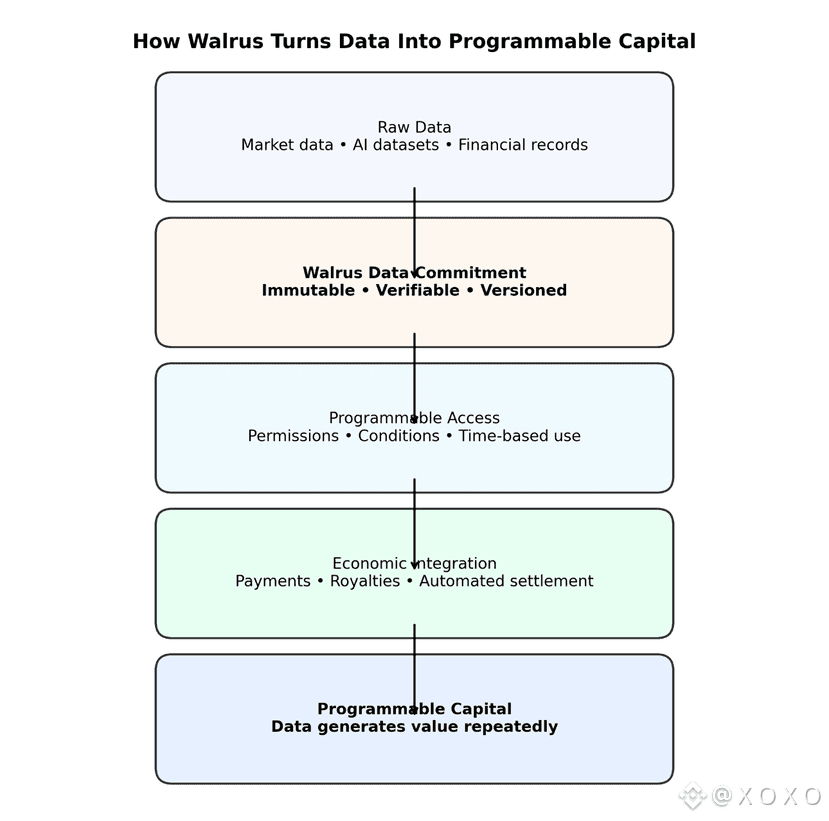


For most of the digital economy, data has been valuable but passive. It gets collected, stored, analyzed, and monetized somewhere downstream, usually by platforms rather than the people who produce it. Even in Web3, data often behaves like a static resource. It exists, but it doesn’t act.
This is where @Walrus 🦭/acc introduces a fundamental shift. Walrus treats data not just as information, but as something that can be controlled, verified, and economically activated. In other words, data becomes programmable capital.
From static data to economic primitives
Capital is useful because it can be deployed repeatedly. Money can be lent, invested, or routed through contracts. Data has traditionally lacked this property. Once shared, control is lost. Once copied, value leaks.
Walrus changes this by anchoring data with cryptographic commitments. When data is stored on Walrus, it gains a permanent identity. That identity is verifiable and versioned, meaning the system knows exactly what the data is and how it has evolved over time. This transforms data from a disposable input into a durable asset.
Programmability without surrendering ownership
The key difference between monetizing data and turning it into capital is control. Capital is not handed over permanently. It is deployed under rules.
Walrus enables this by separating access from ownership. Data owners can define how their data is used, for how long, and under what conditions. Access can be granted to AI models, financial protocols, or applications without transferring custody or losing provenance.
This makes data programmable in the same way smart contracts made money programmable.
Verification creates trustless markets
Markets only function efficiently when participants don’t need to trust each other blindly. Walrus embeds verification directly into data usage. Anyone consuming the data can independently verify that it matches the committed version.
This removes friction. Buyers don’t need intermediaries to certify quality. Sellers don’t need platforms to enforce honesty. Data becomes a self-verifying asset that can move through markets with confidence.
Reusable value instead of one-time extraction
Traditional data monetization is extractive. Data is sold once, copied endlessly, and the original producer is left out of future value creation.
With Walrus, data can generate value repeatedly. The same dataset can be accessed by multiple parties under different terms. Updates create new versions instead of overwriting history. Each interaction becomes an economic event rather than a loss of control.
Over time, this makes high-quality data behave like productive capital rather than exhaust.
Why this matters for AI and financial systems
AI systems increasingly rely on trustworthy datasets. Financial systems rely on auditable records. In both cases, data that cannot be verified or controlled becomes a liability.
Walrus allows data to be embedded directly into automated economic flows. Payments, royalties, incentives, and access rules can all be tied to data usage. That makes data not just valuable, but operational.
in short, Programmable capital reshaped finance by letting money move according to rules instead of trust. Walrus applies the same idea to data.
By making data verifiable, controllable, and economically composable, Walrus turns it into something that can participate in markets rather than sit behind them. As AI, finance, and automation converge, this shift may prove more important than many application-layer innovations.