
One idea keeps resurfacing in crypto every cycle but never quite works: using data itself as an economic primitive. We tokenize assets, stake tokens, collateralize liquidity — yet the data underlying those systems remains fragile, unverifiable, or controlled by third parties. That’s not a philosophical issue. It’s a market failure.
Walrus is interesting because it attacks that failure at the root.
At its core, Walrus is a decentralized blob storage and data availability protocol built on Sui, where large binary data is not just stored, but governed, verified, and economically maintained. Sui acts as the coordination and settlement layer; Walrus handles the heavy data. Together, they create something new: data that can be depended on inside financial systems.
That distinction matters more than most people realize.
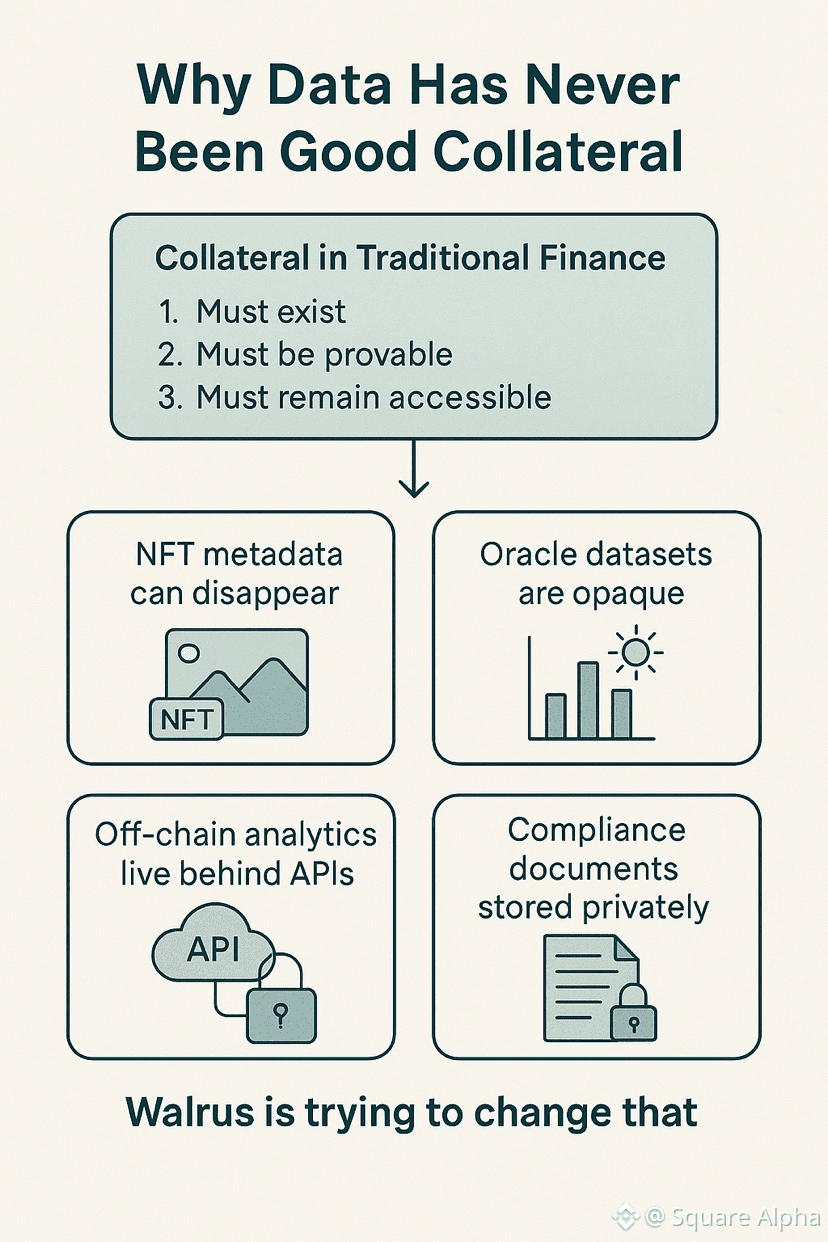
Why Data Has Never Been Good Collateral
In traditional finance, collateral must satisfy three conditions:
It must exist.
It must be provable.
It must remain accessible when needed.
Most crypto data fails at least one of these.
NFT metadata can disappear.
Oracle datasets are opaque.
Off-chain analytics live behind APIs.
Compliance documents are stored privately.
AI training sets can’t be verified after the fact.
Even when data is “decentralized,” there is often no on-chain proof that it remains available in the expected form. Markets can’t price what they can’t verify. As a result, data stays informational — not financial.
Walrus is trying to change that.
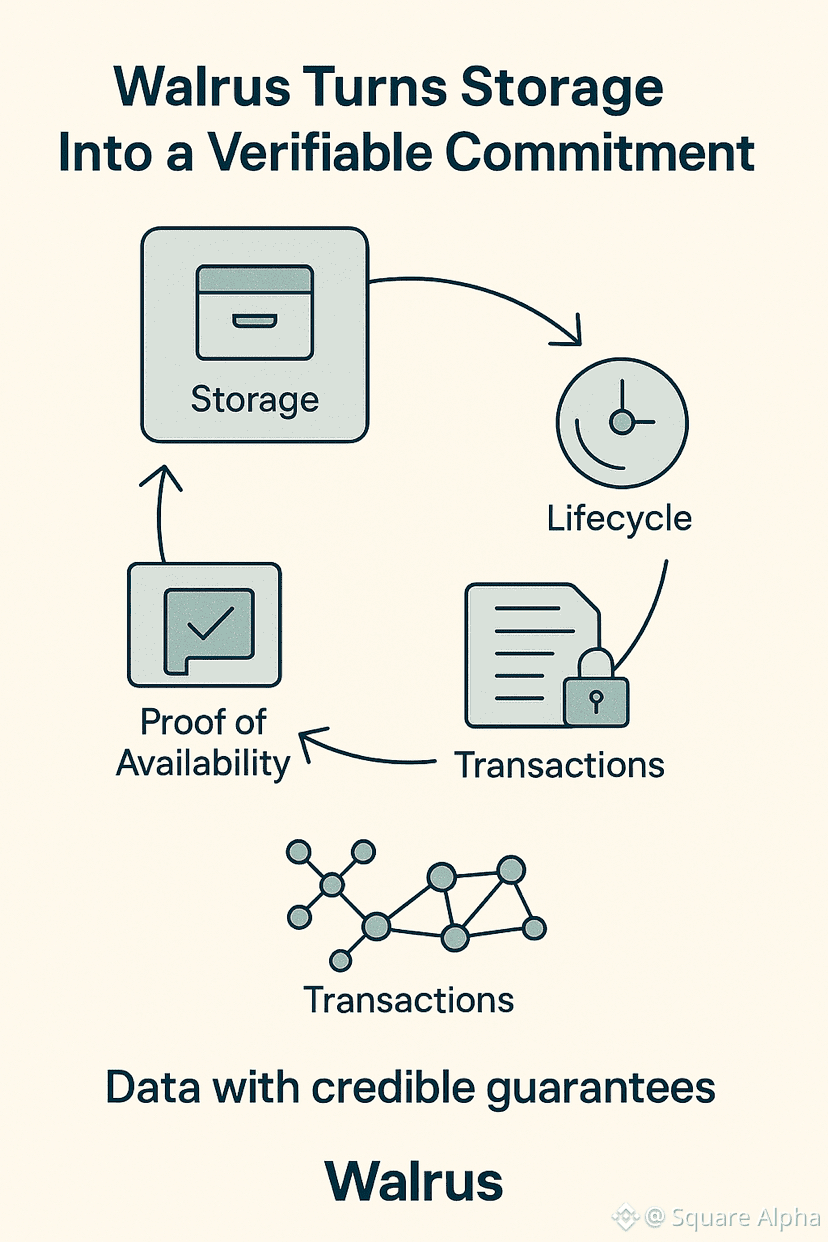
Walrus Turns Storage Into a Verifiable Commitment
Walrus does not just store blobs. It manages their lifecycle using Sui transactions, allowing the protocol to issue Proof of Availability certificates that applications can reference on-chain. This is a quiet but radical shift.
Now data isn’t just claimed to exist.
It can be proven to exist, persistently.
Technically, Walrus achieves this through erasure-coded storage (including its RedStuff design), distributing encoded fragments across nodes so that data can be reconstructed even if parts of the network fail. Economically, availability is enforced through incentives tied to $WAL, aligning storage providers with long-term persistence rather than one-off uploads.
The result is data with credible guarantees.
Where This Unlocks New Markets
Once data becomes verifiable and persistent, it stops being just a resource and starts behaving like collateral.
Consider a few realistic scenarios:
An RWA issuer stores audit trails and compliance records on Walrus, allowing lenders to verify historical compliance before extending credit.
A DeFi protocol uses archived risk datasets as inputs for insurance or lending models, knowing the data won’t disappear mid-cycle.
An AI marketplace sells access to training datasets where buyers can verify integrity and availability before paying.
A research DAO publishes datasets whose long-term availability is provable, enabling future reuse without trust.
In all these cases, Walrus is not the product — it is the trust substrate that makes the transaction possible.
Why Sui Matters Here
This model only works because Walrus is tightly integrated with Sui.
Sui’s object-centric architecture allows data references, proofs, and ownership logic to be handled cleanly at the protocol level. Availability guarantees can be checked by smart contracts, agents, or applications without relying on off-chain promises.
That makes Walrus-compatible data composable — something markets require.
The Market Implication Most People Miss
If Walrus succeeds, storage demand won’t come from retail users uploading files. It will come from applications embedding Walrus into their economic logic. That demand is structurally different.
Apps don’t churn storage casually.
Protocols don’t migrate historical data lightly.
Once data is embedded into workflows, it becomes sticky.
This is why storage infrastructure tends to be undervalued early and indispensable later.
Final Thought
Walrus is not trying to make storage exciting.
It is trying to make data credible.
If data can be proven, persisted, and economically enforced, it stops being a liability and starts becoming an asset. That’s when decentralized data markets stop being theoretical — and start behaving like real markets.
Whether Walrus captures that future depends on execution, cost, and adoption. But the direction is clear: Web3 doesn’t just need more data. It needs data it can trust.


