Dusk was founded in 2018 with a clear awareness of a problem that most blockchains preferred to ignore: real financial systems cannot function in an environment of total transparency, nor can they survive without regulation. Markets depend on privacy, accountability, and predictable settlement, yet public blockchains were designed for openness first and compliance later. Dusk emerged from this tension, not to disrupt finance through avoidance, but to rebuild financial infrastructure in a way that respects how institutions actually operate.
At its foundation, Dusk is a Layer-1 blockchain engineered to support regulated financial activity without exposing sensitive data. This goal shaped every technical decision. Instead of a single monolithic design, the network evolved toward a modular architecture that separates settlement, execution, and privacy. This structure allows the core network to focus on security and finality while enabling higher layers to adapt to complex financial logic. For institutions, this separation is not academic; it mirrors the layered structure of traditional financial systems where clearing, settlement, and execution are distinct but tightly coordinated processes.
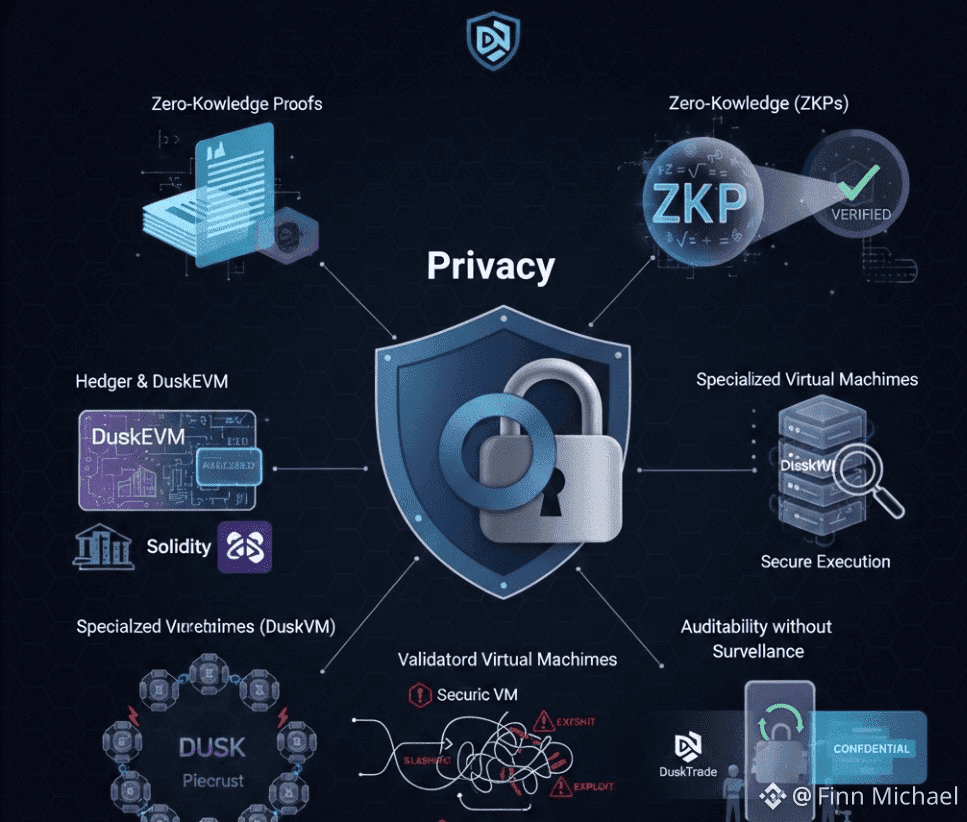
Privacy on Dusk is not treated as an ideological statement, but as a practical requirement. Financial participants cannot reveal balances, counterparties, or strategies to the public without risking market distortion or legal exposure. At the same time, regulators must retain the ability to audit activity and enforce rules. Dusk addresses this conflict through cryptographic techniques that allow transactions to be validated without revealing their contents, while still enabling selective disclosure when authority and law require it. This balance creates a sense of control rather than secrecy, which is essential for trust in regulated environments.
Compatibility with existing development tools reflects another pragmatic choice. By supporting EVM-based smart contracts, Dusk reduces friction for developers who are already familiar with Ethereum. Yet this familiarity is paired with additional responsibility. Building on Dusk means understanding privacy constraints, compliance logic, and permissioned interactions. As a result, the developer ecosystem is smaller, but more focused. The work being done is less about experimental applications and more about financial primitives that must behave correctly under regulatory scrutiny. This focus naturally slows growth, but it also filters out fragility.
Adoption signals around Dusk do not resemble the metrics typically used in public blockchain ecosystems. There is little emphasis on daily users or speculative activity. Instead, progress appears through relationships with regulated exchanges, alignment with European financial frameworks, and pilot deployments involving tokenized securities and funds. These integrations move slowly, often constrained by legal review and licensing rather than technical readiness. For observers accustomed to rapid iteration, this pace can feel uncomfortable, but for financial institutions, it is the only viable path forward.
The economic design of the network reflects this same realism. The DUSK token secures the network through staking, compensates validators, and enables governance, but it is not positioned as a consumer asset. Transaction volumes are expected to be lower than in retail-focused chains, yet each transaction carries greater economic weight and legal consequence. This shifts the network’s success metrics away from scale and toward reliability. In this environment, predictability matters more than speed, and durability matters more than attention.
Dusk’s challenges are not hidden. Regulated finance adopts new infrastructure cautiously, often after years of testing and negotiation. Education around zero-knowledge systems remains limited outside specialized circles, and competition exists from private ledgers that offer simpler onboarding at the cost of decentralization. Liquidity and network effects take time to develop when participation is gated by compliance. These constraints cannot be solved through marketing or momentum; they require patience, credibility, and consistent execution.
Looking forward, Dusk’s future is closely tied to the broader evolution of financial markets. As institutions explore tokenization, programmable settlement, and on-chain compliance, the need for infrastructure that does not force a choice between privacy and transparency will become increasingly clear. If that shift continues, Dusk is positioned not as a disruptive outsider, but as a quiet integrator—one that allows existing systems to evolve rather than collapse.
In a space often driven by speed and speculation, Dusk represents a slower, more deliberate approach. It is building for environments where mistakes carry legal consequences and trust must be engineered, not assumed. That restraint may limit short-term visibility, but it also defines the network’s long-term relevance. In regulated finance, progress is rarely loud, but when it succeeds, it endures.