
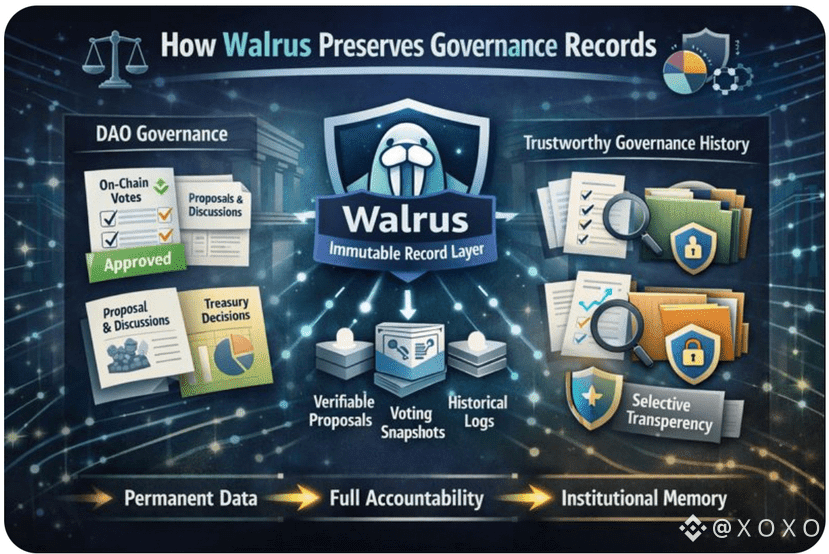


Governance is where Web3 stops being theoretical and starts becoming institutional. Tokens, votes, proposals, and forums may look lightweight on the surface, yet over time they form the constitutional history of a protocol. Decisions about treasury policy, upgrades, risk parameters, and incentives are not one-off events. They shape behavior years later. Therefore, the ability to preserve governance records accurately is not a nice-to-have feature. It is foundational.
This is the context in which @Walrus 🦭/acc becomes especially relevant. Walrus approaches governance records not as temporary artifacts of coordination, but as long-lived financial and institutional data that must remain verifiable long after the vote has passed.
Governance is a historical process, not a moment
Most governance systems focus heavily on execution. A proposal is created, voted on, and either passes or fails. Once the result is known, attention moves on. The surrounding context, however, often fades. Discussion threads get fragmented across platforms. Snapshot data is referenced indirectly. Rationale is summarized loosely, if at all.
This creates a structural weakness. When a DAO revisits a decision months or years later, it often relies on partial memory. Why was this parameter set this way? What risks were discussed? Which assumptions turned out to be wrong?
Governance without durable records turns into governance by folklore.
Why blockchains alone don’t solve governance memory
It is tempting to assume that because votes happen on-chain, governance history is automatically preserved. In practice, this is only partially true.
On-chain voting records capture outcomes, but not intent. They show what was approved, not why. Critical information such as proposal drafts, revisions, economic analysis, simulation results, and off-chain deliberation often live elsewhere. Even when these artifacts are linked, they are rarely immutable or guaranteed to remain available.
Over time, this creates a gap between formal governance results and the underlying reasoning that produced them.
Walrus treats governance data as institutional records
Walrus closes this gap by treating governance artifacts as first-class records rather than supporting material.
Proposals, voting snapshots, discussion summaries, and supporting documents can be committed to Walrus as verifiable data. Once committed, each artifact gains a permanent identity. If it is updated, a new version is created rather than overwriting the old one. History accumulates instead of collapsing into the latest state.
This matters because governance is iterative. Early drafts, rejected alternatives, and minority positions often become relevant later. Preserving them creates continuity.
Versioning creates accountability over time
Governance evolves. Proposals change. Risk models improve. What looked reasonable in one market regime may appear naive in another.
Walrus preserves this evolution explicitly. Each version of a governance document or dataset remains accessible and verifiable. Researchers, auditors, and community members can trace how thinking developed over time rather than reconstructing it from memory or fragmented archives.
As a result, accountability improves naturally. Decisions are no longer isolated outcomes. They become part of a documented trajectory.
Selective transparency for real governance needs
Transparency in governance does not mean publishing everything indiscriminately. Many DAOs deal with sensitive issues, including security risks, treasury strategy, or negotiations. At the same time, they must be able to demonstrate integrity and process legitimacy.
Walrus supports selective disclosure. Governance records can remain confidential while still being provable. When needed, a DAO can demonstrate that a decision followed a documented process without exposing unnecessary internal detail.
This mirrors how governance works in traditional institutions, but with cryptographic guarantees instead of trust-based assurances.
Reducing governance fragmentation
One of the most practical benefits of Walrus is consolidation.
Instead of governance data being scattered across forums, documents, and off-chain storage, Walrus provides a durable reference layer. Links stop breaking. Records stop disappearing. Governance history becomes something the protocol can rely on rather than something the community tries to remember.
For long-lived DAOs, this reduces operational friction and knowledge loss as contributors change over time.
Why this matters as DAOs mature
As DAOs grow, they start to resemble institutions. They manage large treasuries. They interact with regulators. They coordinate complex systems. At that stage, informal governance memory becomes a liability.
Walrus provides the missing infrastructure that allows governance to scale responsibly. It does not change how decisions are made. It ensures that decisions, and the reasoning behind them, are preserved accurately.
Good governance is not only about participation. It is about continuity.
Walrus recognizes that governance data is not disposable. It is institutional capital. By preserving proposals, votes, and context as verifiable records, Walrus gives DAOs something rare in Web3: a reliable memory.
As on-chain organizations move from experimentation to longevity, this kind of record-keeping will quietly become one of the most important pieces of infrastructure beneath them.