
Most discussions about decentralized storage focus on “keeping files safe.” That is the wrong lens. The real innovation of @Walrus 🦭/acc , $WAL, and #walrus is turning storage into composable, verifiable infrastructure that applications can depend on in a trustless, programmable way.
In the Web3 era, data is more than content — it is the foundation of application logic, AI models, NFT ecosystems, and financial primitives. If data disappears, contracts execute but applications fail. Walrus solves that problem directly.
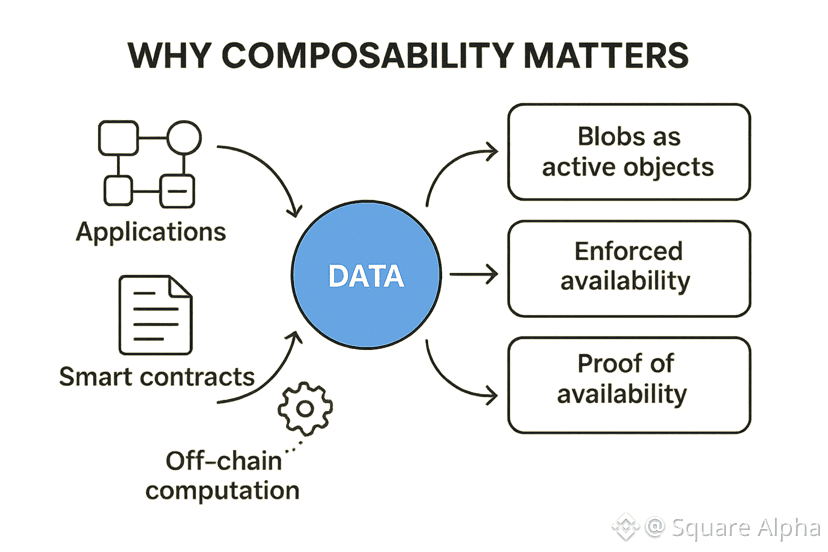
Why Composability Matters
On Sui, applications are object-centric and highly modular. They interact with multiple smart contracts, off-chain computation, and state-heavy processes. Data needs to be available predictably, verifiably, and continuously, not just stored somewhere. Walrus enables this by:
Treating blobs as active objects with lifecycle rules
Enforcing availability programmatically on Sui
Issuing Proof of Availability certificates that smart contracts can reference
This makes data composable — developers can embed storage guarantees into business logic without trusting any centralized server.
Operational Reality: Mainnet in Action
Walrus mainnet is already serving applications under real conditions:
Distributed storage across multiple nodes with erasure coding (RedStuff design)
Continuous monitoring of node participation to handle churn
Automated enforcement of availability guarantees
Unlike experimental protocols, this is production infrastructure. NFT platforms, AI datasets, and decentralized websites are already depending on Walrus to keep critical data alive.
WAL Aligns Incentives With Persistence
$WAL is more than a token — it is the mechanism that enforces reliability. It:
Rewards validators for maintaining blob availability
Discourages downtime with on-chain accountability
Supports governance decisions that improve protocol sustainability
This ensures that storage isn’t just theoretically decentralized — it is economically enforced, which is critical for long-term adoption.
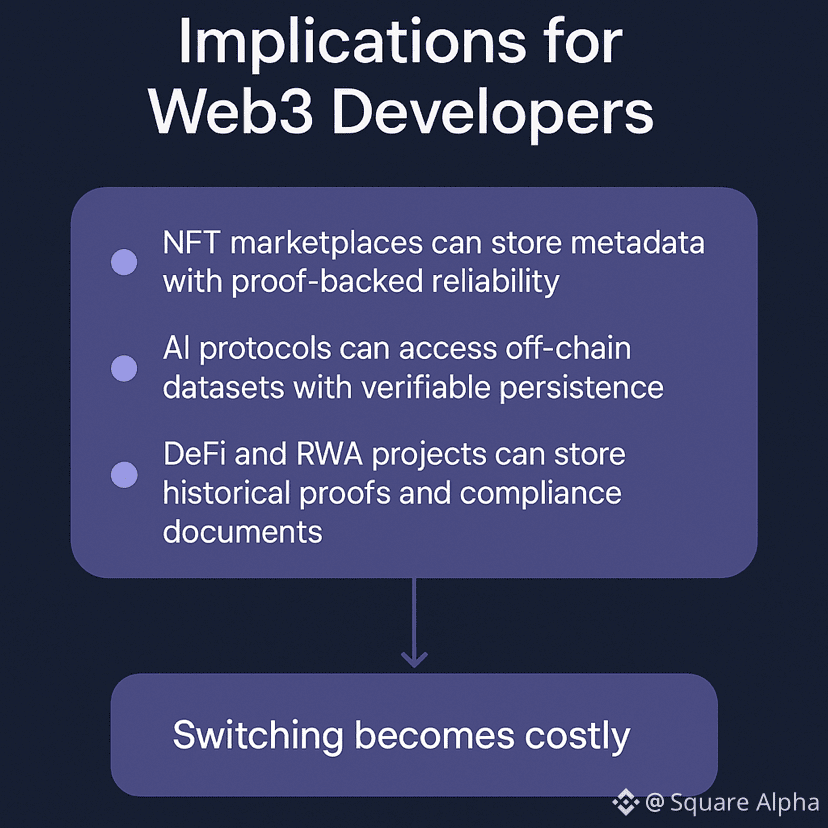
Implications for Web3 Developers
For builders, Walrus changes how applications are designed:
NFT marketplaces can store metadata with proof-backed reliability
AI protocols can access off-chain datasets with verifiable persistence
DeFi and RWA projects can store historical proofs and compliance documents
Once developers rely on Walrus for these use cases, switching becomes costly, creating a stickiness effect that grows the ecosystem organically.
Decentralization Meets Real Utility
Walrus demonstrates that decentralization is not just a slogan. By codifying responsibilities, enforcing them on-chain, and aligning economic incentives, it creates functional decentralization. Nodes cannot cheat, data cannot vanish silently, and applications can operate with confidence — even under churn.
Final Take
Walrus is doing something subtle but powerful: it is industrializing decentralized storage for Web3. By making data verifiable, composable, and economically enforced, it turns storage from a background service into a critical, trusted infrastructure layer for Sui and beyond.
For traders, developers, and investors alike, the bet is clear: infrastructure that applications quietly depend on eventually becomes indispensable. Walrus is positioning itself right at that point.


