

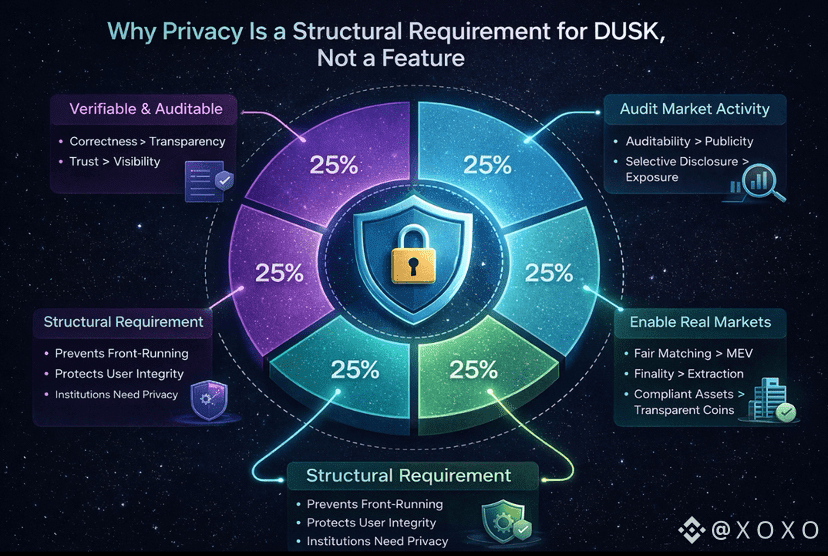
Most blockchains talk about privacy the way consumer apps talk about dark mode. Optional. Toggleable. Nice to have if you care about it, ignorable if you don’t.
@Dusk was built from the opposite assumption.
Privacy, in DUSK’s design, is not a feature layered on top of an otherwise transparent system. It is a structural requirement. Remove it, and the system no longer works as intended. Not partially. Fundamentally.
To understand why, you have to stop thinking about privacy as secrecy and start thinking about it as market infrastructure.
The Privacy Illusion in Public Blockchains
Public blockchains achieved something historic: shared state anyone can verify. But they also introduced a hidden cost that only becomes obvious when you try to move real financial activity onchain.
Total transparency collapses markets.
In a fully transparent system:
Order sizes are visible
Trading strategies are observable
Counterparty behaviour can be predicted
Balance changes signal intent
Timing leaks information
For retail experimentation, this is tolerable. For professional markets, it is fatal.
In traditional finance, privacy is not about hiding wrongdoing. It is about preventing information asymmetry from being exploited in real time. No serious exchange publishes every order before execution. No clearing house exposes positions mid-settlement. No regulator demands that trades be front-run by default.
Yet this is exactly what most public chains enforce.
The result is predictable: front-running, sandwich attacks, MEV extraction, strategy leakage, and structural disadvantages for honest participants.
Privacy is not missing because teams forgot to add it. It’s missing because most chains were not designed for real markets.
What DUSK Is Actually Optimizing For
Dusk is not trying to be a general-purpose playground for every possible application. Its core focus is regulated financial activity onchain: trading, settlement, tokenized securities, compliant asset issuance, and auditable markets.
These are environments where:
Trades must be verifiable
Settlement must be final
Regulators must be able to audit
Participants must not be exposed
Those requirements are not compatible with full transparency.
This is why privacy in DUSK is structural. The system is built on the assumption that markets need confidentiality to function correctly, and that compliance requires controlled disclosure, not public exposure.
Privacy as Market Integrity, Not Obfuscation
A common misconception is that privacy equals hiding information from everyone. In reality, market privacy is about selective disclosure.
DUSK’s approach is simple in principle:
Keep sensitive data private by default
Make outcomes verifiable
Allow authorized parties to audit when required
This mirrors how real financial systems work.
A regulator does not need to see every trader’s strategy in real time. They need assurance that trades are valid, rules are followed, and records are accurate. Privacy preserves fairness during execution. Auditability ensures accountability afterward.
Without privacy, markets don’t become safer. They become exploitable.
Why Privacy Cannot Be Added Later
Many chains attempt to “add” privacy through optional tools:
Privacy pools
Shielded transactions
Off-chain mixers
Add-on zk layers
These approaches fail for one core reason: the base layer leaks information.
If the underlying architecture exposes balances, execution order, and state transitions, no overlay can fully protect participants. Metadata alone is enough to reconstruct behavior.
DUSK avoids this by embedding privacy directly into:
Transaction structure
Smart contract execution
State transitions
Settlement logic
This means applications inherit privacy by default. Developers don’t have to choose between usability and protection. The system enforces confidentiality at the protocol level.
That is the difference between structural privacy and optional privacy.
Trading Without Privacy Is Not Trading
Consider an onchain exchange without privacy.
Every order is visible before execution. Market makers can see size and direction. Bots can react instantly. Large participants are penalized for participating honestly. Smaller participants suffer worse prices without understanding why.
This is not a free market. It is a surveillance market.
DUSK treats private order flow as a prerequisite for fair execution. Encrypted orders, hidden balances, and confidential matching are not advanced features. They are the minimum requirements for markets that don’t eat their own participants.
This is why DuskTrade exists as a private, compliant trading system rather than a transparent AMM clone.
Settlement Demands Confidentiality
Settlement is where transparency causes the most damage.
During settlement:
Positions are finalised
Ownership changes
Counterparty exposure matters
Timing affects liquidity
If settlement data is exposed mid-process, it creates attack surfaces:
Liquidity withdrawal
Price manipulation
Forced liquidation strategies
Cascading failures
Traditional systems isolate settlement precisely to avoid this.
DUSK’s private settlement ensures that:
Trades complete without interference
Balances are not exposed mid-flow
Finality is achieved without signaling intent
Again, this is not secrecy for secrecy’s sake. It is structural stability.
Compliance Does Not Require Public Data
Another myth is that regulators require full transparency.
They don’t.
Regulators require:
Accurate records
Provable compliance
Audit access
Enforcement capability
Public exposure of sensitive data actually undermines these goals by encouraging evasion, manipulation, and off-ledger activity.
DUSK’s privacy model supports compliance by enabling:
Encrypted records
Selective disclosure
Zero-knowledge proofs for rule enforcement
Post-facto audits without real-time exposure
This aligns far more closely with how financial oversight actually works.
Privacy Protects Users and Institutions Alike
Privacy is often framed as a user right. In DUSK, it is also an institutional requirement.
Institutions cannot operate in environments where:
Positions are visible
Strategies are exposed
Counterparties are identifiable in real time
This is not paranoia. It is risk management.
By providing protocol-level privacy, DUSK makes it possible for institutions to operate onchain without sacrificing basic operational security.
At the same time, users benefit from:
Reduced front-running
Fairer execution
Less extractive environments
Stronger guarantees
Privacy aligns incentives across the system.
Why DUSK Chose Privacy First, Not Later
Designing privacy-first is harder.
It complicates:
Smart contract design
State management
Verification logic
Developer tooling
But it avoids a much worse outcome: building an ecosystem that cannot evolve into real financial infrastructure.
DUSK accepted this complexity early because retrofitting privacy into transparent systems usually fails. Once data is public, it cannot be made private again. Once behaviors are extractable, markets adapt around exploitation.
By starting with privacy, DUSK ensures that future growth does not break core assumptions.
The Cost of Ignoring Privacy
Blockchains that ignore privacy tend to converge on the same outcomes:
MEV arms races
Bot-dominated activity
Poor user experience
Regulatory discomfort
Institutional absence
They may grow in activity metrics, but not in trust.
DUSK optimizes for a different axis: correctness over hype, integrity over visibility, sustainability over short-term volume.
That tradeoff only works if privacy is structural.
Privacy as Infrastructure, Not Ideology
It’s important to be clear about what this is not.
DUSK’s privacy is not ideological. It is not about resisting oversight or avoiding rules. It is about building markets that behave like markets.
Privacy is the infrastructure that allows:
Fair price discovery
Honest participation
Reliable settlement
Enforceable compliance
Without it, decentralization does not produce freedom. It produces chaos.
The Long-Term Implication
As tokenized assets, regulated trading, and onchain settlement mature, the industry will be forced to confront a simple truth:
Fully transparent blockchains cannot host real financial markets.
They can host speculation. They can host experimentation. They cannot host systems that handle serious capital at scale.
DUSK is positioned for that future because it treated privacy as a requirement from day one, not a feature to be added when things break.
Closing Thought
Privacy in DUSK is not a setting. It is a foundation.
Remove it, and the system stops being suitable for the problems it was built to solve. Keep it, and something rare becomes possible: onchain markets that are fair, compliant, auditable, and resilient.
That is not an aesthetic choice. It is an architectural one.