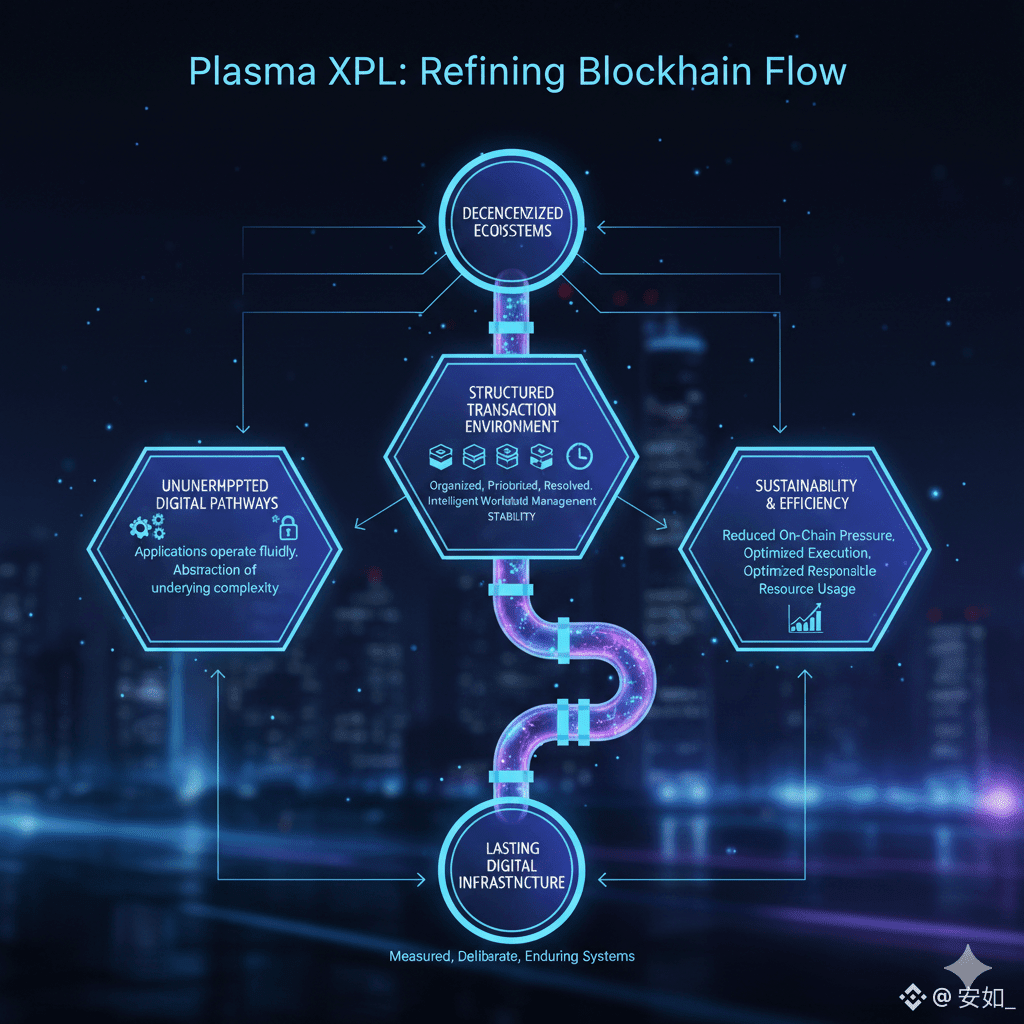
Most blockchain projects compete horizontally. Plasma is competing vertically — and that distinction matters more than marketing narratives suggest.
Rather than positioning itself as a generalized smart-contract platform, Plasma has made a focused architectural and economic decision: optimize the network specifically for stablecoin settlement at scale. This is not a cosmetic positioning choice; it shapes Plasma’s consensus design, throughput targets, fee mechanics, validator incentives, and ultimately the utility of the Plasma token itself.
Recent development signals and test-phase disclosures indicate that Plasma is being built around predictable performance under sustained load, not peak throughput benchmarks optimized for demos. This distinction is critical. Stablecoin issuers, exchanges, and payment processors care less about theoretical TPS ceilings and more about consistent latency, deterministic finality, and operational reliability. Plasma’s roadmap reflects this reality.
Infrastructure First, Applications Second
Plasma’s design philosophy implicitly rejects the “app-layer-first” model that dominates most L1 ecosystems. Instead of incentivizing early DeFi experimentation, Plasma prioritizes settlement reliability, treating applications as downstream consumers of infrastructure rather than the core growth engine.
This approach aligns with real-world stablecoin usage data. The majority of stablecoin volume today is not driven by novel financial primitives, but by:
Exchange settlement and internal treasury flows
Cross-platform liquidity rebalancing
OTC and institutional transfer rails
Payment backends requiring minimal volatility exposure
Plasma’s architecture reflects these realities. The network emphasizes high-throughput block production with bounded execution complexity, reducing variance in confirmation times. This is not about being “faster than everything else,” but about being consistently fast enough — a far more difficult engineering problem.
What Plasma’s Recent Updates Signal
While Plasma avoids aggressive public hype cycles, recent protocol-level updates suggest three clear priorities:
1. Sustained Load Testing Over Burst Metrics
Rather than advertising headline TPS figures, Plasma has focused on how the network behaves under prolonged transaction pressure. This matters because settlement layers fail not at peak demand, but during sustained operational stress.
2. Validator Economics Aligned With Throughput, Not Speculation
Plasma’s token model ties validator rewards and participation incentives to actual network usage. This discourages idle security and encourages long-term operational commitment rather than short-term yield extraction.
3. Stablecoin-Native Fee Predictability
Fee volatility is a non-starter for payment and settlement infrastructure. Plasma’s fee logic prioritizes stability and predictability, even at the cost of reduced speculative fee markets.
These choices collectively indicate that Plasma is not optimizing for retail attention cycles, but for enterprise integration timelines, which move slower but compound more reliably.
The Plasma Token: Utility Over Optics
The Plasma token’s role is often misunderstood when viewed through the lens of speculative L1 tokens. Its primary function is not narrative signaling, but network coordination.
Token utility is concentrated in three areas:
Validator participation and slashing-based security
Fee alignment for high-volume settlement actors
Long-term incentive calibration as transaction volume scales
This matters because Plasma’s token demand is structurally linked to real transaction throughput, not to application hype. As stablecoin settlement volume increases, validator participation becomes more competitive, fee flows grow more predictable, and the token’s role in securing the network becomes increasingly central.
In contrast to ecosystems where token velocity undermines value accrual, Plasma’s design implicitly favors low-velocity, high-utility token usage, a model more consistent with infrastructure economics than consumer platforms.
Why Plasma Is Not Competing With Ethereum (and Why That’s Intentional)
A common analytical mistake is to frame Plasma as an Ethereum competitor. This framing misses the point entirely.
Plasma is not attempting to absorb Ethereum’s application ecosystem. Instead, it positions itself as a specialized settlement layer that can coexist with existing liquidity hubs, reducing friction rather than displacing incumbents.
This strategic restraint is important. By aligning with dominant stablecoin flows rather than fragmenting liquidity, Plasma shortens integration cycles and lowers switching costs for institutional users. In infrastructure markets, compatibility beats novelty.
Plasma’s value proposition is therefore not maximal composability, but minimal operational risk.
Data-Driven Conclusions
When evaluating Plasma through an infrastructure lens rather than a speculative one, several conclusions emerge:
The stablecoin settlement market is already large enough to justify specialized infrastructure.
Plasma’s architectural choices reflect real usage patterns, not hypothetical demand.
The Plasma token is structurally tied to throughput and security, not marketing cycles.
Adoption success will be measured in settlement volume, uptime, and fee stability, not TVL or social metrics.
Plasma’s trajectory suggests it is building for the part of crypto that already works — and trying to make it work at scale.
That is not the loudest strategy in the market.
But infrastructure rarely is.