
When I began researching @Walrus 🦭/acc Protocol more deeply, I noticed how its design prioritizes efficiency in ways that many other storage solutions overlook. The protocol handles large unstructured data through a method that avoids unnecessary duplication while maintaining strong guarantees.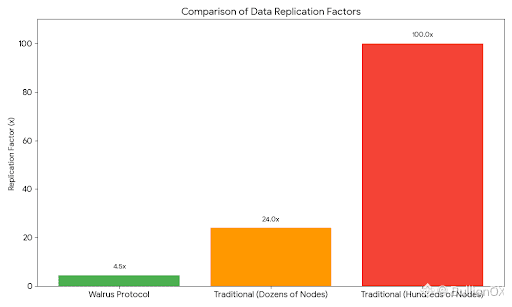
RedStuff, the core erasure coding algorithm, encodes blobs into slivers using a two dimensional approach. This fragmentation allows reconstruction from only a portion of the pieces, even under significant node failure.
The replication factor settles around 4x to 5x overall. This keeps storage costs manageable compared to systems that replicate data fully across dozens or hundreds of nodes.
Nodes in Walrus form committees through staking. They compete for delegation based on reliability and attract $WAL stake to increase their workload share.
Users pay storage fees in WAL upfront for a fixed period. These payments distribute gradually across epochs to reward performing nodes.
Availability proofs appear on Sui as certificates. These on chain records confirm data retrievability without requiring full downloads.
Sui objects represent blobs, enabling Move smart contracts to manage them. Ownership transfers, lifetime extensions, or conditional access happen directly through code.
Epoch transitions handle node changes smoothly. Reconfigurations occur periodically to maintain committee diversity and prevent disruptions.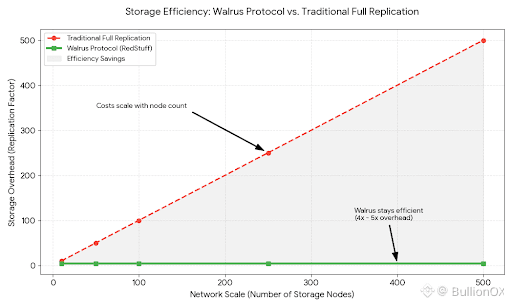
In my view, this combination of low-overhead encoding, incentive- aligned staking, and on-chain programmability creates infrastructure that feels sustainable. It supports real applications without the economic strain seen elsewhere.
Walrus remains focused on making decentralized storage practical for everyday use cases. The emphasis on verifiable, cost-effective availability stands out as a thoughtful step forward.
$WAL #walrus


