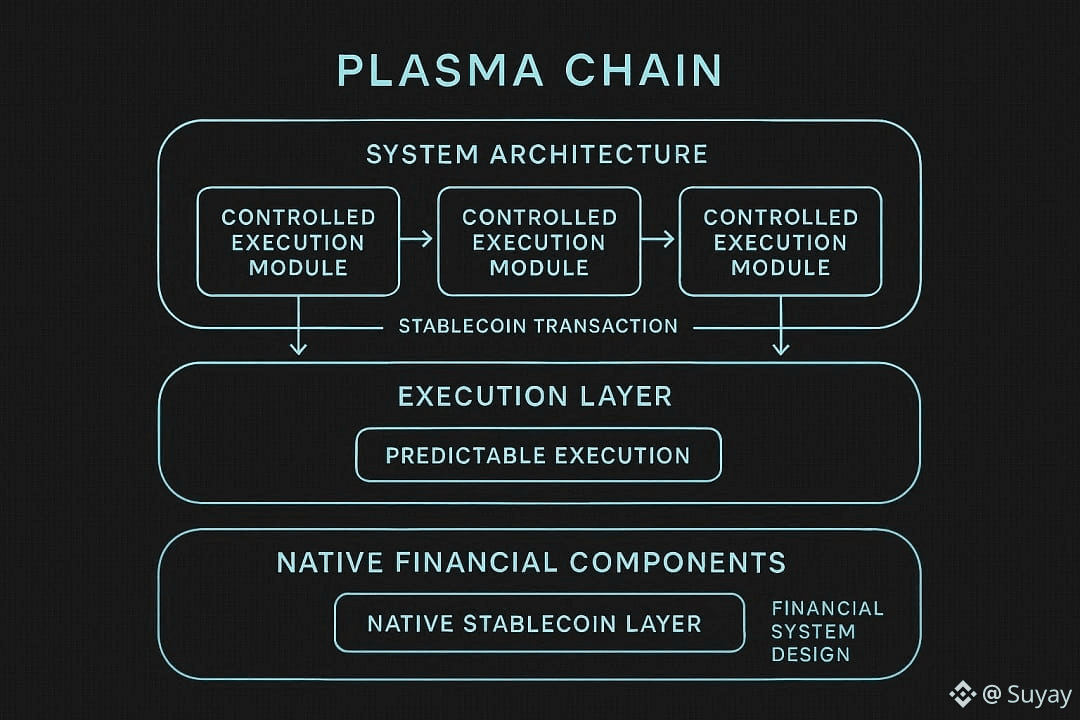
Most blockchains describe themselves as “general-purpose.” Plasma doesn’t. Plasma is engineered as a financial system first, and its architecture reflects that decision at every layer. Instead of optimizing for maximum composability or app diversity, Plasma’s chain design is built around predictable execution, payment reliability, and stablecoin-native behavior.
Understanding Plasma means looking beyond surface features and into how the system is structured, how transactions are executed, and why the underlying design choices point toward financial infrastructure rather than a typical smart-contract playground.
Architecture built around financial flows
At a high level, Plasma Chain is organized to separate concerns that are often blended together in traditional blockchains. The system architecture emphasizes clarity between execution, settlement, and financial primitives. This allows the network to prioritize consistency, low-friction transfers, and controlled behavior under load.
Instead of treating all transactions as equal, Plasma’s architecture assumes that stablecoin payments, transfers, and financial operations will dominate network activity. That assumption reshapes everything: block construction, gas logic, native contracts, and even how users and applications are expected to interact with the chain.
The result is an environment that feels less like an experimental app layer and more like a programmable financial rail.
Execution designed for predictability, not chaos
Plasma’s execution model is designed around one core objective: making financial actions behave consistently. On most general blockchains, execution environments evolve primarily to support increasingly complex apps. Plasma’s execution layer, in contrast, is optimized for high-frequency, low-friction monetary activity.
This shows up in how transactions are processed, how native contracts are embedded, and how the chain reduces uncertainty around fees and outcomes. Plasma treats stablecoin movement not as a use case, but as a default operation of the system.
By controlling execution at the protocol level, Plasma can ensure that financial logic is not dependent on fragmented smart-contract standards, third-party fee models, or ad-hoc application design. This is what enables features like zero-fee stablecoin transfers to exist as a systemic behavior rather than a temporary application trick.
System design aligned with financial infrastructure
The system design of Plasma Chain reflects how real financial networks are built: specialized, layered, and purpose-driven. Rather than maximizing flexibility at the cost of coherence, Plasma limits certain degrees of freedom in exchange for reliability.
Native components handle stablecoin logic, gas abstraction, and financial primitives in a way that reduces surface risk and operational complexity. This creates a system where developers are not reinventing payment infrastructure, but building on top of it.
From a design perspective, Plasma positions the blockchain less as a neutral execution engine and more as a programmable financial core. Apps don’t define how money works on Plasma. The chain does.
Why this architectural choice matters
Architecture is strategy. By designing Plasma Chain around financial execution instead of generalized computation, the project is making a clear statement about where it expects real adoption to emerge.
Financial systems demand different properties than experimental app networks: consistency over novelty, clarity over abstraction, and economic logic embedded at the base layer. Plasma’s architecture reflects those priorities.
This matters because infrastructure outlives applications. When payments, transfers, and financial operations are treated as native behaviors of the chain, the ecosystem that forms around it is structurally guided toward real economic use rather than speculative utility.
From blockchain platform to financial system
Inside Plasma Chain, architecture, execution, and system design converge around a single thesis: blockchains meant for finance should behave like financial networks, not app containers.
By structuring the chain around stablecoins, predictable execution, and native financial primitives, Plasma is not competing to host the most applications. It is positioning itself to host the most meaningful financial activity.
And that distinction is what turns a blockchain into infrastructure.