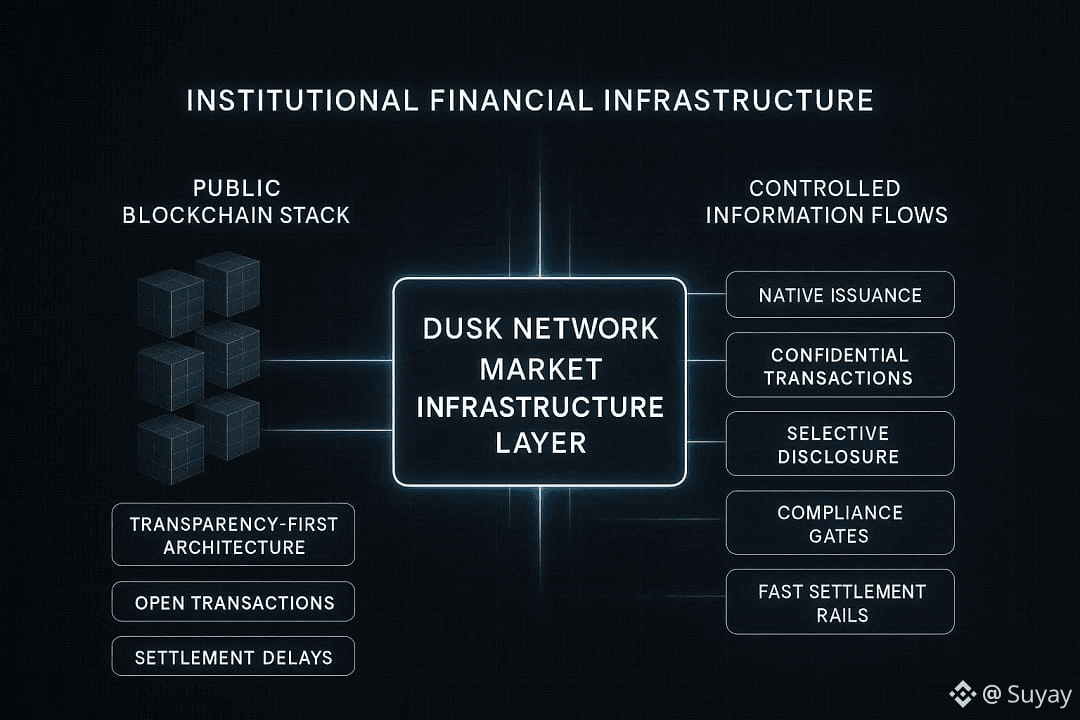
Public blockchains like Bitcoin and Ethereum introduced decentralization, transparency, and programmable assets. But when we move from open crypto-networks to regulated financial markets, their structural limits become clear. Financial markets are not built on radical transparency. They are built on controlled visibility, legal enforceability, fast settlement, and institutional risk management.
This is where most public blockchains fail.
Dusk Network is designed from the opposite starting point: not “open by default,” but market-grade by design. It treats blockchain not as a public database, but as financial infrastructure.
Public blockchains were not designed for financial markets
Permissionless blockchains prioritize openness. Transactions, balances, and contract states are globally observable. Finality is probabilistic. Identity is external. Privacy is optional.
These properties work for open token systems. They do not work for capital markets.
Financial systems operate on layered confidentiality. Trading strategies, positions, counterparty relationships, and settlement flows cannot be publicly reconstructed. Markets collapse when participants are fully exposed.
On public blockchains, transparency is a feature.
In financial markets, uncontrolled transparency is systemic risk.
This mismatch is not cosmetic. It is architectural.
Tokenization does not solve infrastructure
Tokenization is often presented as the bridge between blockchain and finance. In reality, tokenization on public chains usually means digital representations of assets that still live off-chain.
The legal asset remains with custodians, registries, and settlement systems. The blockchain only mirrors ownership claims.
This preserves the same problems:
Reconciliation delays.
Custodial dependencies.
Fragmented settlement.
Off-chain compliance.
Limited legal integration.
Tokenization improves access.
It does not replace market infrastructure.
Dusk’s documentation explicitly distinguishes this from native issuance: assets that are born, managed, and settled directly on-chain, without mirroring legacy back-ends. This difference defines whether blockchain is a wrapper — or the market itself.
What financial infrastructure actually requires
Real financial markets are built on four non-negotiables:
Deterministic settlement
Finality must be fast, predictable, and legally meaningful.Confidentiality by default
Positions, identities, and transaction flows must be shielded, with controlled disclosure.Embedded compliance
Identity, permissions, and regulatory constraints must be enforceable at protocol level.Native asset logic
Issuance, corporate actions, transfer restrictions, and settlement must live on-chain.
Public blockchains were not architected for these conditions.
Dusk Network is.
Dusk’s infrastructure-first architecture
Dusk is not a general-purpose chain adapted to finance. It is a financial market protocol.
Its architecture combines:
Native issuance instead of token mirroring.
Zero-knowledge cryptography as a base layer.
Confidential transaction models.
Selective disclosure mechanisms.
Identity primitives aligned with compliance.
This allows assets to exist directly on the network, with embedded financial logic, visibility rules, and settlement conditions.
On Dusk, privacy is not a feature.
It is execution logic.
Compliance is not external.
It is protocol behavior.
Settlement is not eventual.
It is structural.
Why this changes what can be built
When blockchain only hosts tokens, markets must remain off-chain.
When blockchain hosts infrastructure, markets can move on-chain.
Dusk’s design enables:
Confidential issuance of regulated assets.
Compliant trading environments.
Private settlement flows.
Identity-aware financial applications.
Auditable yet non-transparent markets.
These systems are not achievable on transparent ledgers without heavy off-chain scaffolding. On Dusk, they are native.
Conclusion
Public blockchains transformed digital value.
They did not create financial market infrastructure.
Regulated markets demand confidentiality, deterministic settlement, native asset lifecycles, and embedded compliance. Public chains were never designed to provide this.
Dusk Network starts from that reality.
By building blockchain as market infrastructure, not public record-keeping, Dusk creates a foundation where real financial systems can operate on-chain without exposing themselves.
That is why public blockchains cannot power financial markets.
And why Dusk Network is built to.