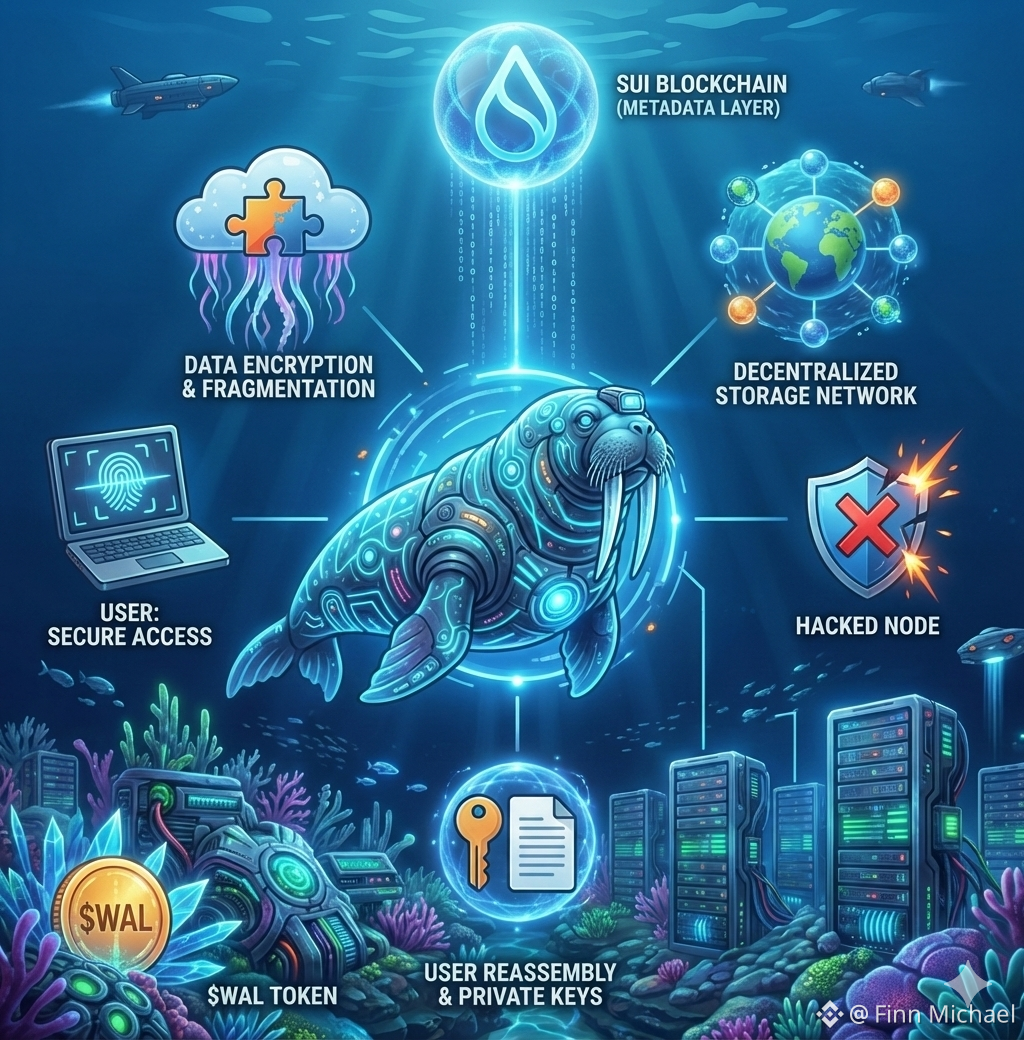
Walrus is a decentralized storage protocol built to solve a structural limitation in blockchain systems: the inability to handle large volumes of data in a cost-efficient, reliable, and programmable way. Instead of attempting to place bulk data directly on-chain, Walrus introduces a layered design in which the Sui blockchain coordinates ownership, payments, and rules, while the actual data is stored across a distributed network of independent storage nodes. This approach positions Walrus as infrastructure rather than an application, intended to serve developers and protocols that require scalable storage without surrendering decentralization or composability.
At the foundation of Walrus lies a clear separation between coordination and data persistence. The Sui blockchain is used to register blob metadata, manage access permissions, enforce storage commitments, and execute smart contract logic related to stored data. The blobs themselves, which can include media files, datasets, application assets, or model parameters, are stored off-chain. This design avoids the prohibitive costs of on-chain storage while retaining verifiability and tight integration with blockchain logic. Developers can reference storage objects directly within smart contracts, allowing data availability to become part of application state rather than an external dependency.
To achieve durability and availability without excessive cost, Walrus relies on erasure coding rather than full replication. Each data blob is split and encoded into multiple fragments, which are distributed across different storage nodes. Only a subset of these fragments is required to reconstruct the original data, meaning the network can tolerate node failures without losing access to stored content. Compared to systems that replicate entire files multiple times, this significantly reduces storage overhead while maintaining resilience. The tradeoff is increased complexity in encoding, recovery, and bandwidth usage, but the protocol is designed to balance these factors through carefully selected parameters and node coordination.
Storage nodes participate in the network through a delegated Proof-of-Stake mechanism. WAL token holders delegate stake to node operators, and nodes with sufficient delegated stake are selected into committees during defined time intervals known as epochs. Within each epoch, committee members are responsible for storing assigned data fragments and serving retrieval requests. Performance is evaluated at the end of each epoch, and rewards or penalties are applied based on availability, responsiveness, and adherence to protocol rules. This structure creates a recurring accountability cycle and aligns economic incentives with long-term reliability rather than short-term participation.
A notable aspect of Walrus is its deep integration with Sui’s object-based execution model. Stored blobs are represented as on-chain objects with attributes that smart contracts can read and update. This allows developers to build logic around storage in a way that is difficult or impossible with more static storage solutions. Access controls, expiration conditions, usage tracking, and application-specific rules can all be enforced programmatically. As a result, storage becomes a composable component of decentralized applications rather than a passive data layer.
From an adoption perspective, Walrus has progressed from design and testing into an operational mainnet environment. The network includes independently operated storage nodes, active staking and delegation, and early application usage. Developers are experimenting with Walrus for hosting decentralized websites, storing application assets, and managing large datasets that would be impractical to store on-chain. While usage remains early relative to more established storage networks, the diversity of use cases suggests exploratory demand rather than narrow, single-purpose adoption.
Developer engagement is supported through a range of tools designed to reduce friction. Walrus offers command-line utilities, SDKs, and HTTP-compatible APIs that resemble traditional storage interfaces. This lowers the barrier for teams accustomed to centralized infrastructure while still enabling decentralized guarantees. In addition, the protocol is not limited to a single ecosystem. Although Sui provides the coordination layer, Walrus storage can be accessed by external systems through standard interfaces, opening the door to cross-chain and hybrid Web2–Web3 use cases.
The WAL token underpins the protocol’s economic model and serves three primary roles. It is used to pay for storage services through prepaid commitments, which are distributed over time to storage nodes and their delegators. It secures the network through staking, determining which nodes are eligible to participate in committees and earn rewards. It also functions as a governance token, allowing holders to vote on protocol parameters such as pricing models, penalty thresholds, and upgrades. This multi-role design ties network security, service provision, and decision-making to the same economic asset.
Incentive alignment is a central design goal. Nodes are rewarded for consistent availability and correct behavior rather than raw capacity alone. Penalties for underperformance discourage unreliable participation, while delegation encourages token holders to actively evaluate node operators. Prepaid storage fees help stabilize costs for users and reduce exposure to short-term market volatility, which is particularly important for applications that require predictable infrastructure expenses.
Despite these strengths, Walrus faces clear challenges. Early-stage networks often experience concentration of stake and node participation, which can limit decentralization if not addressed through governance and incentive adjustments. The operational complexity of erasure-coded storage introduces ongoing costs related to recovery bandwidth and node replacement, which must be managed carefully to preserve efficiency advantages. Walrus also competes in a crowded landscape that includes established decentralized storage networks and highly optimized centralized cloud providers. Differentiation will depend on whether its programmability, integration with Sui, and cost structure translate into clear, sustained advantages for developers.
Looking forward, the protocol’s trajectory will depend on execution rather than narrative. Continued improvements in encoding efficiency, retrieval performance, and verification mechanisms will be necessary to support higher workloads. Ecosystem growth will require not only more tooling but also production-grade applications that rely on Walrus as core infrastructure. Governance decisions will shape how decentralization, economics, and technical evolution are balanced over time.
Walrus is best understood not as a general replacement for all storage systems, but as a specialized infrastructure layer for decentralized applications that need scalable, programmable, and verifiable data availability. If demand for such applications continues to grow, and if the protocol can maintain alignment between technical design and economic incentives, Walrus has the potential to establish itself as a durable component of the broader decentralized stack.