

Think of it like this: on the Dusk Network, not everyone gets to do everything. It's like at a bank – the teller can't approve million-dollar loans, and the CEO doesn't handle every customer transaction. Dusk uses this idea to create a system where only certain people can do particular actions. It keeps everything safe, private, and in line with the rules.
Why limit access like this?
Regular blockchains treat everyone the same. But in the real world, financial companies have very specific roles with set rules. Some issue assets, others trade, and some make sure everyone is in line. Dusk brings that structure to blockchain.
* Only approved companies can create tokenized assets.
* Only certain people can trade specific assets.
* Auditors can check things without seeing private info.
* The people who keep the network running don't see confidential information.
Basically, Dusk is set up to mimic how finance works.
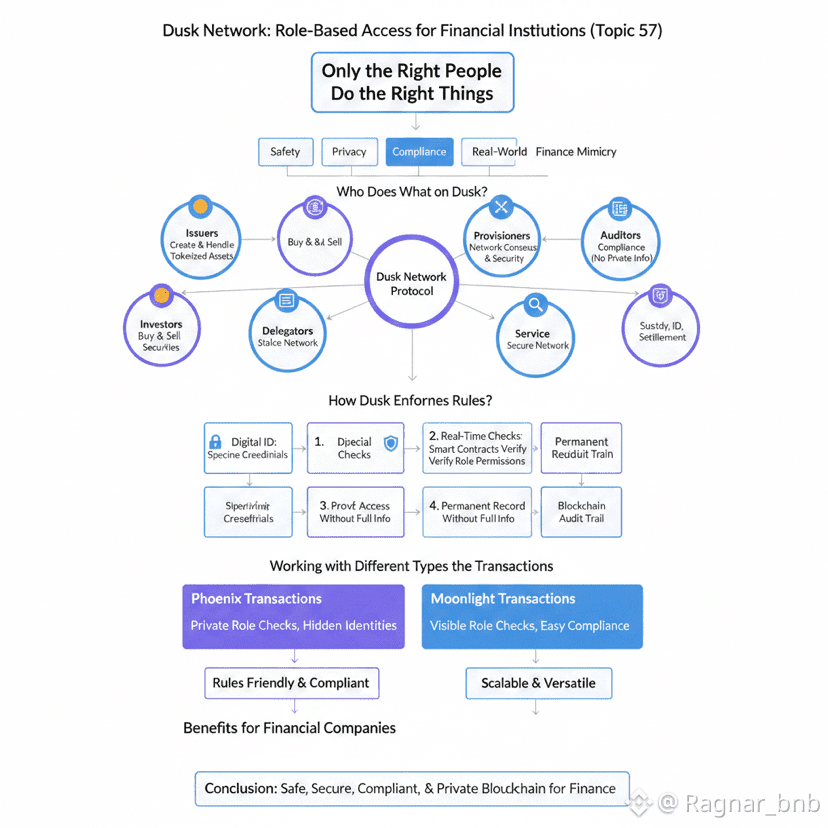
Who Does What on Dusk?
Dusk has different roles for different players:
*Issuers:** Create and handle tokenized stuff.
*Investors:** Buy and sell those tokenized securities.
*Provisioners:** Keep the network running smoothly and agree on transactions.
*Delegators:** stake holders who contribute to network security.
*Auditors:** Check if everyone is following the rules.
*Service Providers:** like custodians, ID checkers, or settlement services.
Each role has specific powers and limits, all built into the system.
How Does Dusk Enforce These Rules?
It's like a digital bouncer that uses a few tricks:
1. Digital ID: People get special online credentials that prove their role, without sharing too much private info.
2. Real-Time Checks: Smart contracts check if your role lets you do what you're trying to do. If you don't have permission, the transaction is blocked.
3. Proof of Eligibility: You can prove you're allowed to do something without showing all your information.
4. Permanent Record: Everything is recorded on the blockchain, so auditors can double-check that the rules were followed.
This way, the rules are set in stone, transparent, and can't be messed with.
Working with Different Types of Transactions
Dusk has Phoenix and Moonlight transactions and here's how role-based access plays into them:
*Phoenix:** Roles are checked privately, keeping identities hidden.
*Moonlight:** Roles are visible, so it’s easy to check for proper compliance.
Companies can choose which type is best, balancing privacy with compliance.
Why This Is Good for Big Financial Companies
*Rules Friendly:** Easy to show that the system follows the actual regulations.
*Failsafe:** Rules inside the system block bad actions, not just written policies.
*Scalable:** New roles can be added as things grow without a complete overhaul.
*Versatile:** Digital credentials can be used in other Dusk-based applications.
All that makes Dusk a solid choice for things like tokenized assets and exchanges.
Security and Control
The role definitions are baked into the protocol, not controlled from the above. Changes require a formal process. Security reviews ensure no one can bypass the rules. That builds trust among the big players and regulators.
In Conclusion
Restricting access to institutional players by roles is a key part of Dusk Network. It ensures that everyone plays by the rules. This setup makes blockchain usable for real-world finance, in a way that is safe, secure, compliant, and still private.
