

Dusk Network is a project I kept coming back to while researching regulated blockchain infrastructure, mainly because it approaches privacy from a very different angle. Most chains I have studied treat privacy as a feature that can be added later. Dusk feels like it started by asking a harder question: what if privacy and regulation were not exceptions, but the default conditions the system must satisfy? When you look at it from that lens, the architecture starts to make a lot more sense.
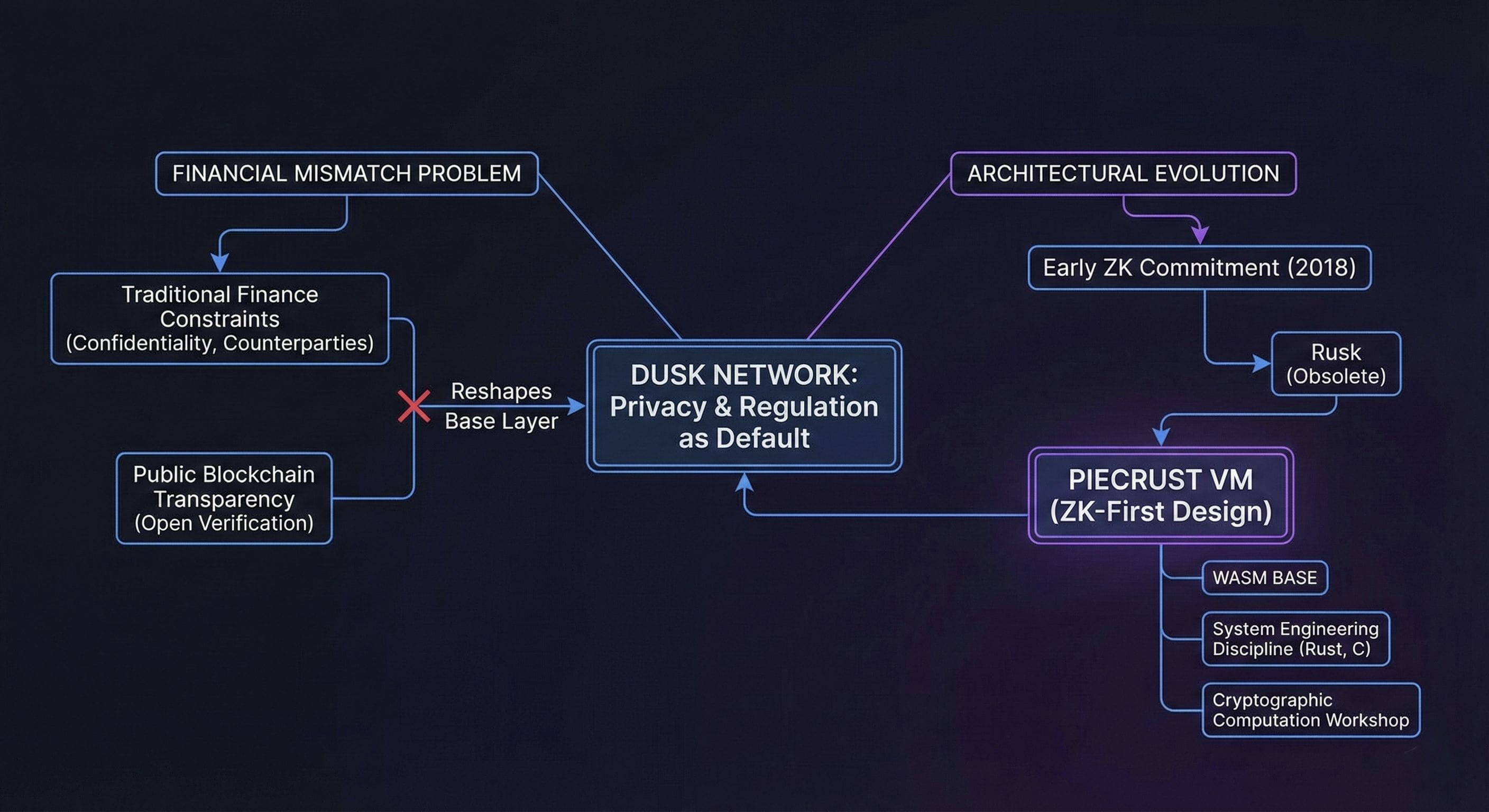
When we read about early financial blockchain experiments, a recurring problem appears. Public transparency is great for open verification, but it breaks down quickly in real financial environments. Institutions cannot expose balances, counterparties, or contractual logic to the entire world. In my knowledge, many compliance failures in crypto come from forcing traditional finance into systems never designed for it. Dusk exists because of that mismatch. It does not try to make finance adapt to crypto norms. It reshapes the base layer so financial constraints are native.
As I researched the project’s history, one thing stood out. Dusk being founded in 2018 matters. That was a period when privacy discussions were still theoretical for most layer 1s. The team did not wait for zero-knowledge systems to become fashionable. They committed early, which explains why they eventually had to abandon their first execution environment. The earlier Rusk architecture was a stepping stone, not an endpoint, and that decision shows a willingness to discard working systems when they no longer fit the long-term vision.
We often underestimate how much a virtual machine defines a blockchain’s future. I tell you this from experience studying developer ecosystems. Builders do not just write code; they inherit the assumptions of the VM they work on. Dusk’s move to the Piecrust VM in 2023 is not just a technical upgrade. It is a philosophical reset. Instead of forcing zero-knowledge proofs to operate inside a VM never designed for them, the VM itself was rebuilt around cryptographic computation.
When I explain Piecrust to people outside crypto, I use a simple comparison. Running zero-knowledge proofs on a traditional VM is like doing heavy industrial work in a home kitchen. You can do it, but everything is slow, fragile, and inefficient. Piecrust, being ZK-friendly by design, is more like a workshop built for that workload. It does not magically remove complexity, but it makes the work practical and repeatable.
They made a very deliberate choice by building on WebAssembly. From what I have seen, WASM changes developer behavior in subtle but important ways. Writing smart contracts in Rust or C-like languages feels closer to traditional systems engineering than blockchain scripting. This matters because cryptographic systems demand discipline. In my research, the chains that attract serious infrastructure developers are usually the ones that respect their existing skill sets rather than forcing them into unfamiliar execution models.
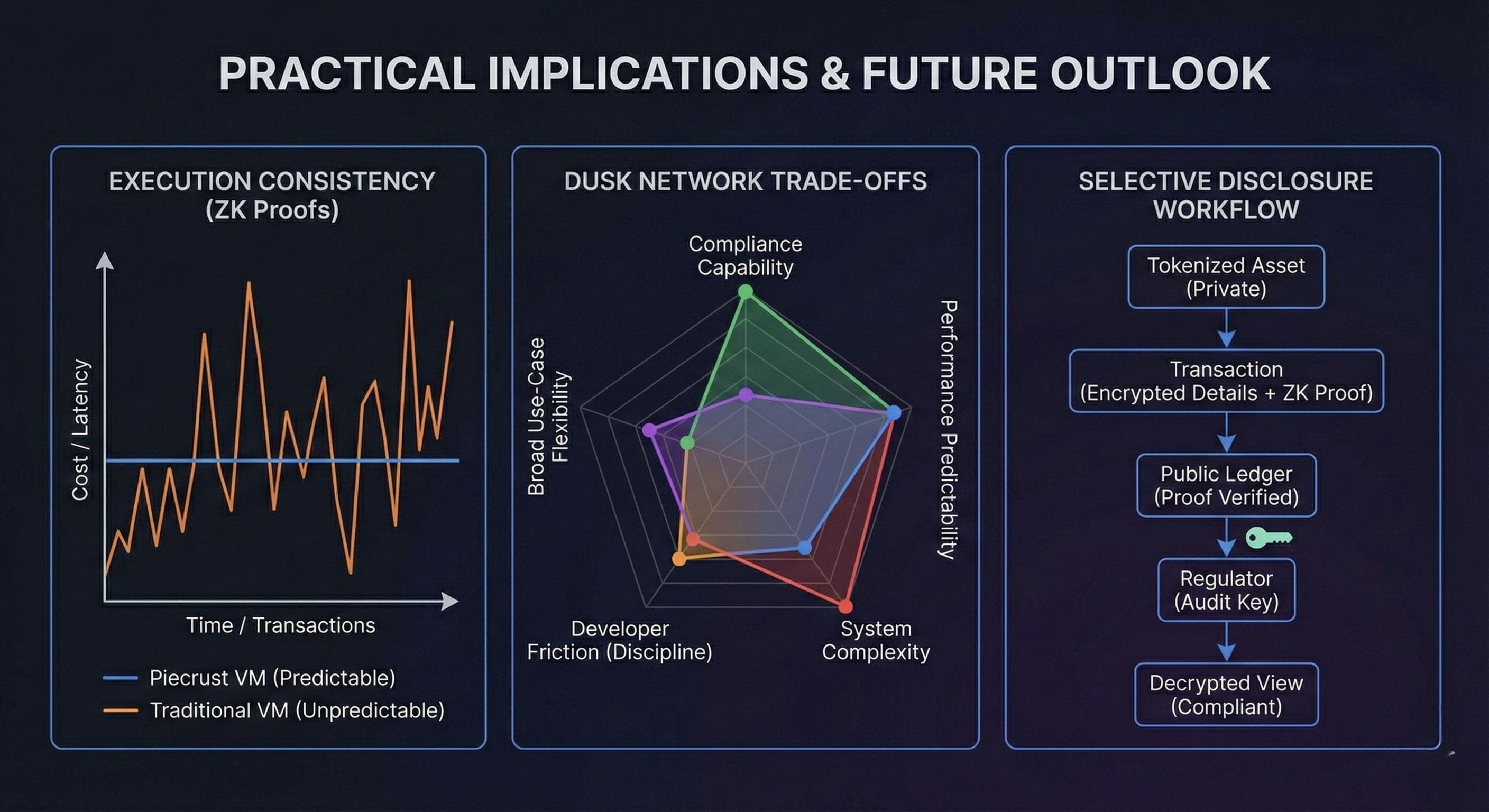
Another point that deserves attention is performance predictability. We read a lot about scalability in crypto, but regulated finance cares just as much about consistency. Zero-knowledge proofs are computationally heavy, and unpredictable execution costs can make financial products unusable. Piecrust’s near-native execution speeds are not about raw throughput. They are about making complex cryptography behave like a reliable system component rather than an experimental feature.
From a system design perspective, Dusk’s modular approach is also telling. I have seen many blockchains fail because they hard-coded assumptions that later became liabilities. Regulation evolves, financial products evolve, and privacy requirements shift over time. Modularity gives Dusk room to adapt without breaking the entire protocol. In my knowledge, this is one of the few ways a blockchain can remain relevant over a long regulatory cycle.
Let me put this into a practical scenario we often discuss internally. Imagine a tokenized financial instrument where transaction details must remain confidential, but regulators need the ability to audit activity when required. On a transparent chain, confidentiality is impossible. On a fully private chain, oversight is impossible. Dusk’s architecture allows both conditions to coexist through selective disclosure. The proof system hides what should remain private while still allowing verification of what matters legally.
We should also be honest about the trade-offs. A ZK-centric layer 1 is inherently complex. I tell you openly that complexity increases the burden on core developers and auditors. WASM flexibility is powerful, but it demands strong safeguards. If tooling, documentation, or security practices fall behind, adoption will slow. This is not a flaw unique to Dusk, but it is a risk that grows with ambition.
From what I see, the biggest long-term challenge is not technical, but institutional trust. Even the best-designed infrastructure must prove itself under real regulatory pressure. They will need to show that privacy controls and auditability mechanisms work not just in theory, but in practice. In my experience, this phase takes time and cannot be rushed by engineering alone.
I research many blockchain projects, but few are this explicit about the problem they are solving. Dusk is not trying to be everything. It is trying to be correct for a narrow but demanding use case. If developers continue to find Piecrust usable, and if institutions find the compliance model credible, the architecture has room to grow. If not, the same specialization that defines its strength could limit its reach. Over time, execution will decide which side of that line Dusk falls on.
