
Have you ever worried about where your digital files actually go when you upload them? Most of us just hit save and hope for the best but the technology behind it is actually pretty cool. Today I want to walk you through a system called Walrus and a clever method it uses called Red Stuff to keep your data safe.
I think you will find it interesting because Walrus is designed to be a decentralized storage network. This means it does not rely on one single giant company. Instead it spreads your files across many different computers. We are going to look at how Walrus makes sure that your data never gets lost even if some of those computers stop working.
The Way Walrus Starts Saving Your Files
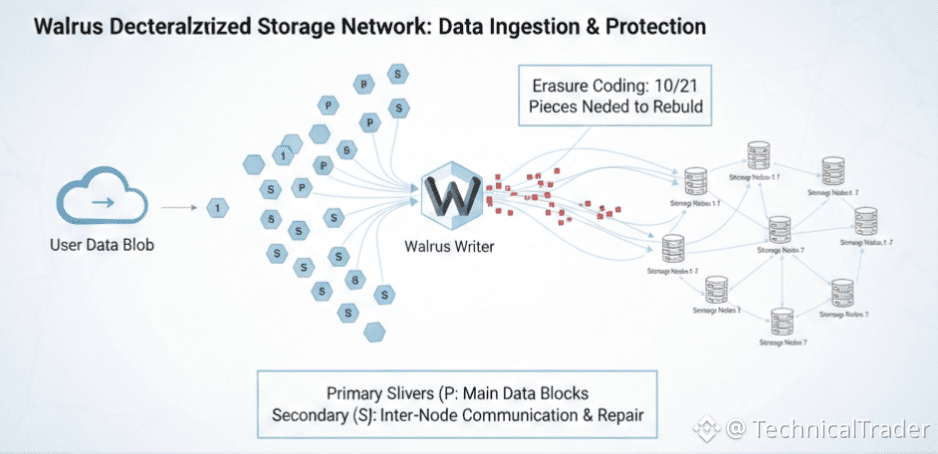
When you and I want to put something on the Walrus network we start with a blob. In the world of Walrus a blob is just a fancy name for your data like a photo or a document. The system uses a writer to break this blob into smaller pieces called slivers and sends them out to different storage nodes.
The neat thing here is that the writer in Walrus is honest and careful. It sends out at least twenty one different parts to different places. This is the first step Walrus takes to make sure your information is scattered safely so that no single point of failure can destroy your hard work.
How Walrus Uses Primary Slivers For Safety
Inside the Walrus network there is a special type of data piece called a primary sliver. You can imagine these as the main building blocks of your file. Walrus uses a mathematical trick called erasure coding which is a bit like a high tech safety net for your data.
I want you to picture a puzzle where you only need half the pieces to see the whole image. That is basically what Walrus does. If a storage node has enough small symbols it can perfectly rebuild the entire primary sliver. This means Walrus is very good at fixing itself when things go wrong.
The Magic Of Secondary Slivers In Walrus
Walrus adds another layer of protection that I find really smart which is the secondary sliver. Think of this as a backup to the backup. While the primary sliver is the main piece the secondary sliver helps the Walrus nodes talk to each other and share information.
If a computer in the Walrus network is missing some data it only needs a few symbols from its neighbors to fix its secondary sliver. This secondary layer acts like a bridge. It allows Walrus to be much faster and more efficient than older systems that had to copy the entire file over and over again.
Rebuilding Data Across The Walrus Network
Let us imagine a new computer joins the Walrus network and wants to help store your files. Since it is new it starts with nothing. This is where the Red Stuff proof comes into play. The new node starts asking other nodes in the Walrus system for small bits of the data it needs.
Because Walrus uses something called a vector commitment it can easily spot if someone is lying. The new node gathers correct symbols until it can rebuild its own secondary sliver. It is like watching a community come together to help a neighbor rebuild their house piece by piece until it is perfect.
How Everything Comes Together In Walrus
Once a node in the Walrus system has fixed its secondary sliver it can then help others fix their primary slivers. It creates a beautiful cycle of sharing and repairing. Every time a node gets a bit stronger it helps the rest of the Walrus network get stronger too.
Eventually every honest node in the Walrus network ends up with all the parts it needs. This proof shows us that Walrus is not just guessing. It is a solid system where the data is guaranteed to spread until it is fully protected. I think this is a huge win for anyone who cares about digital privacy and safety.
Why The Red Stuff Proof Matters For Us
You might wonder why we call it Red Stuff or why these proofs are important. Essentially these proofs are the promises that Walrus makes to you. They prove that even if some nodes are offline or acting weird the network will still satisfy what we call Write Completeness.
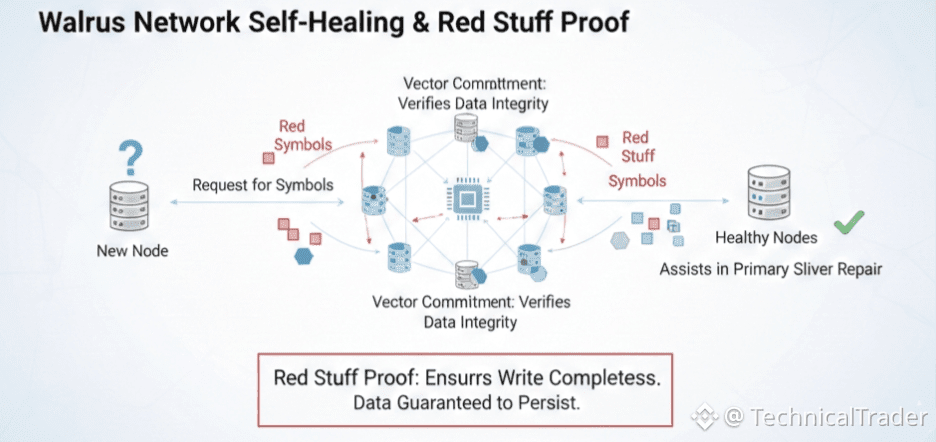
This means that once you give your file to Walrus the network will not stop until the file is safely stored in multiple locations. We can rest easy knowing that Walrus is built on logic that ensures our data stays alive forever. It is a very robust way to think about the future of the internet.
Wrapping Up Our Look At Walrus Technology
As we have seen Walrus is doing some very advanced things to keep our digital lives organized.
By using two different layers of slivers and a smart way to check for errors Walrus sets a high bar for storage.
It is all about making sure that you and I have access to our files whenever we need them.
I really enjoy looking at how these systems work because it shows how much thought goes into keeping the internet running.
Walrus and its Red Stuff method are great examples of how clever math can solve real world problems.
It is a fascinating look at the tools we will use to store our data in the coming years.
What you think about this? don't forget to comment 💭
Follow for more content 🙂

