

Walrus Protocol is one of those designs that made me pause while researching modular blockchain infrastructure. We read many papers about decentralization, but very few projects show restraint in what they choose not to build. When I looked deeper into Walrus, what stood out was not storage itself, but how deliberately they avoided becoming a standalone Layer 1. In my knowledge, that decision alone tells you a lot about the team’s understanding of system design.
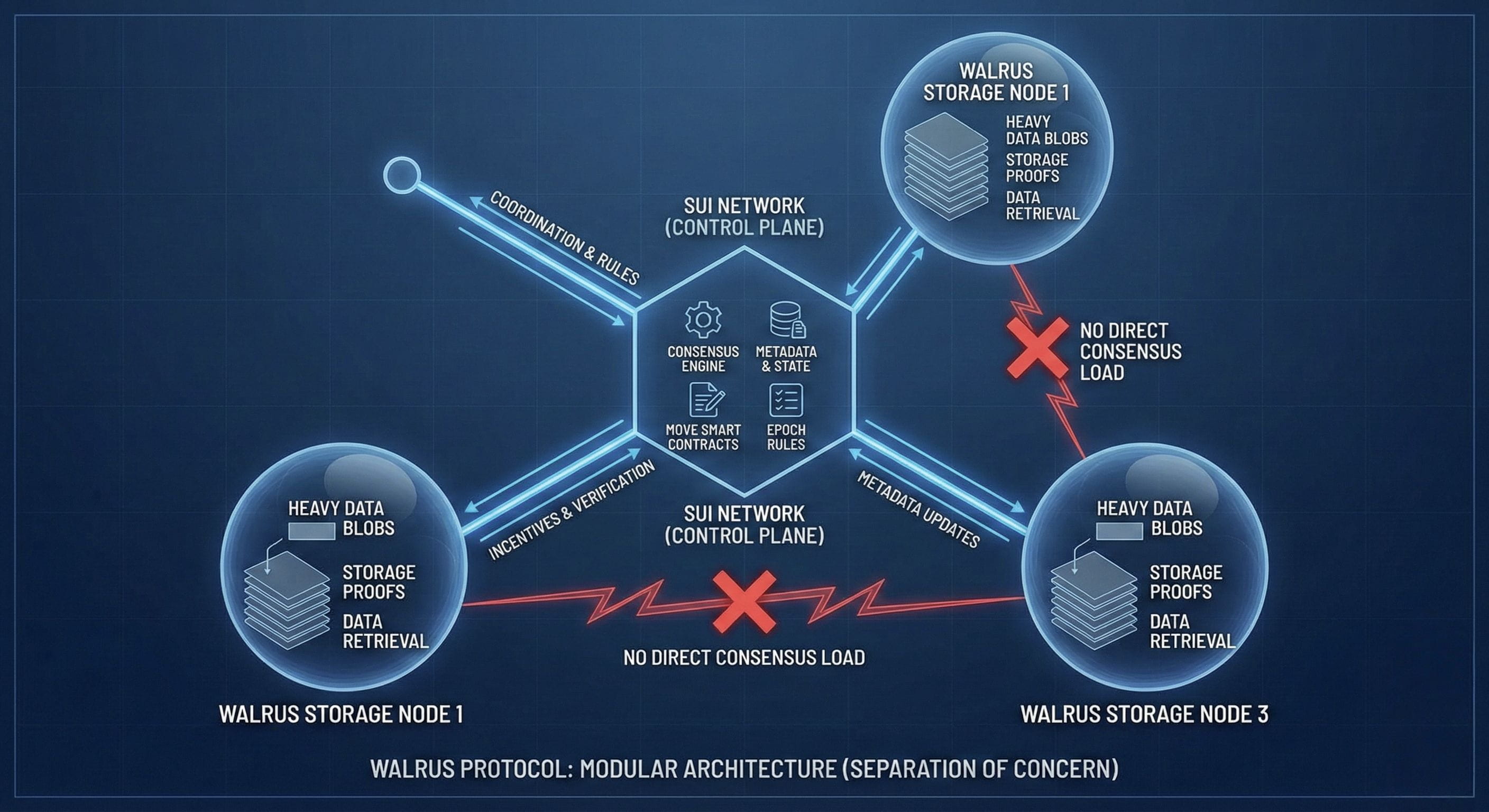
As I researched further, I realized Walrus treats coordination as a separate problem from storage. Instead of reinventing consensus, they rely on Sui Network as a control plane. I tell you honestly, this feels closer to how real distributed systems are built outside crypto. One layer handles fast, reliable coordination, while another focuses on heavy operational work. Walrus applies that logic cleanly by letting Sui manage metadata, state, and rules, while Walrus nodes handle the actual data.
When we think about decentralized storage, congestion is a recurring issue. Many systems collapse because storage logic, payments, coordination, and verification all fight for block space on a single chain. In my research, this is where Walrus quietly differentiates itself. By pushing coordination onto Sui, the storage network avoids loading consensus with large data operations. That separation is not theoretical. It directly improves responsiveness and keeps the system usable as it grows.
One detail I found particularly well thought out is how Walrus represents storage on-chain. Storage reservations and data blobs are modeled as native Objects on Sui. Because Sui uses the Move programming language, these Objects come with strict ownership and transfer rules. We read about composability often, but here it applies to storage itself. In my knowledge, that turns storage into something programmable rather than just rented space.
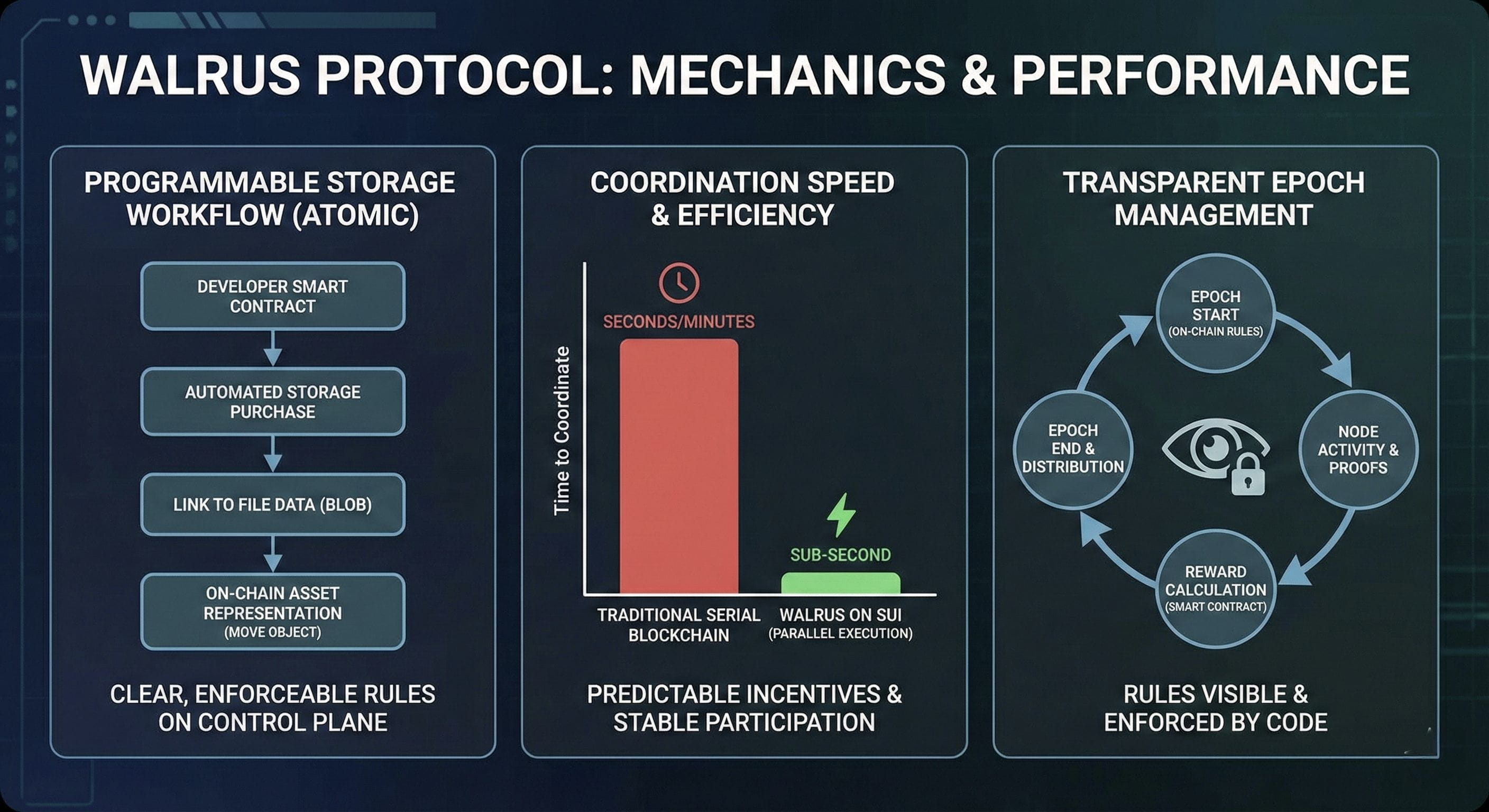
I tell you about a scenario that helped me understand the impact. A developer can write a smart contract that automatically purchases storage on Walrus, links it to a specific file, and then represents that file as an on-chain asset. That asset can be transferred, traded, or integrated into other contracts, all in one atomic flow. They are not stitching together off-chain systems. Everything follows clear, enforceable rules defined on the control plane.
Another area where the design shows maturity is coordination speed. Running a decentralized storage network is not just about storing files. Nodes must be registered, stakes updated, rewards calculated, and participation verified. We have seen how slow, serial blockchains struggle with this kind of administrative load. Walrus avoids that trap by leaning on Sui’s parallel execution engine. In my research, sub-second coordination is not a luxury. It is a requirement if you want predictable incentives and stable participation.
Epoch management is also handled with a level of transparency that I find refreshing. The Walrus network operates in defined epochs, and all the logic that governs those epochs lives in smart contracts on Sui. This includes which nodes are active, how availability proofs are evaluated, and how rewards are distributed. I tell you clearly, this removes a lot of ambiguity. Participants do not have to trust an opaque off-chain coordinator. The rules are visible and enforced by code.
From a professional standpoint, I see this as a strong alignment between economic logic and technical execution. The business rules of the storage network are secured by Sui’s validator set, which already provides economic security at scale. Walrus benefits from that without duplicating effort. In my knowledge, duplicating consensus layers is one of the biggest sources of fragility in new protocols.
Of course, no architecture is without trade-offs. By relying on Sui as a control plane, Walrus inherits its assumptions and dependencies. I tell you honestly, this is a conscious decision, not a shortcut. The system gains performance, clarity, and composability, while accepting that coordination security comes from an external layer. For many real-world use cases, that is a reasonable and even desirable exchange.
When I step back and look at Walrus as a whole, what I see is discipline. They are not trying to be everything at once. They focus on storage, incentives, and availability, while letting a high-throughput blockchain handle coordination. We read many ambitious designs in crypto, but fewer that feel grounded in how distributed systems actually scale.
In my final assessment, Walrus feels less like an experiment and more like infrastructure thinking. If this control plane model continues to work under real load, it could quietly influence how future specialized networks are built. Sometimes the most important innovation is knowing what to outsource, and Walrus, in my view, understands that better than most.

