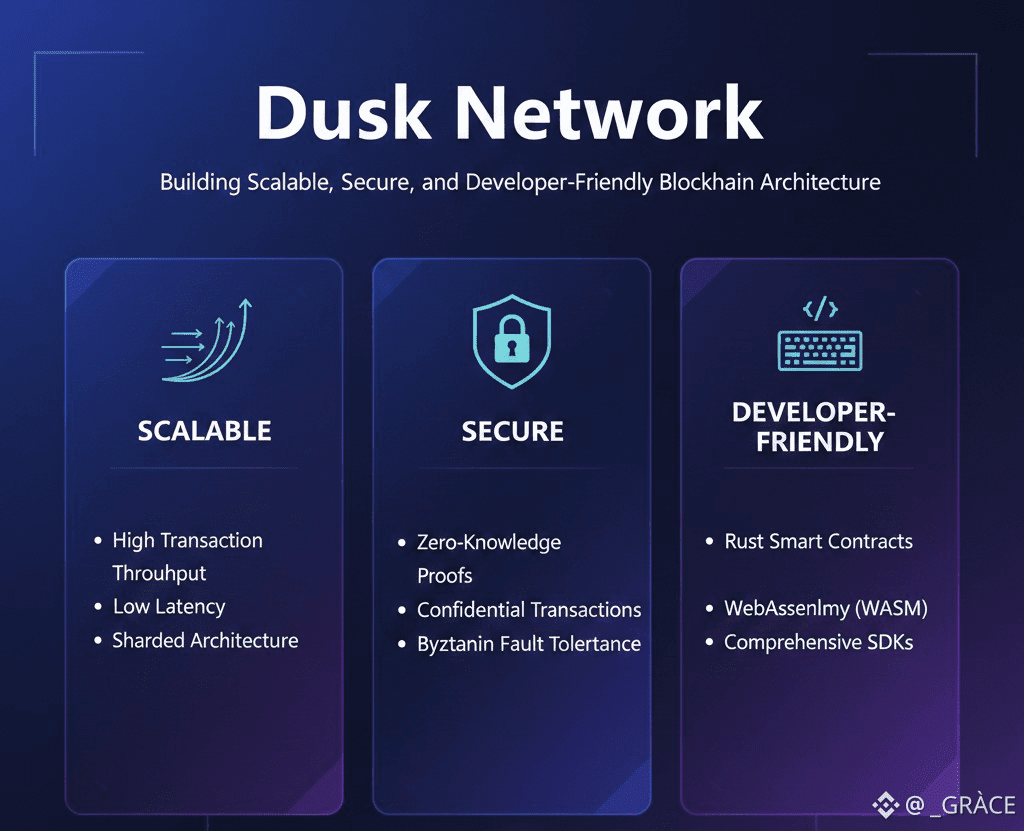
Blockchain has long been celebrated for its promise of decentralization and security, yet many networks struggle to combine scalability, efficiency, and programmability. Dusk Network addresses this challenge with a fresh approach, crafting a system that can handle complex operations at scale while maintaining integrity and resilience. Its architecture demonstrates how innovation in design can shape the next generation of blockchain applications, far beyond speculation and hype.
Unlike traditional blockchains that rely heavily on sequential processing, Dusk incorporates a modular consensus mechanism that allows the network to process large volumes of transactions efficiently. This design separates transaction validation from block creation, enabling multiple operations to occur in parallel without compromising security. By doing so, Dusk can maintain high throughput while avoiding the bottlenecks commonly seen in older blockchain models. The system is engineered to manage thousands of transactions per second, making it suitable for large-scale applications that require reliability and speed.
The network’s architecture also introduces a unique token model that incentivizes participants to maintain network integrity. Nodes are rewarded for contributing computational resources, validating operations, and supporting decentralized governance. This encourages an ecosystem where participants act in alignment with the network’s long-term health, reducing the risk of centralization and promoting sustainable growth. Unlike many systems where rewards disproportionately favor early adopters or large investors, Dusk emphasizes fairness in its incentive structure.
A key innovation in Dusk lies in its approach to confidential computation and smart contract execution. Instead of merely processing transactions, the network allows developers to design complex applications that run in a decentralized manner with predictable behavior. The system supports a wide range of programming logic and automation, opening doors to sophisticated decentralized finance applications, supply chain tools, and other programmable workflows. By offering a robust environment for developers, Dusk encourages experimentation and real-world adoption simultaneously.
Security remains a central consideration in Dusk’s design. The network integrates mechanisms to prevent common blockchain vulnerabilities, including double-spending, front-running, and malicious node activity. Its modular approach allows the system to adapt to new security challenges as they arise, ensuring that the network evolves without compromising user confidence. The focus is on creating a blockchain that is resilient under stress, capable of handling both high transaction volumes and complex contractual logic securely.
Scalability and adaptability are further enhanced through Dusk’s lightweight communication protocols. These protocols reduce the amount of redundant data transmitted across the network while maintaining verifiability and consensus integrity. Nodes communicate efficiently, and transactions propagate in a manner that minimizes latency. The combination of these features ensures that Dusk can function effectively in environments with diverse network conditions, from local clusters to global deployments.
The network’s potential extends beyond technical excellence. By supporting a flexible framework for developers, Dusk fosters innovation in areas previously constrained by traditional blockchain limitations. Projects that require high transaction throughput, low latency, or complex programmable logic can now explore decentralized solutions with confidence. This opens the door to novel applications in financial services, supply chain automation, tokenized asset management, and even emerging fields such as decentralized identity and IoT integration.
Governance is another cornerstone of the network’s forward-looking design. Dusk incorporates decentralized decision-making processes that allow stakeholders to propose upgrades, vote on protocol changes, and contribute to the network’s evolution. This collaborative approach balances innovation with stability, ensuring that the blockchain can grow organically while avoiding abrupt or destabilizing modifications.
Despite its advanced capabilities, Dusk remains user-focused. The network’s tools and interfaces are designed to facilitate seamless integration with external systems, enabling organizations to adopt blockchain solutions without overhauling existing infrastructure. By reducing technical friction, Dusk encourages developers, enterprises, and innovators to leverage its platform, accelerating adoption and creating a vibrant ecosystem around its core technology.
Looking ahead, Dusk Network exemplifies how careful design and strategic innovation can produce a blockchain that is scalable, secure, and programmable. Its modular architecture, advanced consensus mechanisms, and developer-friendly environment position it as a platform capable of supporting the next generation of decentralized applications. Unlike networks built for speculation, Dusk focuses on real-world viability, demonstrating that blockchain can be both innovative and practical.
In conclusion, Dusk Network is not just another blockchain project; it is a blueprint for the future of distributed systems. Its emphasis on scalable architecture, resilient security, and programmable smart contracts highlights a new era where decentralized networks can meet the demands of complex applications. By addressing the fundamental limitations of traditional blockchains, Dusk paves the way for more robust, adaptable, and forward-looking solutions that have the potential to transform how industries operate in a decentralized world.