
Imagine you’ve spent months filming a high-production documentary. You upload it to a leading "centralized" cloud provider, feeling secure. But then, a single server farm in Virginia experiences a cooling failure, or worse, a policy change flags your content as "sensitive" and locks your account. Suddenly, your hard work is a ghost in the machine—inaccessible and beyond your control.
This is the hidden fragility of our modern web. We trust giant "black boxes" with our digital lives, but we don't truly own the key. Enter Walrus, a decentralized storage protocol that doesn't just store your data; it shatters it into a thousand pieces and scatters them across a global, unhackable landscape.
The "Red Stuff" Revolution: Beyond Simple Backups
Traditional cloud storage works on replication—making a few copies of your file and putting them on different servers. If those servers belong to one company, you still have a single point of failure.
Walrus introduces a mathematical marvel called Red Stuff (an advanced 2D erasure coding). Instead of just copying your file, Walrus transforms it into tiny fragments called slivers.
• How it works: Think of it like a puzzle where you only need 30% of the pieces to see the whole picture.
• The Security Edge: Even if two-thirds of the storage nodes on the Walrus network were to go offline or act maliciously at the exact same time, your data remains perfectly recoverable.
• The Result: You get "enterprise-grade" reliability without needing a multi-billion dollar data center.
Breaking the "Vendor Lock-In" Chains
In the world of AWS or Google Cloud, you are a tenant. You pay rent, and if you stop, or if they change the rules, you're out. Walrus, built on the Sui ecosystem, treats storage as a programmable asset.
Real-Life Scenario: A decentralized social media app uses Walrus to store user videos. Because the storage is "on-chain" via Sui objects, the user—not the app—truly owns the video's "Blob ID." If the app disappears tomorrow, the user can still point any other interface to their Blob ID and retrieve their content. That is true data sovereignty.
Visualizing the Flow: Centralized vs. Walrus
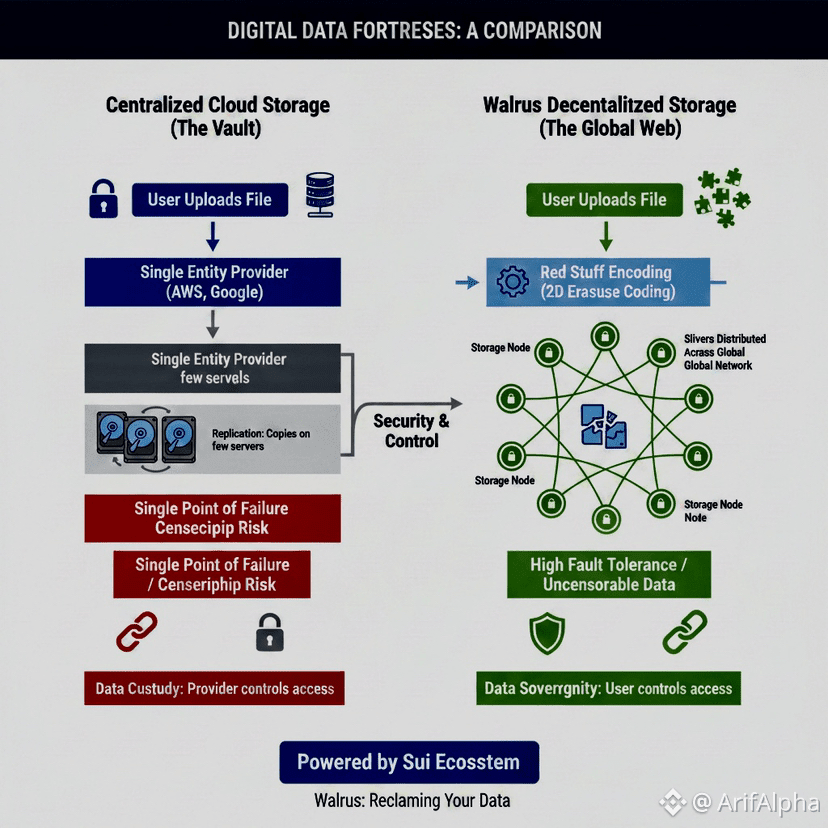
1. The Centralized Model (The Vault)
• User → Sends File → Central Server (Single Point of Entry) → Storage Disk
• Risk: If the "Vault" door is jammed (outage) or the owner loses the key (censorship), the file is gone.
2. The Walrus Model (The Global Web)
• User → Red Stuff Encoding → Fragments (Slivers) → Global Node Network
• Security: No single node has enough data to "read" your file. You need the cryptographic key and the network's consensus to rebuild it.
Why This Matters for the Next Bull Run
As AI and GameFi explode, the demand for "Blob storage" (large files like AI training sets or 4K gaming textures) is skyrocketing. Storing a 1GB file directly on a traditional blockchain is financial suicide.
Walrus solves the "Storage Trilemma":
1. Cost: It’s significantly cheaper because it doesn’t require every node to store the whole file.
2. Speed: It’s optimized for fast "data availability," making it perfect for dApps that need to load assets instantly.
3. Trust: It removes the middleman. You aren't trusting a CEO; you're trusting code.
The Bottom Line
Centralized clouds are like keeping your gold in someone else's safe. Walrus is like turning that gold into dust, spreading it across the world, and having a "magic magnet" that only you hold to pull it back together instantly. It’s not just a technical upgrade; it’s a shift in who holds the power in the digital age.
As we move toward a fully decentralized web, do you feel more secure trusting a single corporation with your data, or a mathematical protocol that never sleeps?
Let’s discuss in the comments—would you trust your most private files to a decentralized "shredded" network?
@Walrus 🦭/acc #Walrus #walrus $WAL

