
In the race to tokenize everything from government bonds to real estate, a fundamental paradox has emerged. Traditional finance demands privacy and compliance, while public blockchains offer transparency and permissionlessness. Dusk Network is building to resolve this core conflict.
Unlike general-purpose Layer 1s, Dusk was engineered from the ground up for one mission: to serve as the foundational ledger for regulated, institutional finance. As we enter what many are calling the "Year of Asset Tokenization," understanding Dusk’s unique architecture is key to seeing the next evolution of blockchain utility.
The Compliance Conundrum: Why General-Purpose Blockchains Fall Short
Imagine a major bank wanting to issue a digital bond. It cannot use a fully transparent chain where every trade and wallet balance is public, exposing client positions and sensitive deal terms. Yet, it also cannot operate in a regulatory vacuum without mechanisms for audit trails, KYC (Know Your Customer), and AML (Anti-Money Laundering) checks. This is the wall traditional finance hits with existing infrastructure.
General-purpose chains excel at decentralization and censorship resistance but were not designed with these specific regulatory and privacy gatekeepers in mind. Dusk Network recognized that for trillions in real-world assets (RWAs) to move on-chain, the technology must adapt to the world of finance, not the other way around.
Deconstructing Dusk's Architecture: A Three-Pillar Foundation
Dusk’s solution rests on three integrated pillars that together create a compliant and private financial environment.
1. Confidentiality Through Zero-Knowledge Proofs
At its core, Dusk utilizes advanced zero-knowledge proof (ZKP) cryptography. This allows transactions—their amounts, participants, and types—to be encrypted on the public ledger. Your activity is shielded from public view. However, it’s not a black box. The revolutionary part is selective auditability. Authorized regulators, equipped with the proper keys, can pierce the privacy veil to perform legally mandated audits. This fulfills the dual need for individual privacy and systemic transparency.
2. The Compliance Layer: Programmable Regulation
Privacy alone isn’t enough. Dusk bakes compliance into its protocol layer. Its native tools, like the Citadel identity system, allow for private KYC and credential verification. Smart contracts can be programmed to enforce trading rules, investor eligibility requirements, and disclosure schedules. This means a security token can have its regulatory rulebook enforced automatically by the blockchain it lives on, reducing reliance on slow, error-prone manual processes.
3. The Performance Engine: Succinct Attestation Consensus
Financial markets need speed and certainty. Dusk’s Segregated Byzantine Agreement (SBA) consensus, also called Succinct Attestation, provides deterministic finality. When a transaction is settled on Dusk, it’s truly settled within seconds—no reversals, no uncertainty. This is a non-negotiable requirement for institutional settlement systems and a key advantage over chains with probabilistic finality.
DuskEVM: The Bridge for Developers
A powerful chain is useless without developers. Dusk introduces the DuskEVM, an Ethereum-compatible execution layer. Developers can write in the familiar Solidity language and use standard Ethereum tooling, but their smart contracts gain a superpower: the ability to process private, confidential data. This drastically lowers the barrier to entry, allowing the vast Ethereum developer community to build compliant, privacy-focused financial applications without learning entirely new programming paradigms.
Real-World Use Cases: From Theory to Practice
This isn’t just theoretical. Dusk’s technology is designed for concrete, high-value applications:
Tokenized Securities: Issuing and managing equities, bonds, or funds with embedded compliance on-chain.
Private Institutional DeFi: Creating lending pools and AMMs where KYC is enforced and trading positions remain confidential between parties.
Confidential Payments & Settlements: Enabling private delivery-versus-payment (DvP) settlements between large institutions.
The project’s strategic partnerships, including being a shareholder in a Dutch stock exchange (NPEX), signal a clear path toward these real-world adoptions.
The Landscape: How Dusk Compares
To visualize Dusk's unique position, let’s conceptualize the blockchain design space. Think of a triangle with three points: Decentralization/Open Access, Privacy, and Regulatory Compliance.
Traditional L1s (Ethereum, Solana): They excel at the top point—decentralization and open, permissionless access. They often sacrifice built-in privacy and compliance for this openness.
Private, Permissioned Chains: They cluster near the compliance and privacy points but completely sacrifice the decentralized, public nature of a true L1. They create walled gardens with fragmented liquidity.
Dusk Network: It occupies a unique central zone, attempting to blend all three. It’s a public, permissionless ledger that uses cryptographic innovation to offer privacy and embed compliance tools directly into its protocol.
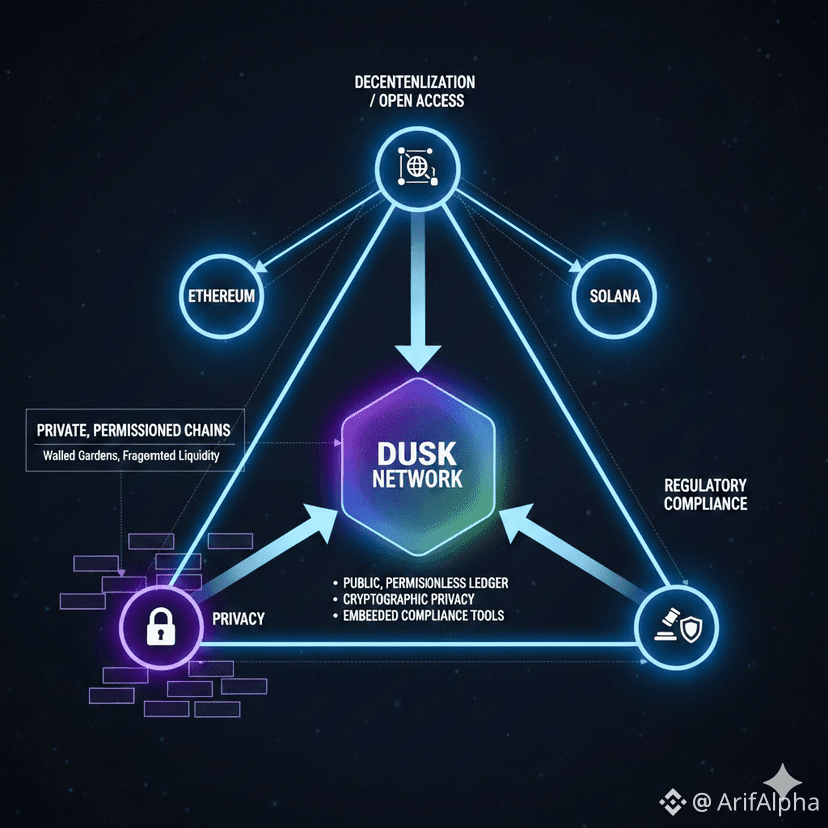
This is Dusk’s key differentiation. It doesn’t ask institutions to choose between a private chain and the network effects of a public one. It offers both.
The infrastructure for the next wave of finance is being built now. Dusk Network is positioning itself not as another blockchain for speculation, but as critical, utility-driven plumbing for the tokenized economy.
Its success hinges on a bet that the future of institutional blockchain adoption requires a nuanced, hybrid approach—one that respects both the individual’s right to privacy and society’s need for regulated, stable markets.
What do you believe is the most significant barrier to institutional adoption of blockchain technology: the technical limitations, the regulatory uncertainty, or the cultural shift within traditional finance itself?
