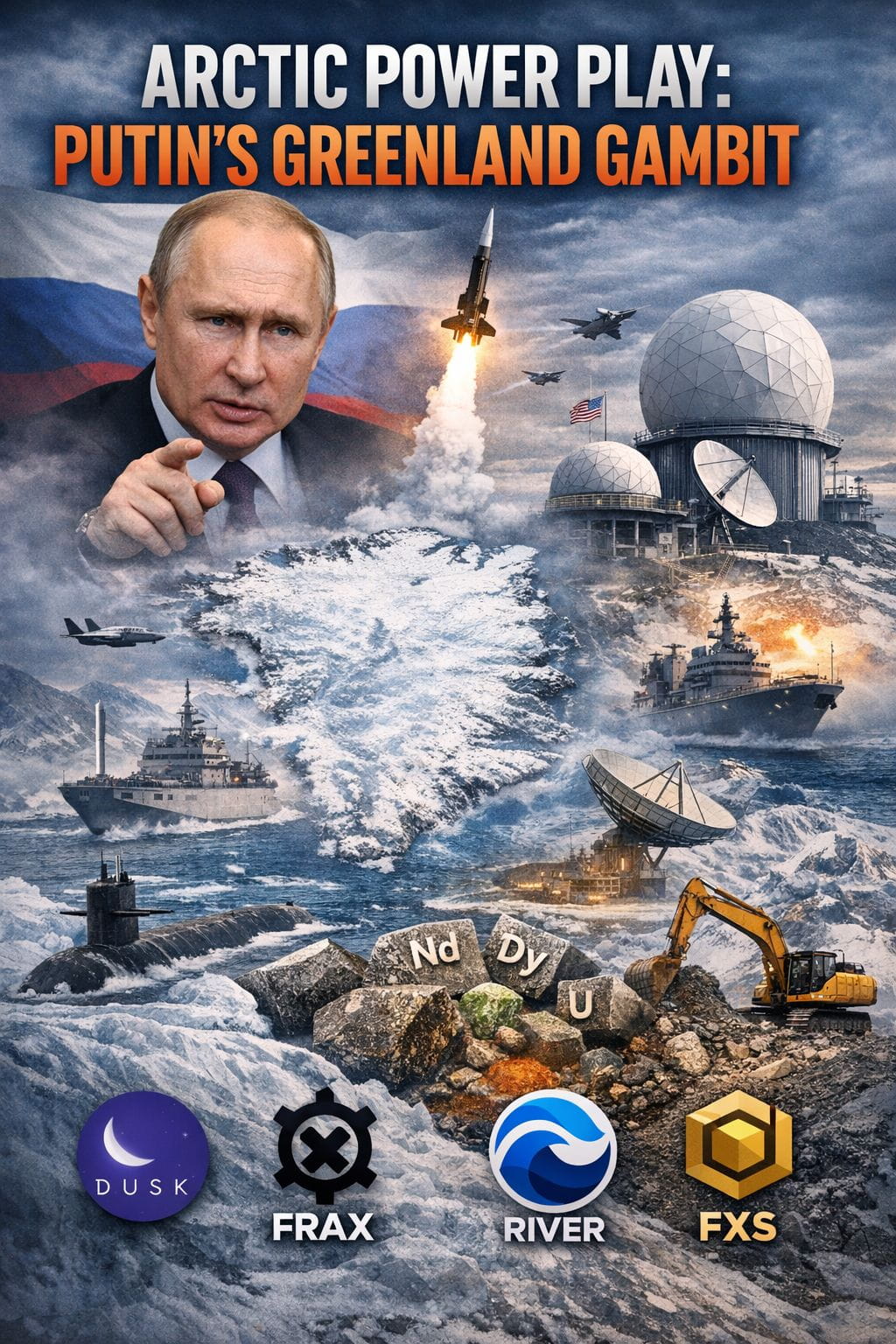
A recent comment from Russian President Vladimir Putin has escalated Arctic geopolitics to a new level. Russian envoy Kirill Dmitriev revealed that Putin “understands” why the United States is so interested in Greenland. This isn’t a casual remark—it's a clear signal that Moscow now sees Greenland as a global strategic asset.
🔥 Why This Matters
1️⃣ The Arctic Choke Point — A Trillion-Dollar Future
Controlling Greenland means controlling emerging Arctic sea lanes that could cut Asia–Europe shipping times by up to 40%.
Beneath the ice lie massive reserves of rare-earths—neodymium, dysprosium, uranium—critical for AI, semiconductors, privacy-tech, and global defense infrastructure.
This rare-earth + data-control narrative is now echoing inside blockchain as well, where security, compliance, and real-economy linkage are becoming premium.
2️⃣ The U.S. Is Stepping Up
Pituffik Space Base (formerly Thule) is one of America’s most critical missile-warning and space-tracking sites.
AI surveillance, satellite integrity, and secure data flow are the three priorities operating there.
This is exactly where privacy-focused blockchain ecosystems like $DUSK naturally align—
because in highly sensitive zones like the Arctic, secure and compliant information flow becomes the ultimate power.
👉 The more geopolitical tension rises, the more demand there is for privacy-layers and regulated-compliant blockchains.
3️⃣ Europe’s Warning — Tension Inside NATO
Denmark, France, Germany, and Norway have all made it clear: Greenland is not negotiable.
If this friction escalates:
👉 Supply chains, energy corridors, and dollar liquidity could face heavy shocks.
Such volatility directly impacts algorithmic finance and stable liquidity systems—
where FRAX and FraxShare (FXS) stand out due to their efficient liquidity engineering.
Geopolitical shocks → dollar stress → higher demand for decentralized stability.
4️⃣ Russia’s Position — A Quiet but Firm Signal
Moscow states that Greenland belongs to Denmark, but warns that Arctic militarization will continue accelerating.
This implies:
🔹 Shifts in shipping routes
🔹 Higher rare-earth supply risk
🔹 Realignment of global energy flows
In such conditions, $RIVER —a high-efficiency, utility-driven network—attracts attention,
as investors often rotate into scalable, cost-efficient infrastructures during uncertainty.
⚠️ What’s Next — And Why Markets Are Watching Closely
Any U.S. or NATO-level move around Greenland could ignite an intra-alliance crisis.
Historically, geopolitical pressure drives money toward three sectors:
🔸 (1) Privacy + Regulated Infrastructure → DUSK
As data sovereignty becomes a global priority, DUSK’s regulated privacy model gains long-term relevance.
🔸 (2) Dollar Liquidity & Stable Ecosystems → FRAX / FXS
Dollar volatility consistently increases the demand for decentralized, adaptive liquidity.
🔸 (3) High-Efficiency Growth Networks → RIVER
During instability, smart money leans into networks that are lean, scalable, and adoption-ready.
🧭 Bottom Line
Greenland is no longer just a geopolitical argument—
it’s now the nexus of rare-earths, data control, security, energy, and AI infrastructure.
And within that emerging macro-trend, DUSK, $FRAX , RIVER, FXS align naturally with the real-world themes shaping global markets.
Where tension rises, opportunity follows.
And the Arctic is heating up fast. 🚀
🔖 Hashtags
#DUSK #FRAX #RIVER #FraxShare #AIInfrastructure