


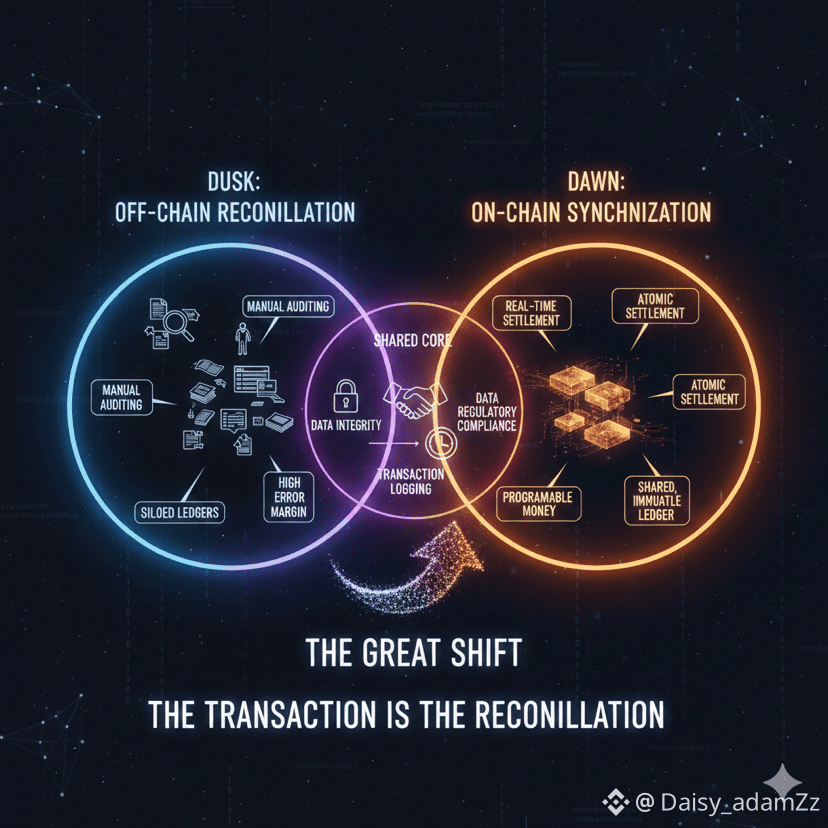
One of the least visible but most expensive problems in finance is off-chain reconciliation. It’s the constant process of matching records between administrators, custodians, issuers, and auditors to make sure everyone agrees on what happened. Transfers may look instant on the surface, but behind the scenes, operations teams are still checking balances, confirming supply, and resolving mismatches. This is where delays, errors, and risk quietly accumulate.
Dusk is taking a deliberate approach to solving this problem by making the blockchain itself the authoritative record. Not a secondary log. Not a settlement layer that still depends on external systems. The chain is where truth lives.
Most blockchains still rely heavily on off-chain processes. Compliance lists are maintained in databases. Corporate actions are tracked manually. Final balances are often confirmed by reconciliation rather than guaranteed by the protocol. This means that even if a transfer happens on-chain, the operational certainty still depends on people and parallel systems.
Dusk is designed to remove that dependency.
By embedding asset rules, permissions, and lifecycle logic directly into the protocol, Dusk allows financial instruments to be issued, transferred, updated, and retired in a single, shared system. When a change occurs, it happens on-chain and becomes final. There is no need for multiple parties to update their own ledgers and then compare results afterward.
This shift has important consequences for real markets. When the chain is the source of truth, operational workflows become simpler and safer. Administrators don’t need to reconcile token supply against separate registries. Custodians don’t need to manually confirm positions. Auditors can verify state directly from the chain instead of relying on exported reports.
Dusk’s architecture supports this while still respecting the realities of regulated finance. Sensitive data does not need to be publicly exposed for the system to work. Positions, identities, and transaction details can remain private, while proofs and validations ensure that rules are followed. This allows institutions to rely on on-chain certainty without turning financial activity into public data.
What stands out is that Dusk is not trying to eliminate controls. Instead, it is moving controls into the system itself. Rules are enforced automatically. Permissions are checked natively. Asset behavior is predictable and verifiable by design. This reduces human intervention without removing accountability.
The impact of this approach is not measured in transaction speed or volume, but in operational reliability. Fewer manual checks mean fewer errors. Fewer parallel ledgers mean less confusion. Fewer reconciliation cycles mean lower cost and faster settlement.
This is not the kind of feature that generates hype, but it is exactly the kind of infrastructure that real financial markets need. Dusk is building for long-term use, where systems must hold up under audits, regulation, and daily operational stress.
By making the blockchain the authoritative record, Dusk is addressing one of the most persistent pain points in finance. It’s a quiet change, but one that has the potential to make on-chain markets far more practical and resilient.
Source: Dusk Foundation
