
As multi-chain activity grows, many users eventually want their tokens back on their native blockchain — where protocol features, governance, and long-term utility are designed to work best. For DUSK holders, migrating BEP20 or ERC20 DUSK back to native DUSK is the official and secure way to return assets to the Dusk mainnet.
This migration is handled directly through Dusk’s Web Wallet and works with WalletConnect-compatible Web3 wallets. The goal is simple: lock your tokens on Ethereum or Binance Smart Chain, and receive the same amount of native DUSK on Dusk’s mainnet.
Behind the interface, the system follows a strict one-to-one model. When your BEP20 or ERC20 DUSK enters the migration contract, those tokens are permanently locked. Only after that lock is confirmed does the network issue native DUSK to your Dusk wallet. This ensures supply consistency and prevents duplication across chains.
Under normal network conditions, the entire process completes in about 15 minutes.
Step-by-Step guide for Migration Flow
Begin by opening the Dusk Web Wallet and either importing an existing wallet or creating a new one as per your conditions . Once inside, you will be guided to initiate the migration process you can understand when yiu enter also.
After reviewing the migration prompt, you will connect your Web3 wallet using the WalletConnect or others if you have . This wallet holds your BEP20 or ERC20 DUSK on Ethereum or Binance Smart Chain.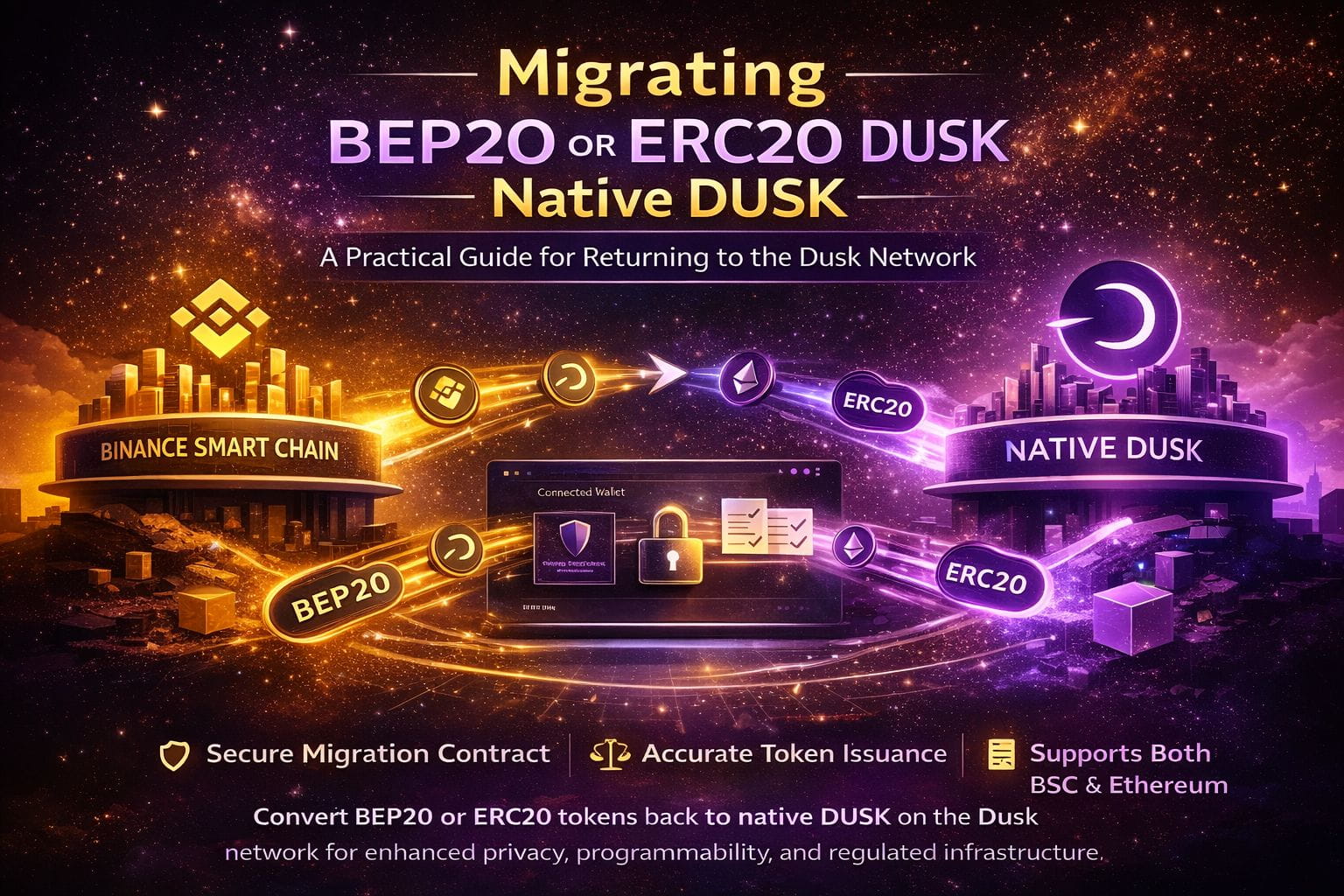
When you confirm the transaction from your Web3 wallet, the migration contract is triggered. At this point, your tokens are sent into the contract and locked on the source chain to make sure of it correction . The contract emits an event that includes your Dusk mainnet address as the destination.
From there, the Dusk network processes the issuance and sends native DUSK directly to your mainnet wallet. For security reasons, this issuance step may take up to 15 minutes before final confirmation.
Tracking Your Migration
You can monitor the progress directly through your Web3 wallet on Ethereum or Binance Smart Chain. Once the migration completes, the original transaction hash from your source chain will be referenced inside the Dusk transaction memo. This allows you to trace the full path of your tokens from locking to issuance.
Minimum Amounts and Decimal Rules (you should read this carefully )
The migration system works with a base unit called LUX. The minimum amount you can migrate is 1 LUX, which equals 1,000,000,000 DUSK wei.
Any amount smaller than this threshold will be rejected by the contract.
There is also an important rounding rule. BEP20 and ERC20 DUSK use 18 decimals, while native DUSK uses only 9 decimals. Because of this difference, the migration contract only accepts clean multiples of 1 LUX.
If you submit an amount that is not an exact multiple, the system will automatically round the value down.
For example, if you attempt to migrate 1.234567890 DUSK (in wei terms), the contract will issue exactly 1 LUX in native DUSK and discard the fractional remainder.
This mechanism guarantees precision and avoids mismatches between decimal formats.
Why This Migration Matters
This migration process is more than a technical utility. It plays a key role in bringing assets back into Dusk’s native environment — where privacy, programmable compliance, and regulated financial infrastructure are built directly into the protocol.
By locking external representations and reissuing native tokens, Dusk maintains:
• Supply integrity across chains
• Accurate accounting between formats
• Full compatibility with native features
• Clean compliance with protocol rules
Final Notes
Migrating from BEP20 or ERC20 DUSK to the native DUSK is an official, secure, and well-structured process and it make sure it safety — as long as users respect the minimum limits, decimal rules, and confirmation steps.
Always use the official Dusk Web Wallet, verify transactions carefully, and allow the full confirmation window to complete before taking further action.
In a cross-chain world, clean migration paths like this are not optional — they are foundational. #Dusk $DUSK @Dusk
