
Blockchain technology is entering a new phase or also say it creating the new era. For more than a decade, chains have focused on moving tokens, executing simple logic, and securing transactions. But the next wave of decentralized systems will not be driven only by finance. It will be driven by intelligence — autonomous agents, AI-driven automation, on-chain reasoning, and tokenized real-world systems that must process information, verify truth, and act without constant human input.
This is the context in which Vanar Chain is being built.
Vanar is not positioning itself as a faster blockchain, a cheaper layer, or another general-purpose network. It is positioning itself as “The Chain That Thinks” — a blockchain designed from the ground up to support artificial intelligence, semantic data, automated decision-making, and real-world infrastructure directly on-chain.
Designed for AI from Day One
Most blockchains were never designed to support AI workloads. When AI is added to them, it usually lives off-chain. The blockchain becomes a settlement layer, while reasoning, training, and memory happen elsewhere. This creates fragmentation: trust on-chain, intelligence off-chain.
Vanar takes a different approach.
Instead of retrofitting AI features, Vanar builds intelligence into the core protocol itself. Every layer of the system is optimized for:
• Native AI inference and training
• Semantic data operations rather than raw byte storage
• Vector storage and similarity search
• AI-optimized validation and consensus
This matters because intelligent applications do not operate on simple states. They operate on context, similarity, memory, and evolving logic. Vanar treats these as first-class citizens of the blockchain, not external services..
The Five-Layers of Vanar Stack
The real innovation of Vanar lies in its at the vertical architecture. Rather than offering a single execution layer or just a hard words, Vanar introduces a five-layer stack where data becomes progressively more intelligent as it moves upward you can also say it's the way move on new era where data ai is intelligence
Each layer has a specialized role.
Layer 1 — Vanar Chain: The Infrastructure Layer
At the foundation sits Vanar Chain, Vanar is responsible for the consensus, execution, and verification of the system.
This layer is optimized not only for transaction throughput, but for semantic integrity. Validation is designed to handle structured knowledge, proofs of computation, and AI-driven execution paths. Instead of treating data as static state, the chain treats it as evolving information that can be referenced, verified, and reasoned over.
This allows the base layer to support applications that require:
• On-chain verification of AI outputs
• Deterministic execution of adaptive logic
• Secure coordination between autonomous agents
Vanar is not simply confirming transfers — it is validating truth and computation.
Layer 2 — Neutron: Semantic Memory as it name say memory work
Above the infrastructure layer sits at the Neutron, the semantic memory layer.
Vanar introduces native support for these important points :
• Vector databases
• Similarity search
• Contextual indexing
• Long-term memory compression
This layer allows the chain to store not just data, but meaning and understanding.
Instead of retrieving the information by exact key matches, agents can retrieve information by similarity, relevance, and context. This is fundamental for AI systems that must compare past states, detect patterns, and build knowledge over time.
Neutron turns the blockchain into a memory system, not just a ledger.
Layer 3 — Kayon: Reasoning and Decision Logic
The third layer, Kayon, is where Vanar becomes truly unique.
Traditional smart contracts execute fixed logic.
Kayon enables on-chain reasoning.
Here, contracts can do all of these things as written :
• Evaluate conditional paths
• Perform inference
• Adapt behavior based on new data
• Trigger actions based on learned patterns
This transforms static the contracts into the intelligent contracts — capable of evolving with context without giving responding to uncertainty, and coordinating the complex systems.
Instead of writing rigid rules, developers can deploy decision systems.
Layer 4 — The Axon: Which is Intelligent Automation
Above reasoning comes Axon, the automation layer as per it's name it work with automatic .
Axon is responsible for:
• Agent coordination
• Autonomous execution
• Workflow orchestration
• Integration with on-chain finance and infrastructure
This layer allows AI agents to interact directly with the markets, assets, and protocols without constant off-chain control which make it easy. Financial strategies, infrastructure operations, and compliance workflows can run autonomously, while remaining fully verifiable on-chain.
This is where Vanar becomes a platform for autonomous economies.
Layer 5 — Flows: For the Industry Applications
At the top sits Flows, the application layer where every thing flowlessly work.
Vanar connects its intelligence stack to real-world systems:
• On-chain finance
• Tokenized real-world assets
• AI agent networks
• Infrastructure coordination
• Automated compliance systems
This is where blockchain stops being experimental and becomes operational infrastructure.
Why This Architecture Matters
Most chains focus on performance. Vanar focuses on capability.
By vertically integrating memory, reasoning, automation, and verification, Vanar creates something rare:
A blockchain that can understand, decide, and act — not just record.
This opens new categories of applications:
• Autonomous trading and treasury systems
• AI-managed asset registries
• Tokenized infrastructure with automated governance
• On-chain compliance engines
• Intelligent agent networks coordinating across markets
These are not DeFi applications.
These are economic operating systems.
The Strategic Positioning of VANRY
$VANRY is not positioned as a speculative utility token. It functions as the economic backbone of an intelligent execution network.
As AI agents, tokenized systems, and autonomous infrastructure scale, demand shifts from throughput to:
• Verified computation
• Trusted memory
• On-chain reasoning
• Autonomous coordination
#vanar is positioning itself at exactly this intersection.
Final Perspective
The blockchain industry is slowly moving from: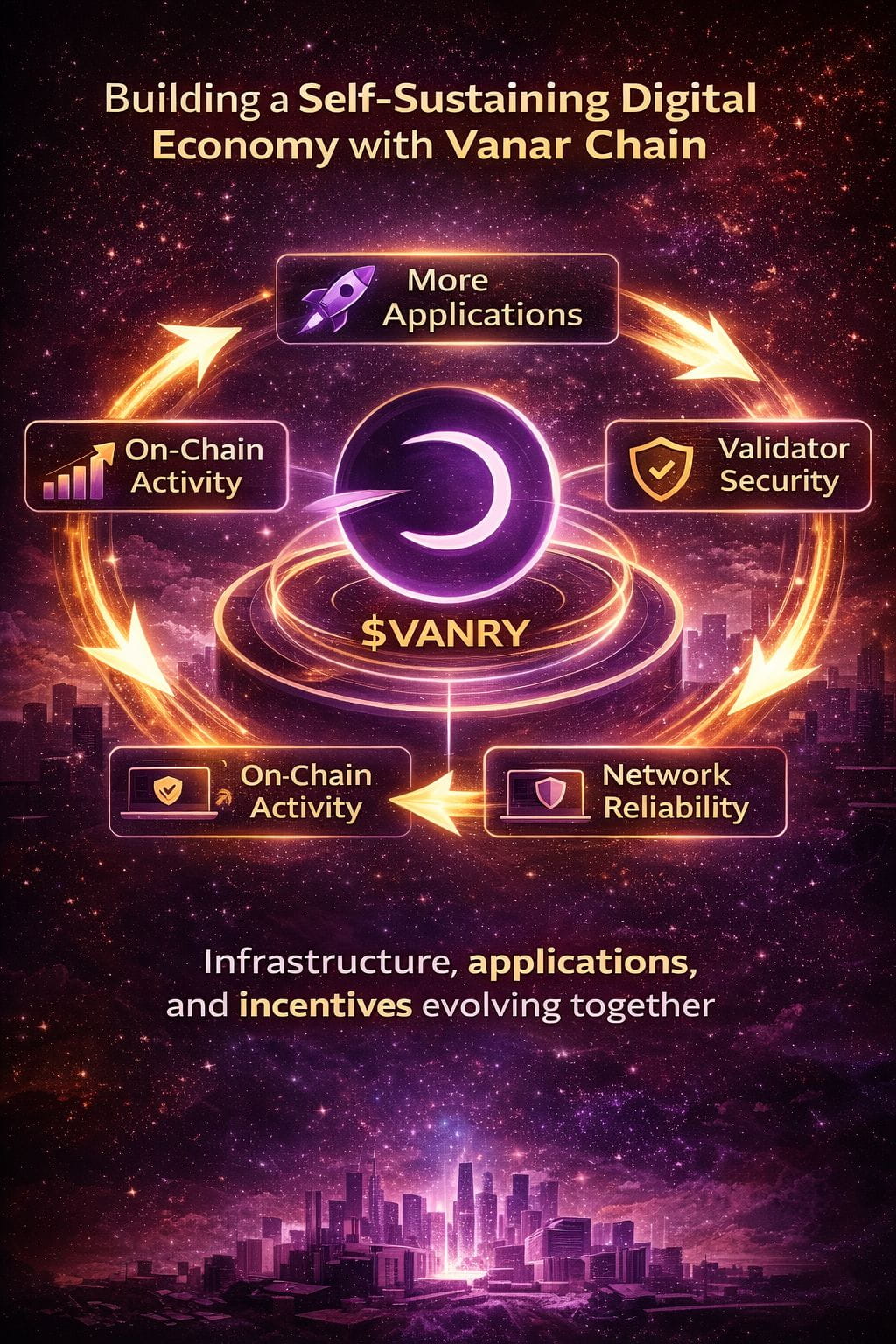
Transactions → Contracts → Protocols → Agents → Intelligent Systems
Most networks are still focused on the first two stages.
Vanar is building directly for the last.
Not faster payments.
Not cheaper swaps.
But on-chain intelligence at system level.
If the next decade belongs to autonomous finance, tokenized infrastructure, and AI-driven coordination, the most valuable chains will not be those that move tokens the fastest.
They will be the ones that can think, verify, and act at scale.
Vanar is not trying to be another blockchain.
It is trying to become the execution layer for intelligent economies. @Vanarchain
