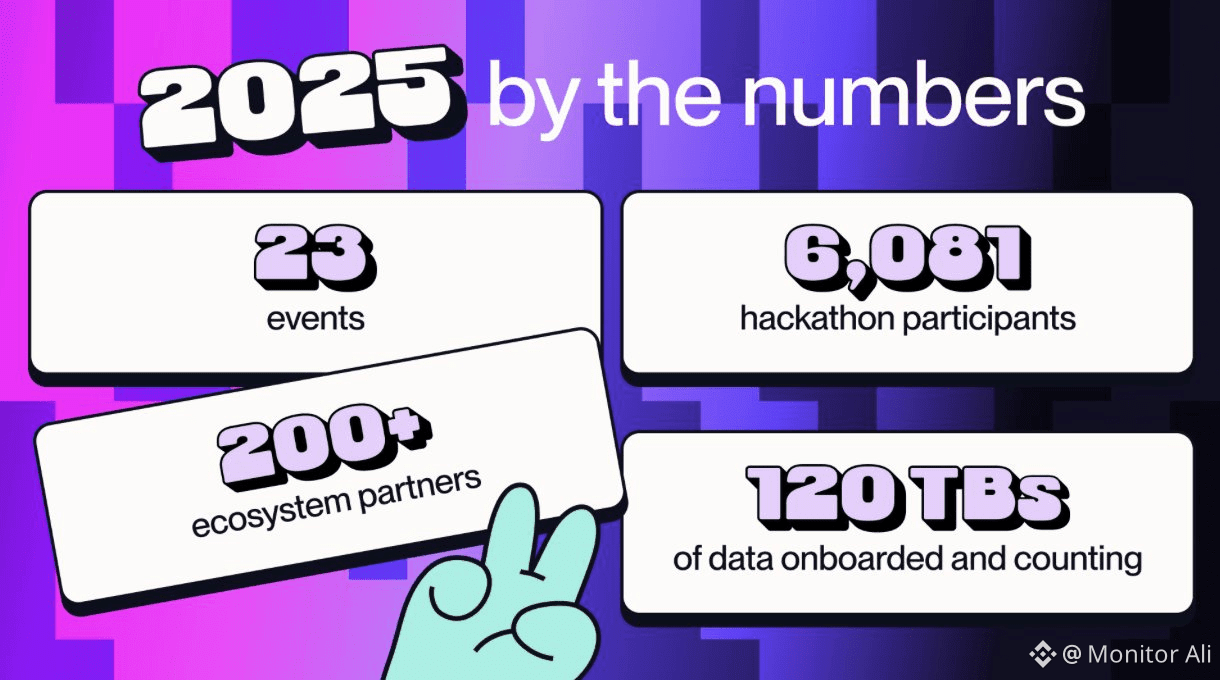
2025 has been a breakthrough year for @Walrus 🦭/acc , entering the year with a clear objective → Build a high-performance data layer where availability, ownership and access can be verified on-chain
This piece covers:
• Key 2025 milestones
• Ecosystem growth and protocol upgrades
• What comes next for 2026
- - - - -
Key 2025 milestones
Over the course of the year, the team has moved decisively from concept to production:
• March 2025 - Mainnet launch → Marking the transition from test deployments to live workloads, onboarding both data users and builders to the ecosystem
• Soon after Mainnet launch, $WAL token had its TGE → Aligning storage usage, staking incentives, and network economics
A few key architectural choices underpinned these milestones, helping to support real-world scale without compromising verifiability:
→ Large data lives off-chain for performance
→ Availability proofs, ownership, and access control are enforced on-chain via @Sui (@Mysten_Labs)
Ecosystem growth and protocol upgrades
Post-mainnet launch, a slew of projects were built with Walrus → unlocking new use cases across AI, health tech, EV + more
Key Dapp built with Walrus in 2025:
• @CudisWellness → user-owned health and wellness data
• @AlkimiExchange → verifiable advertising data and impressions
• @DLPLabs → EV data markets tied to carbon credits and insurance use cases
• @Talus_Labs → autonomous AI agents with verifiable state and execution data
• @MyriadMarkets → transparent prediction markets with onchain data storage
Alongside ecosystem growth, Walrus continued shipping protocol upgrades throughout the year:
• Seal → Brought native encryption and programmable access control
• Quilt → Improved efficiency for small files, reducing storage overhead → Saving 3+ million WAL
• Upload reliability improvements + ongoing SDK / developer tooling refinement
Close & personal thoughts
2026 should become a test of sustainability and execution vs 2025’s focus on establishing production capabilities.
Key areas going forward:
• Further abstraction to make integrating Walrus even more seamless
• Deeper integration with Sui without introducing new bottlenecks
• Expand industry use case beyond the usual data-heavy verticals
From an operational risk perspective, a few personal takeaways come to mind:
• Reliance on Sui / Ecosystem Concentration → Walrus growth is closely tied to Sui, acting almost as a beta play to the broader ecosystem
• Incentives → Balancing incentives + price action + sustaining node participation as storage utilization increases
• Frictionless UI/UX → Whilst integration is key, end user experience must still be sufficiently seamless enough vs centralized storage options; Else, centralized storage options will still continue to win on simplicity + existing user behaviour