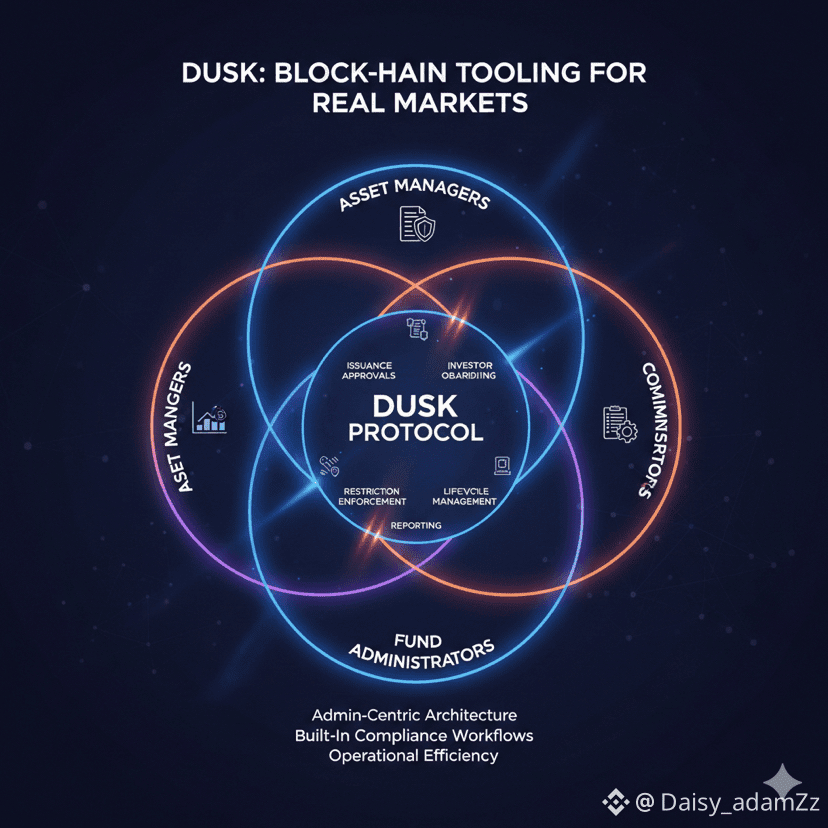
Dusk is approaching blockchain infrastructure from a different angle. Instead of focusing only on developers and smart contract flexibility, Dusk is building tooling for the people who actually operate financial markets every day. Asset managers, compliance teams, and fund administrators are at the center of this design choice, and it shows in how the protocol is evolving.
Most financial activity is not driven by code deployments. It is driven by operational workflows. Issuance approvals, investor onboarding, restriction enforcement, reporting, and lifecycle management are handled by teams whose responsibility is precision and compliance. Dusk is designed to support these roles directly on-chain.
Admin-Centric Architecture
At its core, Dusk treats assets as regulated instruments with defined lifecycles. Tooling is structured around real administrative actions: issuing assets, updating permissions, managing supply, and enforcing rules consistently. These actions are not ad-hoc transactions. They are governed processes embedded into the protocol.
This means administrators can operate assets through clear, auditable workflows instead of relying on manual off-chain coordination. The chain becomes the place where decisions are executed and recorded, not just where transfers settle.
Built-In Compliance Workflows
Compliance is not an optional layer on Dusk. It is part of how the system functions. Access controls, eligibility checks, and restrictions are enforced at the protocol level, allowing compliance teams to rely on the system rather than constantly monitoring it.
Dusk enables selective disclosure, so sensitive information remains protected while still allowing authorized parties to verify correctness. This allows compliance teams to meet regulatory obligations without exposing investor data or operational details publicly.
Operational Efficiency Without Complexity
One of Dusk’s goals is reducing operational complexity. By aligning on-chain actions with real-world fund workflows, the protocol minimizes the need for parallel systems. Asset managers do not need to reconcile multiple ledgers or manually confirm state across platforms.
Supply, ownership, and lifecycle events are consistent because they are enforced by the same system. This consistency lowers operational risk and simplifies daily operations for administrators and operators.
Designed for Long-Term Market Use
Dusk’s adminoz system emphasizes durability over experimentation. Tooling is built to support long-lived assets, ongoing reporting, and repeated operational cycles. This reflects the reality of regulated markets, where infrastructure must remain stable and predictable over time.
By focusing on admin usability, Dusk removes one of the biggest barriers to blockchain adoption in regulated finance: the mismatch between crypto-native systems and traditional operational roles.
Infrastructure That Fits Real Markets
Dusk is not asking financial institutions to change how they operate. It is building blockchain infrastructure that adapts to how markets already work. Admins, compliance teams, and operators can use Dusk as a system of record, confident that rules are enforced, processes are auditable, and operations remain private where required.
This focus on operational tooling is what positions Dusk as blockchain infrastructure for real markets, not just for developers.