
The settlement completes on Dusk.
The record updates. The payment leg closes. The state is final. There is nothing left to process on this side. The operator sees exactly what they are entitled to see, and no more.
So they wait.
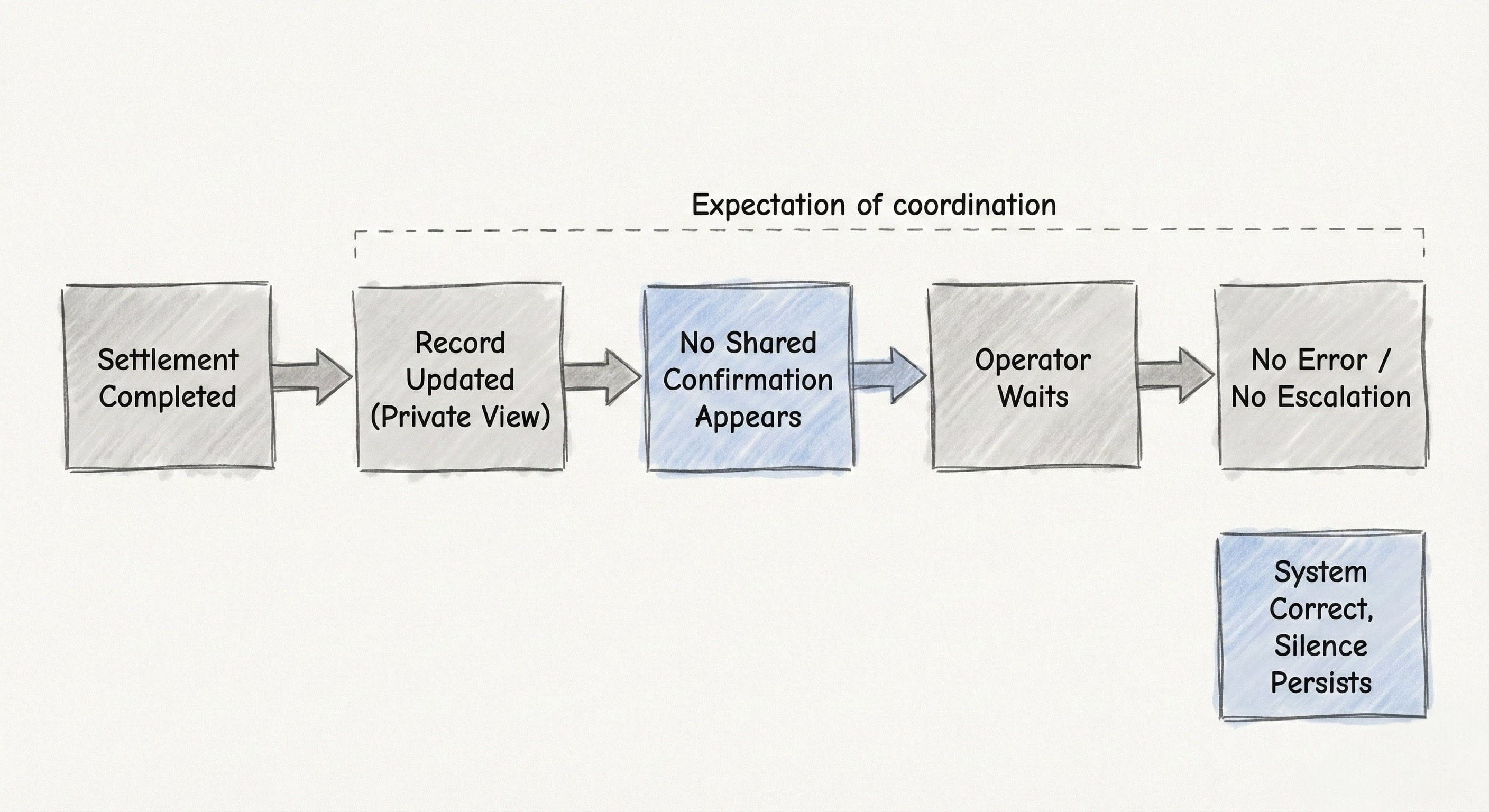
Not because something failed. Because nothing else appeared. No secondary signal. No shared confirmation. The system did what it was supposed to do, and then stopped speaking.
In institutional RWA settlement via DuskTrade (#Dusk ), completion does not announce itself. It arrives quietly, scoped to role and permission. The confirmation exists, but it is not global. It is private. It belongs to a specific view.
The operator checks again. Same state. Same finality.
Normally, coordination happens in the margins a follow-on action, a mirrored update, a small acknowledgment that tells everyone it is safe to move. Here, that margin is absent. Dusk Privacy holds it back. The workflow continues, but confidence becomes individual instead of shared.
Time passes, but not enough to justify intervention.
To pause formally would require escalation. Escalation would widen disclosure. Widening disclosure would change who is allowed to know what, and when. Nothing in the rules demands that step yet.
So routing proceeds.
Payment is booked as aligned. Delivery is assumed to be converging because nothing contradicts that assumption. The system remains correct inside every boundary it enforces.
Elsewhere, another role is watching a different surface. They see movement, but not closure. The confirmation they need exists, but outside their permitted scope. They cannot pull it forward without changing the file. They do not block, because blocking requires a reason that can be stated without breaking Dusk privacy.
Both sides act correctly.
They just act on different clocks.
By the time alignment is certain, the timestamps no longer match. Settlement on Dusk is already treated as complete. Delivery confidence forms later, under a separate entitlement. No error appears. No rule is violated. There is simply no single moment both sides are allowed to call “the point of certainty.”
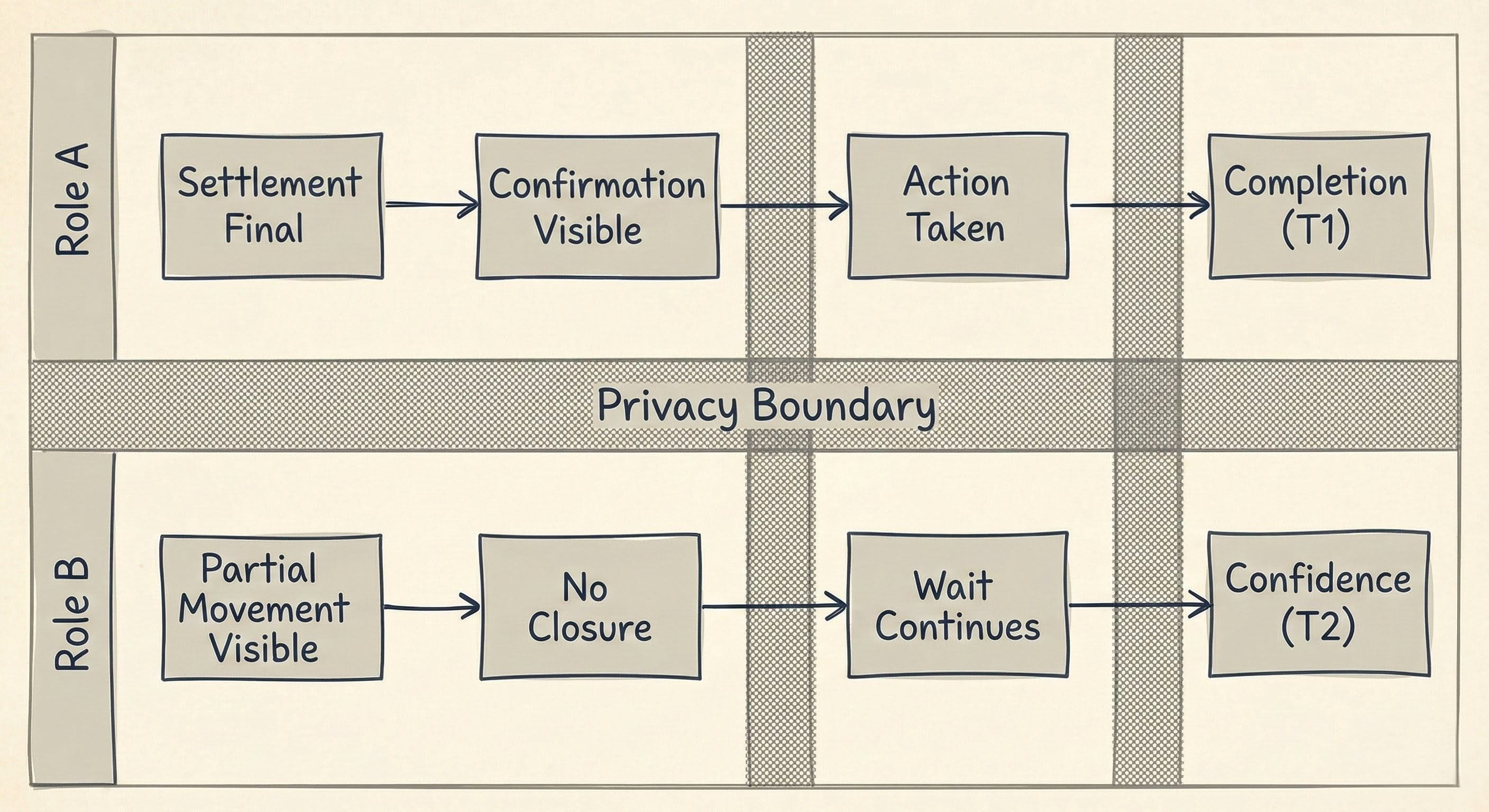
When the sequence is reviewed later, discussion centers on when action was taken, not what happened. Each step was valid. Each decision was compliant. The gap sits between them.
Before the next cycle, a change is introduced. A requirement to document the basis for release earlier in the process, while disclosure boundaries still match. Not because settlement failed.
Because coordination needed something privacy had removed.
