

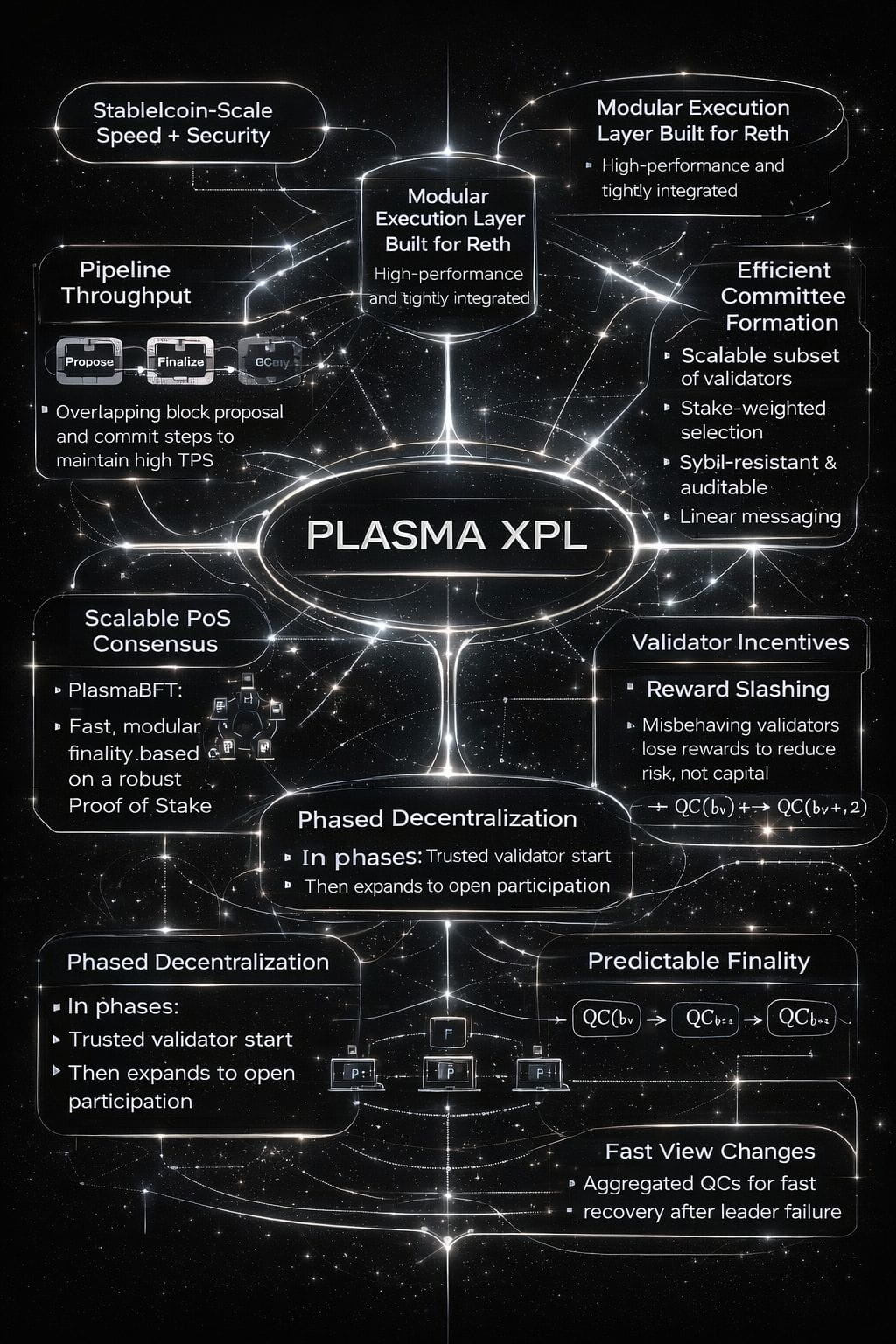
Plasma XPL is engineered around one simple goal: make blockchain finality feel as instant and reliable as traditional finance—without sacrificing decentralization and security. While most networks try to optimize either throughput or safety (and end up compromising on user experience), Plasma XPL approaches the problem from the base layer: it hard-wires performance into consensus itself, then aligns validator incentives so the network behaves predictably under real-world load.
At the center of this design is a dedicated consensus engine known as PlasmaBFT—built to deliver fast, deterministic finality and the kind of system stability required for stablecoin-scale applications where seconds matter, delays are expensive, and uncertainty kills trust.
The Core Idea: High-Performance BFT Finality That Doesn’t Break Under Load
Plasma is secured by PlasmaBFT, a high-performance implementation based on modern BFT research and optimized for minimal overhead. What makes this important is not just speed—it’s certainty. BFT-style consensus provides deterministic guarantees: once a block is finalized, it is final. No probabilistic waiting, no “maybe reorg,” no nervous confirmations.
PlasmaBFT is structured to achieve block finality in seconds with reduced communication overhead. Instead of forcing every validator to message every other validator (which becomes a performance bottleneck as networks scale), Plasma applies an approach that keeps the consensus pipeline tight and efficient, enabling reliable throughput at a level stablecoin ecosystems can actually use.
In practical terms, this means Plasma XPL is built for the kind of activity where users expect the chain to behave like infrastructure—not an experiment. Payments, settlement, high-frequency flows, institutional routing: these use cases don’t tolerate randomness.
Modular Consensus Meets Reth-Based Execution: Performance by Architecture
A major strength of Plasma XPL is that the consensus layer is designed to integrate tightly with a modern execution layer based on Reth architecture. This matters because many chains improve consensus but leave execution as the limiting factor, creating a mismatch between “blocks produced fast” and “transactions processed slow.”
Plasma takes the opposite approach: consensus is modular, built to work cleanly with execution so that finality speed, validator coordination, and transaction processing don’t fight each other. This integration is one reason Plasma aims for “stable performance,” not just impressive lab numbers.
What comes out of this is a chain that doesn’t rely on hype metrics. Plasma XPL is tuned to behave consistently when users actually show up.
Committee Formation: Scaling BFT Without Quadratic Slowdown
One of the biggest technical challenges in BFT systems is communication complexity. If every validator must communicate with every other validator, message volume can rise rapidly and choke the network as validator counts grow.
Plasma solves this through committee formation. Instead of requiring the full validator set to participate in every round, PlasmaBFT selects a subset of validators to form a committee for each round. This drastically reduces messaging overhead and avoids the “all-to-all” quadratic problem that can quietly destroy performance in classic consensus models.
Committee selection follows a cryptographically secure, stake-weighted random process. That’s important because it means the selection is deterministic and auditable while still being resistant to Sybil behavior. In other words: the network can prove the committee wasn’t chosen unfairly, and attackers can’t cheaply manipulate selection.
There’s also a practical advantage here: each validator in the committee is known in advance for the round. That enables efficient signature verification, faster detection of equivocation, and smoother block production without extra coordination friction.
Quorum Certificates: The Engine of Deterministic Finality
Plasma’s consensus uses Quorum Certificates (QCs) as a core building block. A QC is formed when a quorum of validators signs off on a proposed block. These certificates don’t just confirm agreement—they create cryptographic proof that the network has reached consensus on the chain’s state.
This QC chaining is what gives Plasma XPL its deterministic finality properties. When consecutive QCs build forward, finality becomes mathematically enforced, not socially assumed.
The safety rule follows a familiar BFT threshold: the network requires enough validators to tolerate Byzantine behavior. As long as malicious validators remain below the tolerated threshold, two conflicting blocks can’t both be finalized. This isn’t marketing—it’s security logic.
PlasmaBFT Speed Secret: Pipelining for Real Throughput
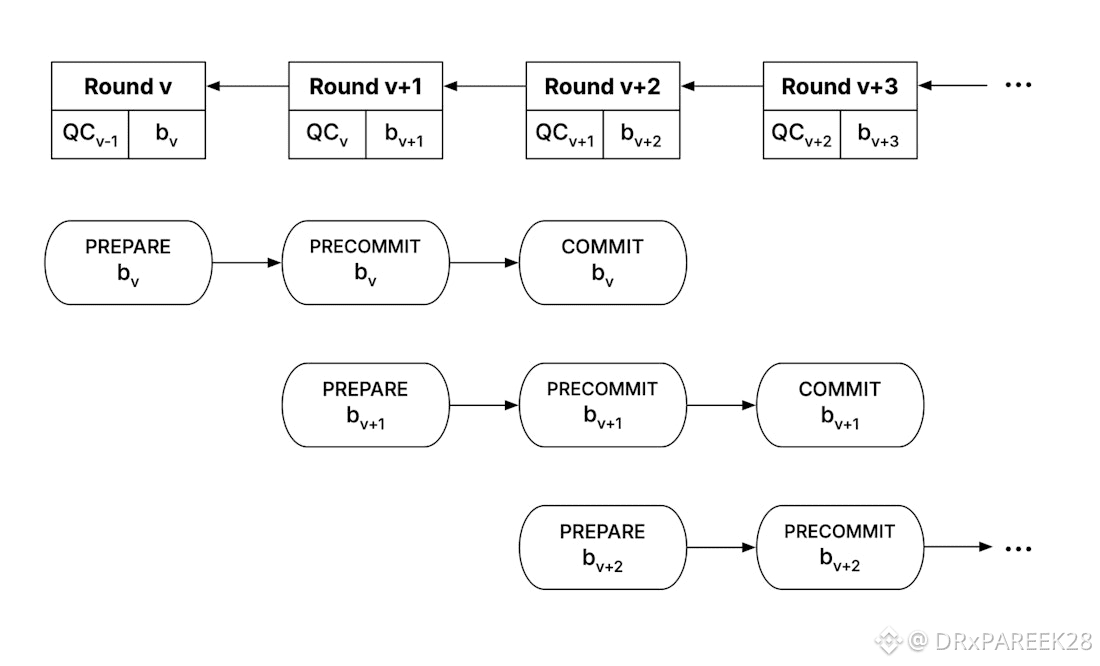
PlasmaBFT supports pipelining, which is a major reason it can sustain high throughput. The idea is elegant: instead of waiting for one block to fully commit before proposing the next, Plasma overlaps phases of block proposal and finalization.
This keeps the chain “always moving,” which is exactly what stablecoin-scale systems need. With pipelining, the network can propose a new block while the previous one is still in the commitment stage, increasing throughput by reducing idle time.
This is how Plasma avoids becoming sluggish as transaction flow rises. It’s not just “fast blocks,” it’s continuous momentum.
Safe Recovery Under Failure: View Changes and Aggregated QCs
No consensus system is complete without handling the hard moments—leader failure, network instability, or partial outages. PlasmaBFT includes a clean mechanism for view changes, ensuring the network remains live while preserving safety.
When a leader fails or a view change occurs, Plasma uses aggregated quorum certificates (AggQCs). Validators forward their most recent QC to the new leader, who aggregates them into a single proof that establishes the highest known safe block. This allows progress to resume quickly without sacrificing correctness.
A key point: this approach aims to achieve the same safety objectives as other certificate-based schemes, but with fewer signature validations. That means recovery stays efficient rather than becoming a bottleneck.
Validator Incentives That Match Real Finance: Reward Slashing, Not Stake Destruction
One of the most unique parts of Plasma XPL is how it handles validator punishment. Many PoS networks rely on punitive stake slashing: validators can lose capital due to misbehavior or failure. While this can enforce discipline, it also introduces extreme operator risk—and institutional participants typically dislike unpredictable capital loss.
Plasma intentionally avoids stake slashing and instead uses reward slashing. In simple terms: validators who misbehave or fail to participate lose block rewards, not their principal.
This design reflects three powerful objectives. First, it reduces user risk because validators can’t be wiped out unexpectedly. Second, it aligns with real-world incentive systems: poor performance leads to lower returns, not financial destruction. Third, it encourages rational behavior—because the “cost” of misbehavior is directly tied to missed earnings.
This is not just softer economics. It’s an adoption strategy. Plasma wants serious operators and long-term reliability, and it understands what kind of incentives those players accept.
Validator Selection: Simplified Proof of Stake for Predictable Behavior
Plasma uses a Proof of Stake model optimized for simplicity and predictable behavior, not unnecessary complexity. Validators earn rewards by participating in consensus and signing blocks. Misbehavior leads to reward denial, which keeps incentives clean and easier to reason about.
Plasma is also exploring optional no-lock staking, which would allow stake withdrawals without delay. If implemented safely, this could become a major UX win, especially for operators who want flexibility without long unbonding periods.
Rollout Strategy: Decentralization Through Phases
Plasma’s consensus rollout is staged in three phases, and this is another sign the project is focused on stability rather than rushing headlines.
The first phase begins with a trusted validator launch using a small group of known validators at mainnet start. This allows for stability and protocol iteration.
The second phase expands the validator set to test horizontal performance under larger committee sizes and validate throughput under load.
The third phase moves to permissionless participation, opening validator access to the public and achieving full decentralization while preserving protocol-level safety.
This phased rollout recognizes reality: decentralization is not a button you press. It’s a process you harden into existence.
Why Plasma XPL Feels Different
Plasma XPL is not trying to impress with vague claims. Its architecture shows intent: deterministic finality, modular integration, scalable committee consensus, pipelined throughput, efficient recovery, and incentive design compatible with institutional risk tolerance.
If the blockchain industry is serious about becoming real financial infrastructure, networks must behave like infrastructure. Plasma XPL is shaping itself to meet that standard—stable, fast, secure, and predictable—so that stablecoins, payments, and high-volume applications can scale without praying the chain keeps up.
That’s the real vision behind Plasma: turning high-frequency on-chain activity from a dream into a default.

