
I remember opening the docs with that familiar tired feeling, the one you get after reading the tenth “vision” in a row. Most whitepapers aren’t written to explain anything, they’re written to look like explanation. You can feel it in the first page, the careful words, the empty certainty.
Vanar didn’t hit me like a pitch. It felt more like someone left their workbench open and walked away. Not polished, not begging to be liked, just trying to show how the pieces fit. I didn’t get the sense it was written for people who clap. It read like it was meant for the small group who actually has to ship something and then live with it when it breaks.
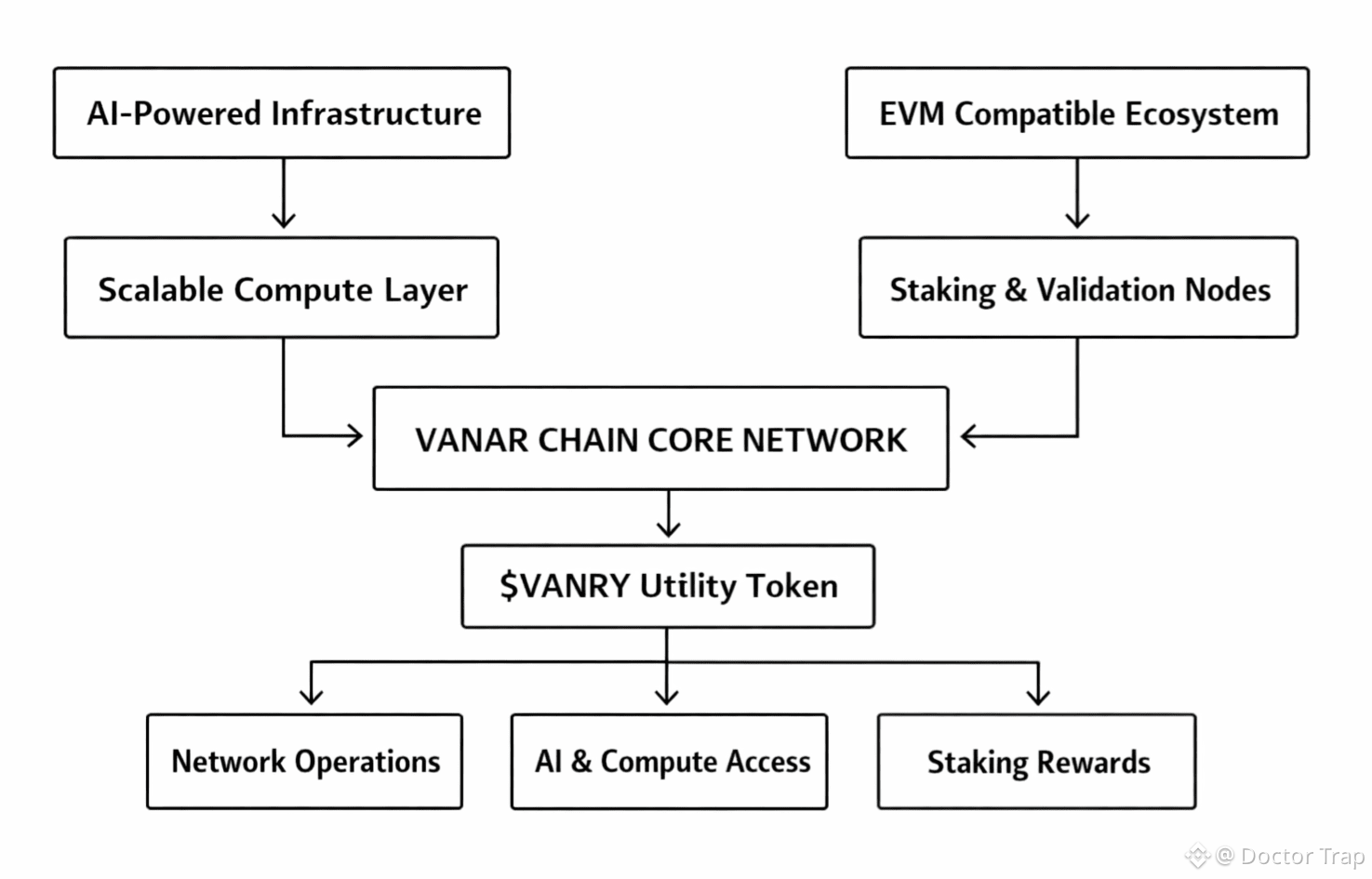
why ai-first feels deliberate, not decorative
When I dig into Vanar Chain’s design, I don’t get the sense that AI was added later to chase relevance. It feels closer to the spine. You can tell when a system expects sustained compute pressure. The choices become conservative in the right places.
Vanar prioritizes stable execution and predictable resource handling. That matters when workloads are continuous, not bursty. AI does not tolerate unstable infrastructure. It degrades slowly, then all at once. To me, Vanar seems built with that quiet failure mode in mind.
I keep coming back to how little they talk about this publicly. No theatrics. Just an assumption that the chain should hold up under stress. That mindset usually comes from people who have seen systems break before.
where vanry actually sits in the machine
I remember being skeptical about the token at first. After enough cycles, skepticism becomes muscle memory. But the more I looked, the more $VANRY felt integrated rather than ornamental. In my experience, tokens that last tend to be boring in their function.
VANRY is tied directly to staking, network participation, and access to execution resources. Nothing fancy. No clever tricks. Just a mechanism to align validators, users, and compute demand. I’ve noticed on-chain activity that looks steady instead of inflated.
Total value locked hovered around the low eight-figure range. Not dramatic. But consistent. That consistency tells me more than spikes ever do. It suggests usage that wasn’t bribed into existence.
engineering choices that suggest scars
Vanar Chain feels like it was built by people who dislike surprises. The EVM compatibility is there, but it’s controlled. That restraint prevents technical debt from spreading too fast.
I’ve watched networks collapse under the weight of features they could not maintain. Vanar’s recent upgrades leaned toward tooling, node stability, and developer ergonomics. Those things never trend. But they are what developers remember when things break at 3 a.m.
I’ve noticed fewer flashy announcements and more quiet improvements. Better SDKs. Cleaner execution paths. These are not things you build if you’re optimizing for headlines. You build them if you expect the chain to still matter when attention moves on.
partnerships that feel earned, not rented
Vanar Chain mentioned alongside serious infrastructure and AI-focused players and pausing. Not because of brand names, but because those ecosystems are unforgiving. They do not tolerate fragile systems.
Vanar’s partnerships make sense technically. They point toward compute-heavy use cases like gaming, immersive media, and AI-driven content pipelines. These domains punish latency and instability.
I’ve watched plenty of partnerships announced for optics. These felt quieter. More practical. The kind that comes from teams testing things privately before speaking publicly.
closing thoughts, without illusions
I’ve been around long enough to know that narratives age badly. Infrastructure ages slowly. Vanar Chain strikes me as something built to age, not explode. That is not exciting, but it is honest.
People eventually ask about price. I look at VANRY’s market behavior only briefly. In my experience, price is the least reliable signal in the short term. It reflects mood more than reality. What matters is whether the chain keeps doing its job when nobody is watching.
What keeps pulling me back to Vanar Chain is that it does not seem afraid of silence. It feels comfortable quietly building, under the surface, choosing depth over breadth, and putting infrastructure first.
The strongest systems rarely ask to be noticed.
