
On paper, sending USDT should feel like sending dollars, but in practice, even seasoned cryptocurrency users still have to deal with the same annoyances repeatedly.
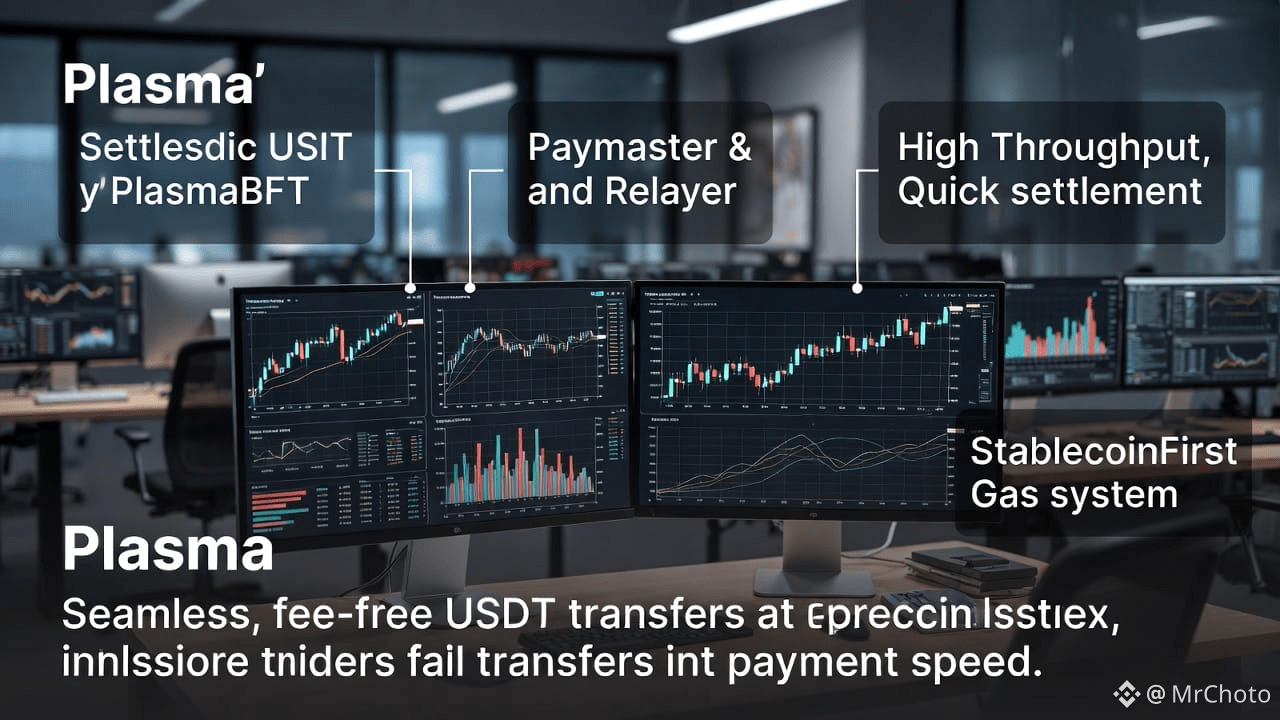
For example, when you want to send $40 to a friend or pay a supplier, you start thinking about gas, network congestion, which chain has liquidity right now, whether the recipient is on the right transport layer, and whether your "simple transfer" will settle in seconds or crawl for minutes. This friction is minimal when you're moving trading collateral once a week, but it becomes a daily issue when stablecoins are used for real money.
Plasma is attempting to close that gap. The fundamental tenet of the project is straightforward: stablecoins should move at payment speed rather than "blockchain speed." Additionally, Plasma is built with stablecoin settlement as its main goal rather than creating a general-purpose chain that also supports stablecoins. According to their own stance, Plasma is a high-performance Layer 1 designed especially for international USD₮ transfers.
Marketing isn't the most crucial factor for traders and investors. It is the reasoning for the design: Stablecoin transfers are the primary transaction type handled by Plasma, with all other types being secondary. This is significant since stablecoins have surreptitiously emerged as the biggest practical application of cryptocurrency. With hundreds of billions in supply and trillions in annual transaction volume, stablecoins constitute a vast economic layer that is already serving as global settlement rails for many users, according to even mainstream reporting.
What does "payment speed" mean in this context, then?
Using a consensus mechanism they refer to as PlasmaBFT, which is based on Fast HotStuff, Plasma's architecture aims for quick settlement and high throughput. They assert that it is designed to handle thousands of transactions per second. They also list block times of less than 12 seconds as part of the network's performance profile on their chain overview. These figures are more important as reliability indicators than as boasting points. When the network is overloaded, payments require constant finality rather than a theoretical maximum TPS.
But speed isn't Plasma's most intriguing move. It's fees, or more precisely, the effort to give users the impression that stablecoin transfers are fee-free.
The protocol-level mechanism (a paymaster/relayer design) described in Plasma papers sponsors gas for valid USDT transactions, including gas for basic transfer and transferfrom calls subject to rate constraints and identity-aware controls. To put it simply, the network attempts to cover the cost of a typical USDT transmission so that the user doesn't need to hold a separate token in order to transfer dollars.
That design decision is not insignificant. The "second asset problem," which requires regular users to purchase and keep a volatile gas token in order to send stable money, is one of the largest psychological obstacles to cryptocurrency payments. Because they already own a variety of assets, traders disregard this. However, that additional step is what separates adoption from abandonment in actual payments.
Plasma does not, however, maintain that everything may be free indefinitely. Plasma describes its strategy as "stablecoin-first gas," which means fees can be paid in stablecoins rather than compelling users to separate asset management, and even positive remarks about the project concede that smart contract interactions and more complicated flows will still require fees. Paying expenses in the currency you're using rather than in a different commodity is more in line with how payments operate in the real world.

From an investor's perspective, this is the true thesis: Plasma is wagering that everyday settlement—remittances, payroll, merchant payments, cross-border supplier invoices, and on-chain treasury movements that seek cost predictability and less operational complexity—will be the primary focus of the next stablecoin wave rather than DeFi leverage.
This is important, as demonstrated by a straightforward real-world example.
Consider a tiny Bangladeshi online retailer who purchases goods from vendors abroad. Because USDT settles more quickly than bank wires and eliminates FX issues, the supplier accepts it. Crypto ideology is irrelevant to the merchant. Two things are important to them: the payment is made promptly and the expenses don't suddenly increase.
That cost predictability breaks at the worst time on a lot of chains these days. When networks are "busy," which frequently refers to market volatility—exactly when companies might need to transfer money quickly—fees increase. By giving stablecoin transfers priority at the protocol level rather than viewing them as just another token transfer that competes with everything else, Plasma hopes that a stablecoin-native chain can ease that experience.
Liquidity behavior is another second-order effect that traders should be concerned about.
Stablecoins become "stickier" on a network if it has strong stablecoin liquidity and a seamless transfer user experience. It is anticipated that more than $1 billion in USD₮ worth of plasma documentation will be ready to go from day one. The market will confirm whether that precise figure is accurate, but the approach is obvious: boost liquidity to make payments feel deep and immediate rather than thin and dispersed.
Plasma should not be viewed as "the next smart contract chain." A specialized settlement rail is nearer. Additionally, because dependability is more crucial than vibes, specialist trains frequently triumph covertly in the financial industry.Risks do exist, of course, and serious investors ought to view them as essential rather than incidental.
First off, "gasless transfers" are never really free; someone has to pay for them. According to Plasma's documentation, the paymaster system has rate restrictions, identification checks, and eligibility criteria to guard against misuse. This includes operational control, governance, and policy choices. It is important for traders to know who sets the regulations and how consistent they are over time.
Second, the stablecoin settlement market is fiercely competitive. Tron dominates USDT transfers in many areas, Ethereum is reliable and liquid, and other L2s and payment-focused chains are continuously promoting fee reductions. Plasma must succeed not only in terms of cost and speed but also in terms of ease of use and scalability.
Stablecoins are already money for millions of people, but the infrastructure still acts like a developer's playground. Nevertheless, if you take away the noise, Plasma's concept is easy to respect. Stablecoin movement should be boring, quick, predictable, and operationally clean, according to Plasma.
Additionally, "boring" is typically the aspect of payments that causes things to change. #Plasma $XPL

