
I realized that Web3 gaming was never meant to be about flipping JPEGs when I heard a gamer declare, "I don't care about crypto, I just want my items to stay mine." It was meant to be about normal-feeling ownership. not based on ideology. Not difficult. Simply put, fair. And if you've been keeping an eye on the market long enough, you are aware that when something starts to become "normal," it usually gets enormous.
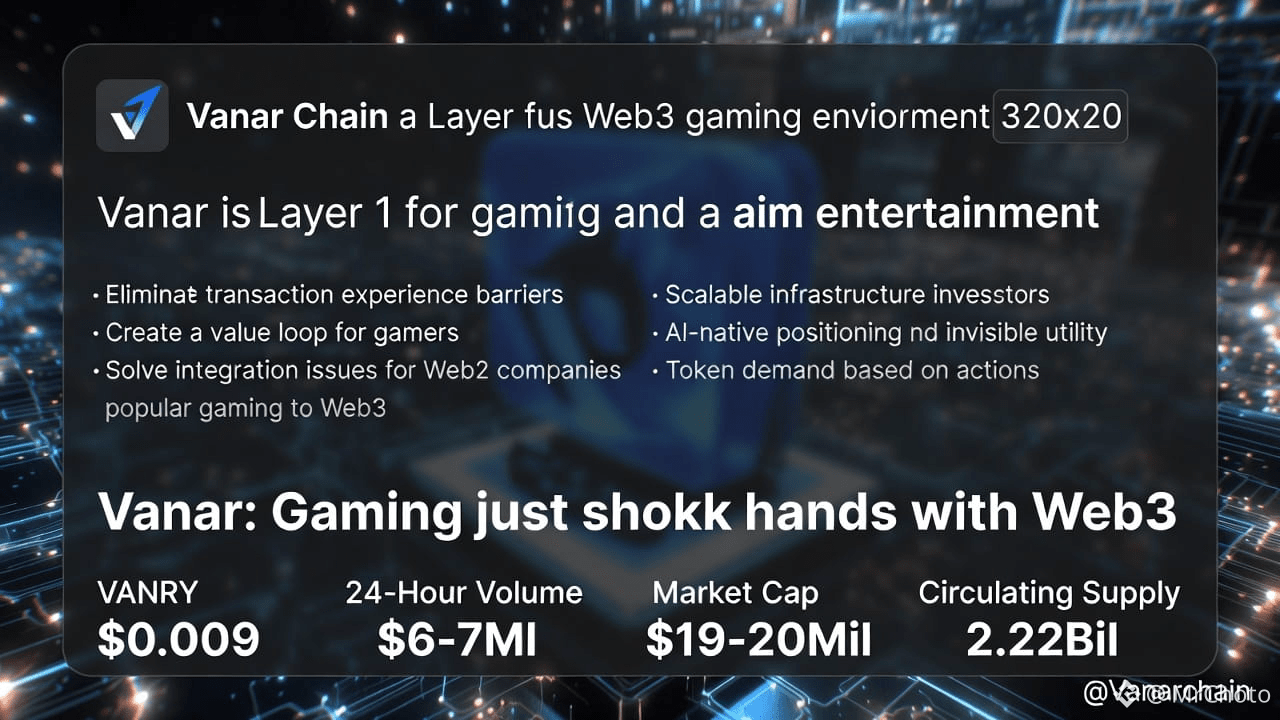
The title "Vanar: Gaming just shook hands with Web3" is effective because of this. Because gaming isn't joining cryptocurrency right now. Crypto is being forced to act like actual infrastructure by gaming.
The opportunity is more than just "another gaming chain" for traders and investors. One of the few industries on the planet that already has a deeper understanding of digital economies than the majority of financial markets is gaming, which presents an opportunity. For more than 20 years, gaming has existed inside a sophisticated micro-economy that includes skins, cosmetics, in-game currencies, marketplaces, creator economies, seasonal demand cycles, whale behavior, bot activity, anti-cheat police, and the psychology of scarcity. In essence, Web3 is entering an established economic environment and asking, "What if we make the ownership layer portable and provable?" Vanar places itself precisely at that moment of the handshake.
In its own whitepaper, Vanar Chain characterizes itself as a Layer 1 intended for "gaming and entertainment." That phrase is important. Not "everything for everyone," not "general purpose." The location where millions of transactions may occur quickly, regularly, and emotionally—where consumers don't want to worry about wallets, gas costs, bridges, or confirmations—is its aim. The entire narrative, according to Vanar's whitepaper, is about adoption friction: despite blockchain's more than ten years of development, industries like gaming, the metaverse, microtransactions, and other consumer use cases continue to face obstacles. 3
Many investors overlook this aspect. For the acceptance of cryptocurrencies, gaming is not "nice to have." It's a test of stress. It's where blockchains go to either gain exposure or demonstrate their ability to manage actual consumer scale.
What role does Vanar play in the present Web3 gaming environment?
Let's be realistic. Three issues have historically plagued Web3 gaming:
The transaction experience comes first. For traders transferring big sums of money, many networks function well, but gaming isn't like that. Minting, trading, crafting, upgrading, renting, tipping, rewarding, and burning are just a few of the thousands of small acts that make up gaming. Users depart if each one feels like a small bank transfer.
The "value loop" comes in second. Many Web3 games produced marketplaces that gave early speculators greater rewards than actual players. That temporarily improves the appearance of charts, but it destroys retention. Grinding is not a problem for gamers. They detest being taken advantage of.
The integration issue comes in third. A firm of video games wants to ship. They have no desire to become into a blockchain research facility. Studios steer clear of integration if it's not easy and affordable.
By design, Vanar's strategy is to eliminate these barriers and draw Web2 companies and gamers into Web3 without making them become crypto natives. The smooth transition from popular gaming to Web3 is emphasized in Vanar's own ecosystem messaging.
Now, as a trader, "design" only matters if it generates quantifiable demand. Let's return to the realities of the market.
According to the most recent live market statistics, Vanar Chain's token (VANRY) is trading at about $0.009, with a 24-hour volume of about $6–7 million, a market capitalization of about $19–20 million, and a circulating supply of roughly 2.22 billion tokens (maximum supply of 2.4 billion). It's small-cap territory. In other words, there is more upward potential but also more fragility. It can react quickly to partnerships, news, or changes in liquidity. If attention shifts away, it may potentially be crushed.
What, then, is this "unique angle"?
I don't think Vanar is primarily focused on games. Many initiatives make that claim. The intriguing aspect is that Vanar is now moving toward a more comprehensive infrastructure story, which includes AI-native infrastructure positioning on its main website in addition to gaming and entertainment. It shows a survival instinct that is actually bullish for long-term sustainability, regardless of whether you believe in that expansion. Because Web3 gaming on its own is extremely cyclical. Gamers purchase entertainment rather than tokens when the market is down. Everything that has the word "gaming" in it rises when the market is bullish. A chain must endure both stages if it is to be durable.
However, the actual question becomes easier for investors:
Is it possible for Vanar to produce actual on-chain activity independent of speculative rotation?
That's why gaming is such an effective testing ground. VANRY demand will be more in line with usage demand than narrative demand if Vanar can support games where players transact on a daily basis without thinking, "I'm using crypto." Invisible utility is the ultimate goal.
Consider a Southeast Asian mobile game that is competitive. Players exchange cosmetics with friends, upgrade goods once a week, and receive little prizes every day. The item database in Web2 is under the developer's control. Marketplaces close, accounts are blocked, items vanish, and gamers essentially rent their virtual lives.
Now flip it: the player never sees gas or seed words, but items and balances are there on the chain. They simply use well-known techniques to log in. Trades settle right away. Items can be sold on external marketplaces or utilized in partner games. A top player has the ability to pay out value that they truly earned.
That's dignity if you're a gamer.
It's a scalable transaction economy if you're an investor.
And that's what you want if you're a trader: a token whose demand is determined by actions rather than catchphrases.
Let's avoid romanticizing it, though. There are risks.
When gaming chains are unable to draw in actual studios, they fail. When they turn into barren "tech stacks" devoid of game-changing apps, they perish. When token incentives are set up incorrectly and draw in mercenary users, they perish. And they perish when there is insufficient liquidity and serious participants are deterred by volatility.
Therefore, don't question, "Will gaming go Web3?" when examining Vanar through a mature lens. In slow motion, that is already taking place. Inquire:
Are games starting to want to live in Vanar?
Is the chain creating a moat for developers?
Is the increase in on-chain activity a result of real users rather than just token campaigns?
Does VANRY play a crucial or interchangeable role in the ecosystem?
The "handshake" in the title becomes more than just a lovely phrase if you can provide proof to support your answers over time. It turns into a theory that you can genuinely invest in.
Ultimately, gaming doesn't embrace technology just because it's cool. When technology gives players greater control, fairness, status, or freedom, gaming adopts it.
Web3's role is to blend in with that experience.
According to Vanar's prediction, it might be the chain beneath that imperceptible layer where digital ownership finally becomes normal enough for millions of players to stop debating cryptocurrency and just start utilizing it.#vanar $VANRY
