
It wasn't the token talk or the tech blog posts that initially drew my attention to Walrus. It was due to storage math, which is duller and more truthful.
Decentralization is often discussed as an ideology in the cryptocurrency community. However, decentralization turns into a spreadsheet problem as soon as you attempt to actually build something. How much does data storage cost? How long? What happens if a node is unavailable? What would happen if there was an increase in demand? Is it possible to forecast costs without waking up to a bill that appears to be a liquidation?
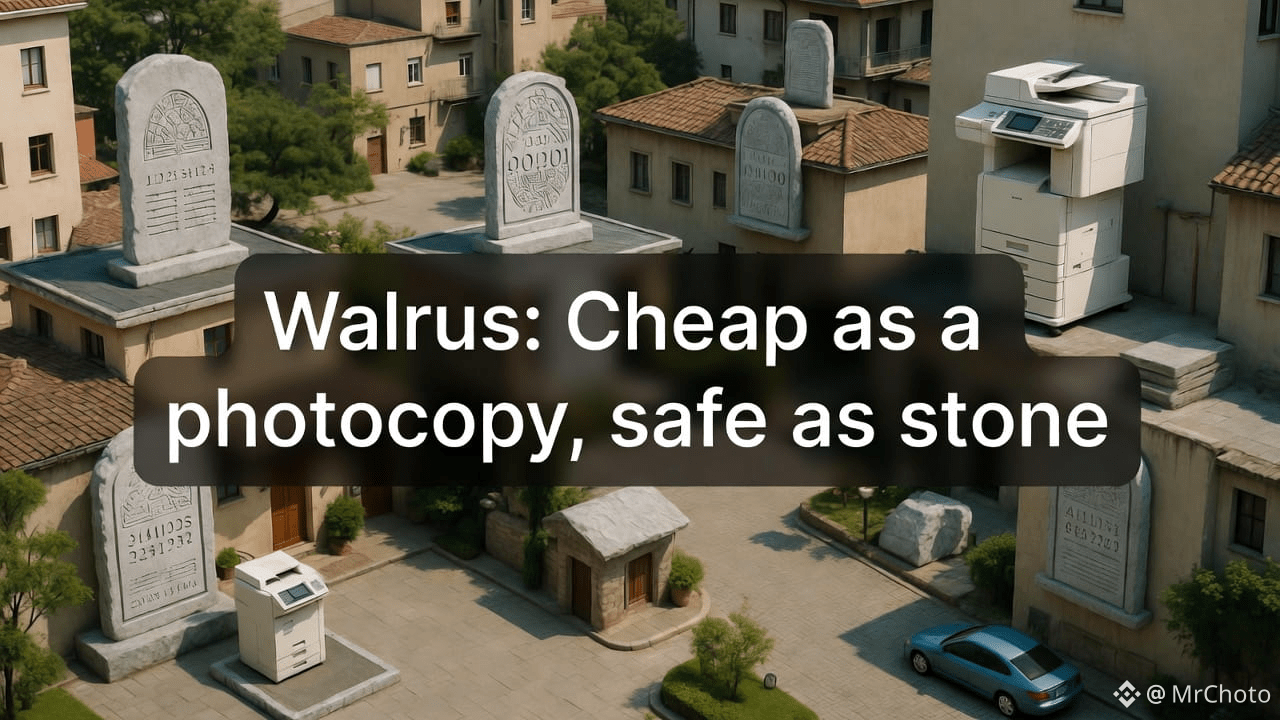
The slogan "Walrus: Cheap as a photocopy, safe as stone" is therefore more accurate than it first appears. It goes beyond branding. Making decentralized storage feel more like infrastructure than an adventure is an implied claim that the market has been silently failing at for years.
The unsettling reality is that the majority of Web3 products are only decentralized in areas where money is transferred. Images, information, postings, datasets, and media files continue to reside in locations that exhibit typical Web2 server behavior and Web2 dangers. Links break. Buckets are misconfigured. Rules are altered by platforms. History is lost by communities. Additionally, you rapidly discover that while the chain may be unbreakable, your application's memory is not if you're developing anything where data is important.
Walrus are there to target that vulnerability. It is a decentralized storage and data availability protocol that was first developed by Mysten Labs and centered on the Sui ecosystem. It was created especially for huge unstructured files, or "blobs." The basic notion is straightforward but challenging to implement: store large amounts of data among numerous operators in a way that is both affordable for daily use and durable enough that "node outages" cease to be existential. Because each storage node only uses a small portion of the resources compared to the blob size, Mysten clearly described this as cost-effective blob storage that scales better as the number of storage nodes increases.
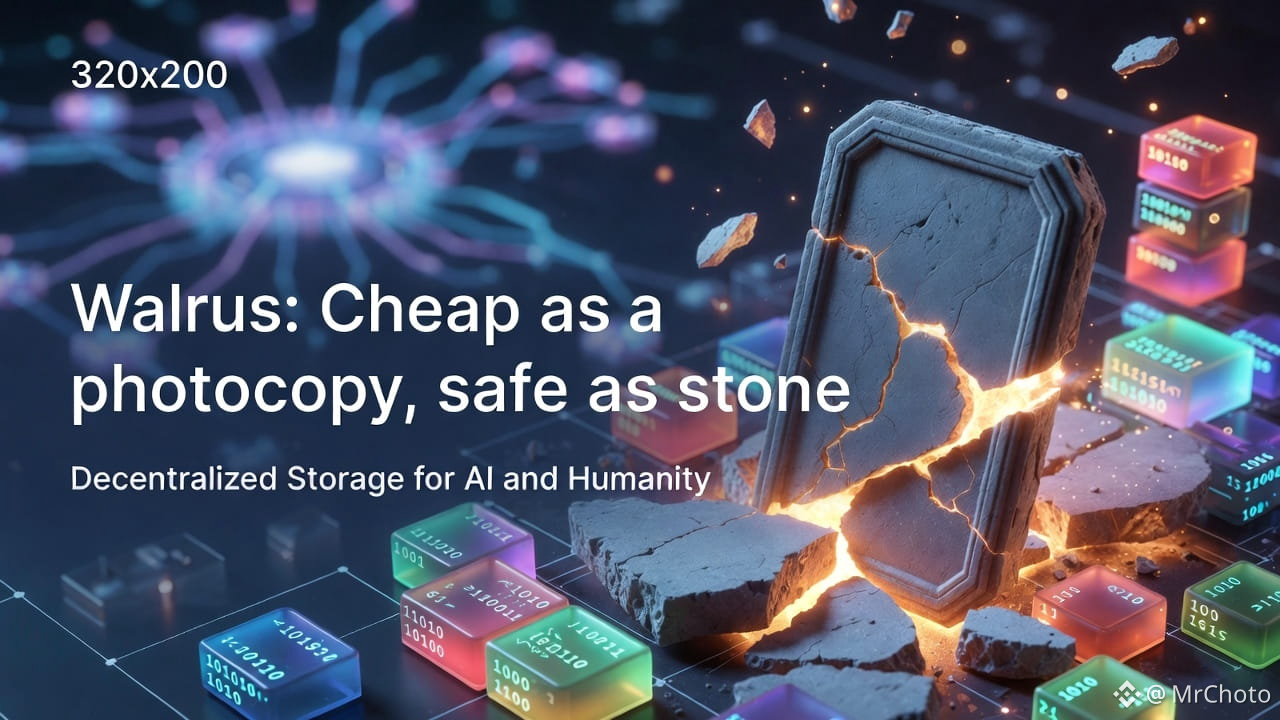
This is the technical part of the photocopy line.
A photocopy is cheap because the cost of reproduction is predictable. Paper plus toner plus time. It doesn’t suddenly become 10x more expensive because one manufacturer changed policy, or because you hit a popularity threshold. Decentralized storage historically hasn’t worked like that. It tends to swing between “cheap but unreliable” and “reliable but priced like a luxury product.”
Walrus tries to flatten those extremes using erasure coding, which is basically the difference between “store five full copies of a file” and “split the file into encoded fragments so you can reconstruct it even if some fragments disappear.” If you’ve never touched this stuff before, picture taking a stone tablet, carving it into pieces, and distributing those pieces across a town. You don’t need every piece to recover the message. You just need enough of them. Underneath, that’s the trick: redundancy without full duplication.
The “safe as stone” part doesn’t mean nothing breaks. It means the system is designed so breakage doesn’t matter as much.
The larger point, however, is what the code makes economically possible. The protocol can increase durability without driving costs into ridiculous territory if storage providers just need to store pieces and can yet ensure recoverability. Walrus's design aims to reduce storage overhead per node as the network expands, and it is specifically designed to handle uploading gigabytes at a time at low cost.
Storage is more than just "data sitting somewhere," hence this is important. Storage poses a risk. It is still going on. It's rent. Additionally, long-term cost predictability makes the difference between acceptance and abandonment when developing for traders, investors, or producers.
The token mechanisms of Walrus are based on this fact. WAL is the payment token for storage, however according to Walrus, the payment system is specifically built to guard against long-term swings in WAL prices and maintain consistent storage costs in currency terms. For a predetermined amount of time, payments are made up front and then dispersed over time to stakers and storage nodes.
Walrus is attempting to make storage feel more like a utility payment than a risky venture, which is a little sentence with a large consequence.
And the tension in the market right now is precisely in that "utility vs. speculation" debate.
According to the most current market statistics, WAL has a market valuation of between $210 million to $220 million, a 24-hour trading volume of about $11 million, and is trading in the $0.14 region (seen across multiple major trackers). These figures don't indicate that Walrus has "won" anything yet, but they do reveal something about market positioning: it's small enough to remain narrative-driven, liquid enough to draw traders, and priced low enough to trigger retail psychology (the "cheap coin" bias is real, even when people act otherwise).
However, the price isn't the true story. It's the discrepancy between the perceived and actual costs of decentralized storage.
According to one post on Binance Square, storing 5GB on Walrus under 5x encoding resulted in roughly 28–30GB of storage after overhead. The author approximated expenditures per epoch (14 days) based on a WAL price of about $0.15 at the time. Even if that isn't considered official protocol accounting, it shows something crucial: users aren't initially shocked by the fact that Walrus is difficult. "Walrus is honest" is the phrase. The technology does not conceal the cost of redundancy behind vibrations.
This is where the majority of superficial interpretations fall short. They perceive "overhead" and presume inefficiency. However, the true cost of safety is overhead. Tablets made of stone are hefty.
Whether Walrus is purchasing the appropriate level of security is the analytical question.
Walrus is a storage network at the surface layer. You pay for time, upload and retrieve blobs, and the system keeps your data.
Walrus is actually a three-group coordinating mechanism underneath:
1. Users seeking consistency,
2. Yield-oriented storage operators,
3. Those who own tokens and want the system to seem more like infrastructure than a joke.
Programmable storage linked to a onchain environment (Sui-first, but they characterize the purpose as broader) is made possible by it, which is important for applications where "the file" is not static. Games require assets, trading communities require persistent media, AI agents require datasets, and DeFi dashboards require substantial offchain-like data without relying on AWS. Walrus itself adopts this idea of "data markets for the AI era."
And it is a significant change. because storage was handled like an archive issue in the previous cycle. Storage is handled as an application runtime issue in this cycle. A dataset is continuously accessed in addition to being saved. A model is updated in addition to being trained. A community is coordinating sentiment, not just sharing memes.
However, the danger layer is just as real.
Economics is the first clear risk. The pricing model is put under pressure if Walrus is successful because of the increased demand for storage. Walrus claims that their goal is to normalize storage prices denominated in fiat currency, but that's not magic. In order for operators to continue supplying without WAL becoming into a precarious balancing act, the protocol must carefully adjust issuance, rewards, and payments.
Narrative dilution is the second danger. There are already strong-branded incumbents in decentralized storage. Filecoin has an industrial vibe. Arweave seems to last forever. Walrus, on the other hand, is more affordable, programmable, and Sui-integrated. However, because consumers don't tolerate storage surprises, "cheap" is a promise that the market will penalize if it fails. In DeFi, people put up with fees. Infrastructure bills infuriate them.
Behavioral risk is the third. Even if they don't appreciate items, traders nonetheless adore tokens. Adoption signals may be drowned out by speculation drawn to WAL due to its substantial liquidity. Prior to mainnet launch, Walrus raised $140 million in a token sale, according to CoinDesk, and mainnet scheduling was a significant narrative moment (March 27, 2025). Infrastructure doesn't expand in spikes, but those moments cause attention spikes. It increases steadily. Earned adoption resembles use charts that irritate you because they are uninteresting rather than a candle.
I keep returning to the title because of this. "Safe as stone, cheap as a photocopy."
It does not imply that Walrus is flawless. It implies that Walrus is aiming for the dull combination of known costs and survivable failure, which is what makes systems real.
The deeper ramifications go beyond storage if Walrus succeeds. It suggests that data will no longer be treated as an attachment in the upcoming generation of cryptocurrency apps. With its texture and longevity, data becomes a part of the onchain foundation, something that developers can presume will exist in the future.
The insightful realization that resonates with me is that the next stage of Web3 will be determined by how long information can persist without consent, not by how quickly value moves.$WAL #walrus @Walrus 🦭/acc

