Decentralized storage is one of the most demanding challenges in modern technology. It must store massive amounts of data across many independent computers while remaining secure, fast, and reliable. Traditional systems like blockchains handle small amounts of data well, but once files become large, moving them around while keeping the system live becomes extremely complex. Walrus is a next-generation decentralized storage network that tackles this problem using a design known as a multi-stage epoch change protocol.
In many storage networks, any major change requires stopping activity, migrating data, and then restarting the system. This creates downtime and increases the risk of data loss or corruption. Walrus takes a very different approach. Instead of freezing the network, it splits reconfiguration into multiple stages. These stages overlap in a controlled way so the network can keep running while updates happen. The result is a system that can evolve continuously without breaking user access or data integrity.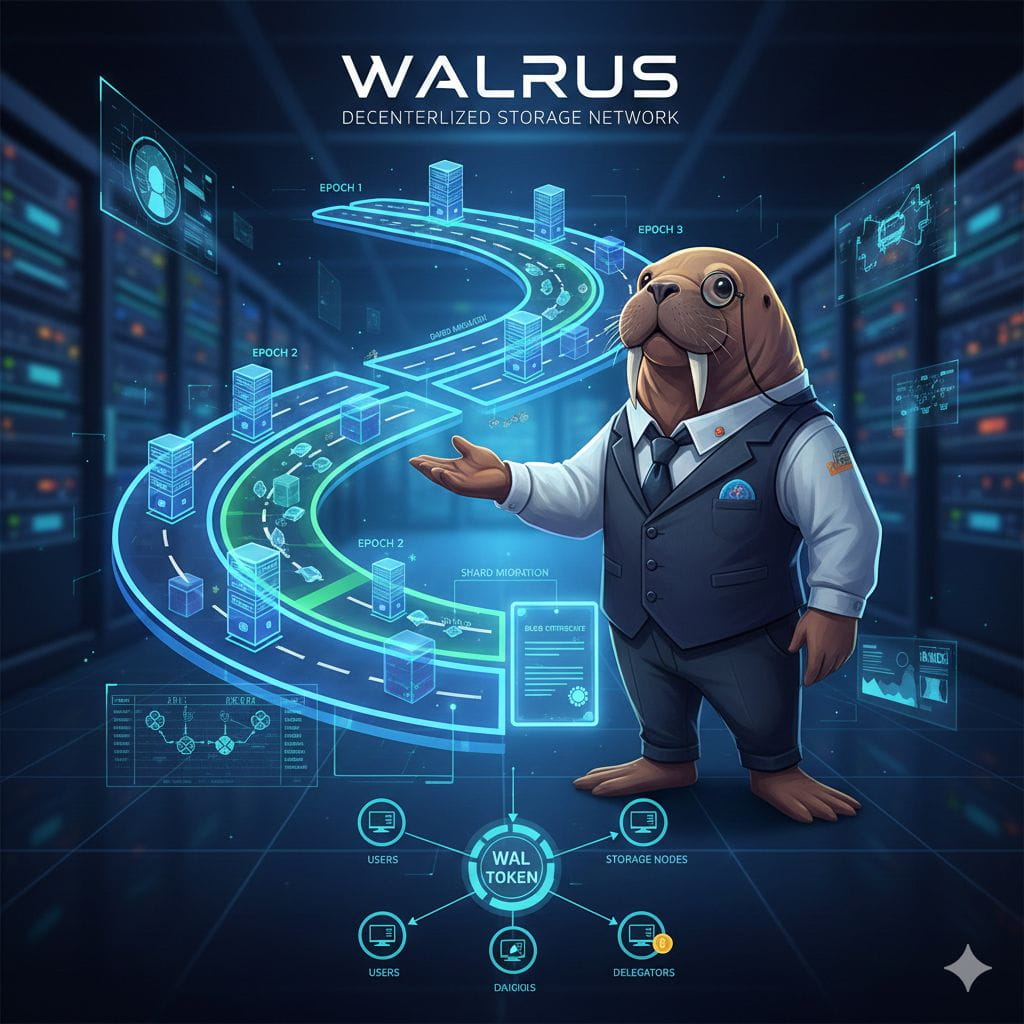
Walrus organizes time into clear periods called epochs. Each epoch defines which set of storage nodes is responsible for holding specific data. When an epoch ends, the network may reassign responsibility to a new group of nodes. Rather than switching everything at once, Walrus introduces these changes gradually through multiple steps. Data written during the old epoch remains protected under the old rules, while new nodes slowly prepare to take over. This ensures there is no interruption, no confusion about ownership, and no risk of losing data during the transition.
The system is designed with real-world conditions in mind. Delays, partial failures, and temporary outages are treated as normal, not exceptional. Some nodes may lag or go offline, and Walrus expects this behavior. Epoch transitions still complete safely without requiring every node to cooperate perfectly. Nodes work in quorums, and progress is driven by cryptographic proofs and threshold rules. This means the network does not rely on global coordination or blind trust. It continues functioning even when parts of the system are slow or unresponsive.
One of the most important design ideas in Walrus is separating logical responsibility from physical data movement. The epoch defines which nodes are accountable for a set of data, but the actual transfer and repair of that data happen gradually in the background. This prevents the entire network from being blocked by a few slow or faulty nodes. It also avoids the huge bandwidth and performance costs that come from trying to move all data at once.
During an epoch transition, normal activity never stops. Users can continue uploading and retrieving data while shard movement, recovery, and repair processes run in parallel. These overlapping stages keep the system live at all times and maintain both consistency and availability. From a user’s perspective, everything works the same way, even while the network is reorganizing itself behind the scenes.
Walrus stores large files, known as blobs, by breaking them into smaller units called slivers. These slivers are distributed across different nodes with built-in redundancy, so files can still be reconstructed even if some nodes fail. Each blob is backed by a certificate recorded on the blockchain, proving that the data exists and can be retrieved. This adds an extra layer of trust and security, because anyone can independently verify the data without relying on a single central party.
The multi-stage epoch change protocol makes Walrus strong in three critical ways. First, it prevents downtime, allowing the network to keep accepting new data and serving existing files while responsibilities shift. Second, it handles large volumes of data efficiently, because migration and repair happen incrementally instead of in massive, disruptive batches. Third, it is resilient to failures, since the system assumes some nodes will be slow or offline and still completes transitions safely.
Economic incentives are deeply integrated into the design through the WAL token. Users pay for storage using WAL, and storage nodes earn WAL for holding and serving data. Nodes can also participate in challenges and repair tasks to earn additional rewards. Token holders can delegate their WAL to storage nodes and share in the rewards. This aligns incentives across the network and decentralizes responsibility, encouraging honest behavior and long-term participation.
By using multi-stage epoch changes, Walrus maintains availability, consistency, and economic alignment even as the network grows or recovers from failures. Reconfiguration becomes a routine operation instead of a dangerous event. This allows the system to scale, evolve, and remain autonomous over long periods without downtime or centralized control.
In simple terms, Walrus is like a highway where new lanes can be added while cars keep moving. Traffic does not have to stop just to make improvements. This makes the system reliable, efficient, and capable of supporting large volumes of data and users at the same time.
Walrus is not just a research experiment. It is built for real-world workloads. It enables decentralized applications, AI services, and media platforms to store and retrieve files securely and continuously. The multi-stage epoch change protocol is the core of this capability, making Walrus a strong foundation for decentralized storage networks designed to last and scale over the long term.