

Walrus Roadmap, Unpacked: Building the Backbone of Web3 Data
Walrus isn’t out there chasing headlines, but honestly, it’s becoming one of the core pillars of Web3—think decentralized, verifiable, and scalable data availability. While other blockchains sprint to rack up transaction numbers or hop onto the latest DeFi craze, Walrus is taking its time and building something solid. It’s focused on laying down a foundation that’s strong enough for other networks, apps, and rollups to trust—no second-guessing, no shaky ground. Every step on the Walrus roadmap sticks to this idea: accuracy, resilience, and long-term utility matter more than flashy features.
Here’s what the Walrus roadmap looks like, stage by stage.
PHASE 1: Building the Core (Stability First)
Everything starts with a solid base. In this first phase, Walrus is all about nailing down a reliable core for data availability. No hype, just getting the fundamentals right.
The main goals:
Make blob storage actually work for big data sets
Use cryptographic proofs to guarantee your data’s there and untouched
Add fault tolerance so the system keeps running, even when something goes wrong
Keep execution layers totally separate from data layers
Walrus treats data as a first-class citizen. Instead of squeezing everything onto blocks and fighting for space, it stores and serves massive amounts of data efficiently—rollup transactions, state changes, off-chain proofs, even media-heavy Web3 apps can live here.
From the jump, Walrus chooses predictability and correctness over raw speed. A little extra latency isn’t a big deal, as long as your data’s always right where you need it. Think of it like cloud storage, but decentralized and trust-minimized.
PHASE 2: Expanding the Validator and Operator Network
Once the core is solid, Walrus starts growing—bringing in more validators and operators, and making sure everyone’s incentives line up.
Here’s what’s happening:
- More operators and validators join the party
- Incentives actually reward people who stick around and keep things running, not just quick opportunists
- Clear penalties for anyone who tries to cheat or flakes out
- Foundation steps back as the network matures
Walrus isn’t rushing to decentralize before things are ready. Operators need to really understand how storage works, how to generate proofs, and how to handle problems when they pop up. The goal is to turn operators into real infrastructure providers, not just speculators looking for a quick score.
This phase locks in Walrus’s role as a neutral data layer. If it’s decentralized on paper but fragile in practice, it’s missed the point.
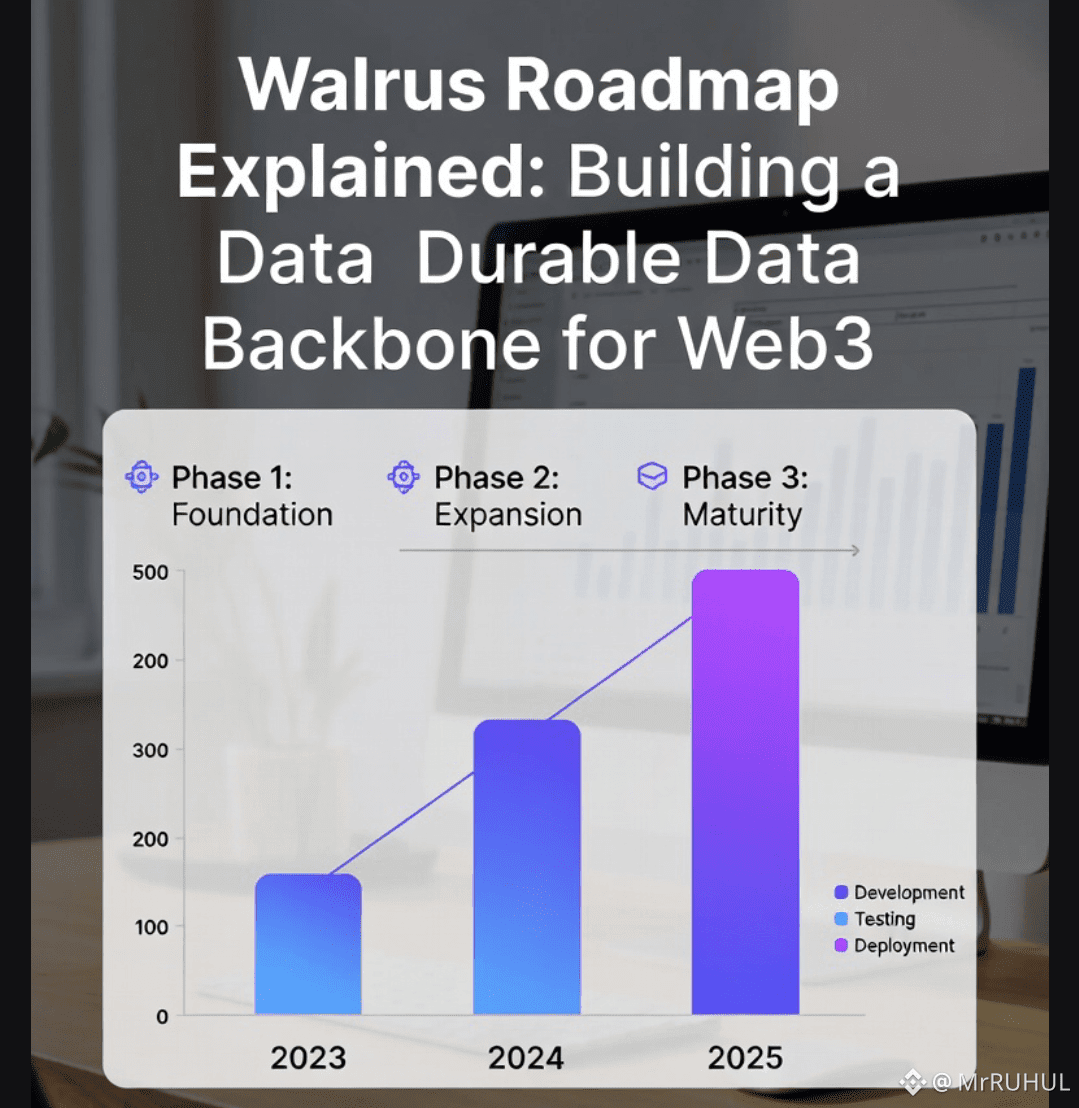
PHASE 3: Deep Integration with Rollups and Modular Chains
Now Walrus steps into its role as the backbone for the whole ecosystem.
The focus shifts to:
Plugging directly into modular blockchains
Supporting all sorts of rollup designs—optimistic, ZK, app-specific, whatever you’ve got
Giving developers the tools to publish, check, and grab data easily
Setting standards for how data gets posted and how availability gets proven
Walrus isn’t here to force rollups to play by its rules. Flexibility is baked in. It’s built to work with different settlement layers, execution setups, and security models.
Unlike monolithic chains, Walrus doesn’t care about winning at execution, governance, or building apps. It’s here to support all that.
PHASE 4: Scaling Up Without Compromise
As adoption picks up, it’s time to scale. But Walrus refuses to sacrifice security or decentralization just to go faster.
Here’s what gets upgraded:
Higher throughput for all those data blobs
Smarter compression and encoding to keep things light
Lower storage costs per byte
Faster, more efficient retrieval—especially for light clients
Performance upgrades only roll out after the network proves it’s secure and truly decentralized. Walrus dodges that classic trap of optimizing too early and patching up security holes later.
At this stage, Walrus can handle high-frequency rollups, gaming, media-heavy apps, even big institutional data needs.
Now, Walrus starts to look like a real alternative to centralized storage—fast, affordable, and still trust-minimized.
PHASE 5: Tools and Developer Experience
Infrastructure means nothing if developers can’t use it. So Walrus puts a lot of energy into making life easier for builders.
This phase brings:
SDKs in multiple programming languages
Simple APIs for posting and verifying data
Monitoring and analytics so teams can see what’s going on with their data
Real documentation—usable, production-ready, not just glossy demos
Walrus isn’t aiming for household name status with everyday users. It’s designed for developers, rollup teams, and protocol engineers who need infrastructure that just works. Think “boring but essential”—the kind of thing the early internet was built on.
PHASE 6: Long-Term Governance and Staying Neutral.@Walrus 🦭/acc #Walrus $WAL