

A couple of years ago, I was shifting funds between wallets during a sharp market move. Routine stuff. Later that night, I opened a block explorer out of habit and saw everything laid out in plain sight. Hash, amount, timing. Anyone could trace it. That was the moment it really clicked for me. Transparency is useful, but in practice it turns every financial action into a public announcement. I wanted verification without turning my activity into an open display.
That tension sits at the heart of most blockchains. Public ledgers make it easy to prove nothing is being faked, but they also expose information that would never be shared so freely in traditional finance. Trade sizes, positions, counterparties, all become visible by default. For individual users that can be uncomfortable. For institutions, it is often unacceptable. The same mechanism that creates trust also removes discretion, and that trade-off becomes harder to justify as real money enters the system.
The analogy that always sticks with me is sending a check in a transparent envelope. Anyone along the way can see the amount and recipient without opening it. You still get tamper resistance, but you lose privacy. In the real world, we solve this by separating verification from visibility. The bank confirms the funds without broadcasting the details. On most blockchains, that separation does not exist.
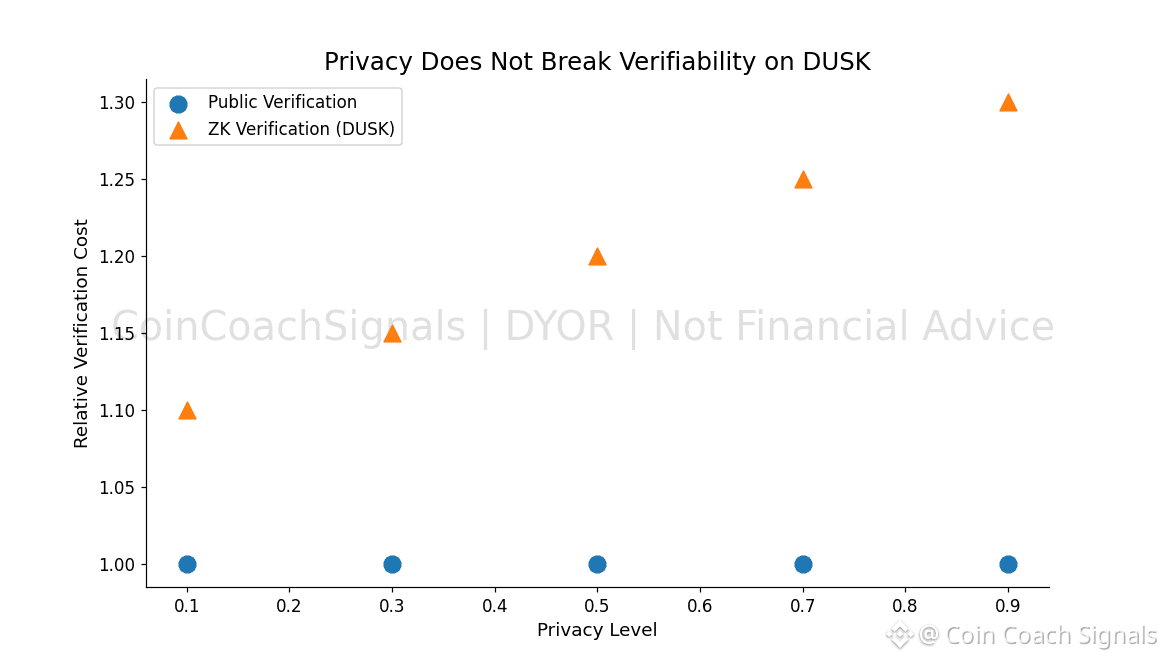
This is the problem Dusk Network is built around. Instead of treating privacy as an optional layer, it is part of the base design. Zero-knowledge proofs are used so transactions can be validated without revealing amounts, senders, or receivers to the public ledger. The network can enforce correctness while keeping sensitive data out of sight. Confidential transfers are not a workaround. They are a first-class option.
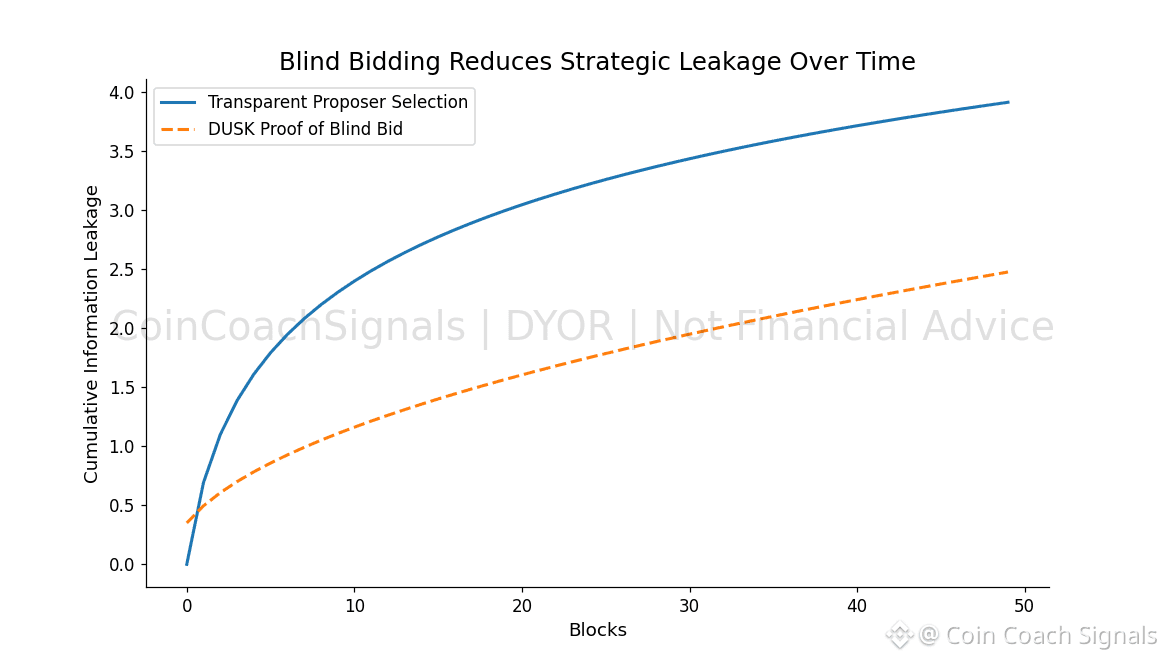
Two design choices stand out. One is the Rusk virtual machine, which allows smart contracts to operate on private state. This makes it possible to build in practice, tokenized assets and financial logic where rules are enforced without exposing underlying data. The other is the Proof of Blind Bid mechanism used in consensus. Validators submit hidden bids for block production, in practice, reducing the information leakage that often leads to front-running or manipulation in more transparent systems. It is not magic, but it is a deliberate attempt to align privacy, security, and performance.
The DUSK token itself is fairly unremarkable by design. It pays transaction fees, is staked by validators to secure the network, and is used in governance to adjust protocol parameters. It does not promise to create trust on its own. It supports the system once there is real usage. That restraint is intentional. Tokens that try to do everything often end up doing nothing well.
On the market side, activity has picked up since mainnet. Recent daily volume has been healthy, and partnerships with regulated entities, including a Dutch exchange managing hundreds of millions in assets, point toward real-world experimentation with tokenized securities. These are not headline-grabbing numbers, but they matter more than hype when infrastructure is the goal.
From a trading perspective, the distinction between short-term noise and long-term value is clear. In the short run, privacy narratives and market sentiment move prices quickly and often irrationally. I have traded enough cycles to know how unreliable that can be. The longer-term question is whether discreet, verifiable finance becomes a requirement rather than a niche. If institutions and builders adopt this model, demand grows through usage, not speculation.
There are real risks. Competition from other privacy-focused chains is intense, especially those that prioritize anonymity over compliance. Regulatory interpretation is also uncertain. Selective disclosure sounds sensible, but acceptance depends on how oversight bodies respond in practice. The most serious risk, though, is technical. Zero-knowledge systems are complex. A flaw in proof generation or verification could undermine privacy guarantees and damage trust quickly. Infrastructure rarely gets a second chance after that.
This is not a system that proves itself overnight. It lives or dies on gradual adoption and quiet reliability. Whether developers and institutions are ready to treat privacy as a default instead of an exception remains to be seen. For now, it is one of the more thoughtful attempts to reconcile verification with discretion, and that alone makes it worth watching as onchain finance grows up.
@Dusk #Dusk $DUSK
