

A couple weeks ago, when the mainnet finally went live on January 7 after six years of quiet building, I found myself pulling up the old Dusk whitepaper I’d bookmarked back in 2021 and promptly forgotten about. I remembered dismissing it then as another privacy coin that would never bridge the gap to real money. Yet here it was, launching right as institutions are actually starting to move RWAs and securities on-chain, and suddenly the whole thing felt less academic and more like something I should have paid attention to earlier.|
The friction I’ve felt for years is simple: public blockchains force you to choose between transparency and usability. Everything is visible—positions, flows, even intent. That’s fine when you’re a retail degen moving small amounts, but the moment you try to run anything sophisticated—proprietary strategies, corporate treasury, regulated funds—the exposure becomes unacceptable. Regulators want auditability, not a permanent public record of every competitive edge.
Think of it like a hedge fund having to publish its entire book in real time to prove it isn’t front-running clients. No one serious would play under those rules.
This is the exact gap Dusk is built to close. It’s a layer-1 where both payments and smart contracts are private by default, using zero-knowledge proofs to hide amounts, addresses, and contract state. The genuinely clever part—and the reason it feels different from earlier privacy chains—is the selective transparency mechanism.
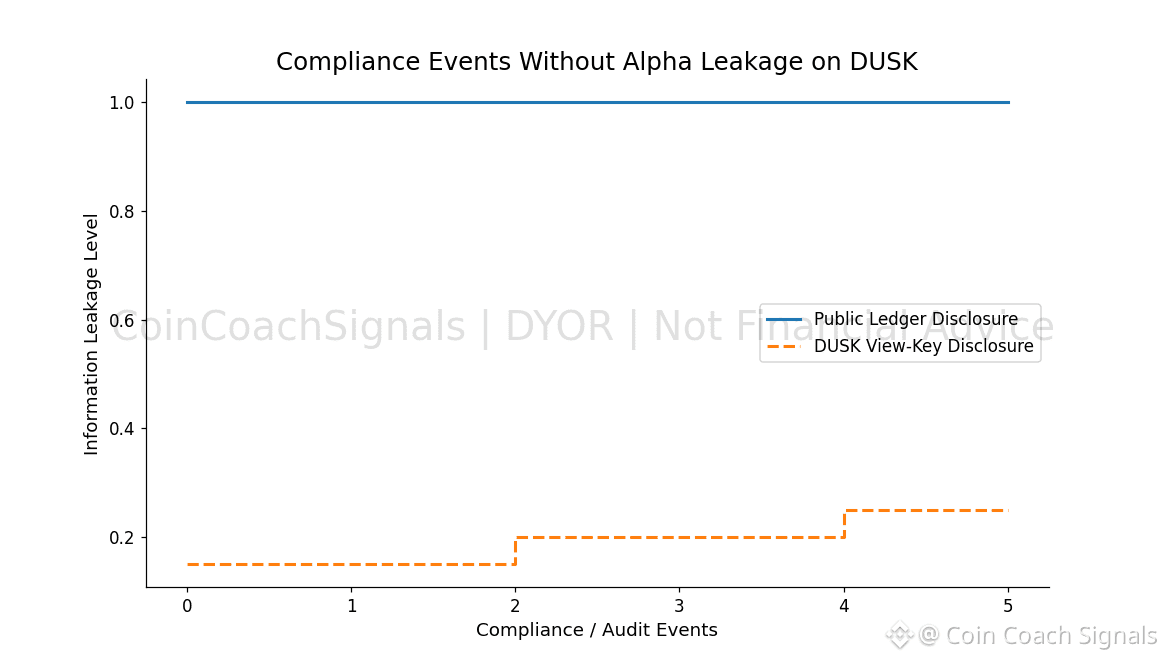
Contracts can be written so that specific parties (an auditor, a regulator, a counterparty in a trade) are issued view keys that let them see exactly and only what they are entitled to see, while the rest remains cryptographically hidden. The proof of correctness still settles on-chain; it’s just that the data itself stays shielded unless deliberately disclosed.
Two implementation choices stand out as particularly thoughtful. First, the consensus uses Segregated Byzantine Agreement, splitting stake between provisioners and a smaller set of generators so the network can finalize blocks quickly even with private transactions that are heavier to verify. Second, the contract model keeps private state off the global ledger entirely—only commitments and proofs are posted, and disclosure happens via separate cryptographic views rather than retroactively “opening” the contract to everyone. That second part is subtle but important; it means compliance events don’t leak alpha to the public.
The token’s role is straightforward and unexciting, which is probably a good sign at this stage: DUSK pays gas, stakes for consensus participation, and will eventually handle governance. Nothing exotic, nothing that screams engineered demand.
Market context is still thin—mainnet has been live barely two weeks. Market cap sits around $115 million with roughly 464 million circulating out of a billion total. TVL is negligible so far, which is normal for a chain that isn’t chasing yield farmers but waiting for institutions to run actual regulated products. The recent volume spike is mostly retail discovering the launch and the privacy narrative, not the end-state users yet.
Short-term, the token will probably keep swinging with whatever narrative is hot—privacy rotation, RWA summer reboot, whatever. Long-term, the infrastructure value is in whether those compliance-ready contracts actually get used for real securities, private OTC desks, or tokenized funds that can’t live on fully transparent chains. The two play out on completely different time horizons.
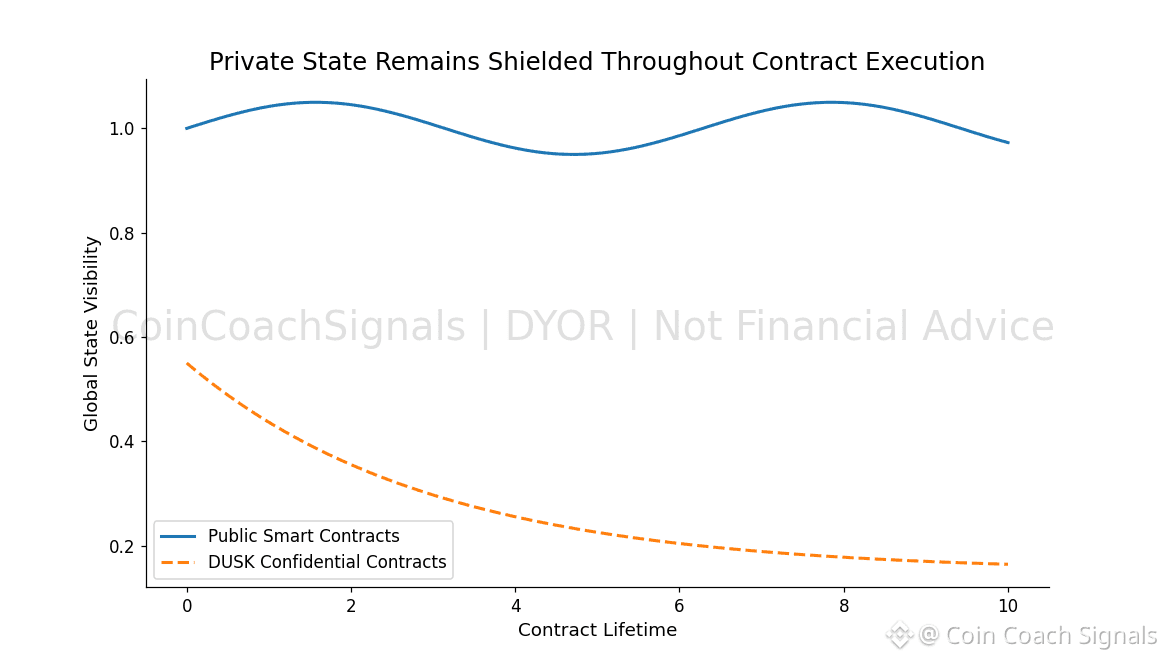
Risks are obvious and non-trivial. The selective disclosure model assumes regulators will accept cryptographic views as sufficient for oversight; there’s no guarantee they will, especially in jurisdictions that still want full data access on demand. Competition isn’t just other privacy chains—Oasis, Phala, Secret—it’s also permissioned systems and layer-2s adding ever-better privacy tools. A plausible failure mode would be a flaw in the view-key issuance logic that accidentally leaks more state than intended during an audit, instantly killing trust from the very institutions the chain is courting. And of course adoption could simply stay low if the UX for writing these confidential contracts remains too specialized.
I don’t know if this is the privacy model that finally works, or just the latest one to try. Six years of development and a clean mainnet launch suggest the team isn’t messing around, but infrastructure like this only reveals its worth years after the hype dies. Sometimes the quiet projects that solve an unsexy but blocking problem are the ones that end up mattering. We’ll see whether institutions decide this particular bridge between discretion and oversight is the one they’re willing to cross.
@Dusk #Dusk $DUSK
