

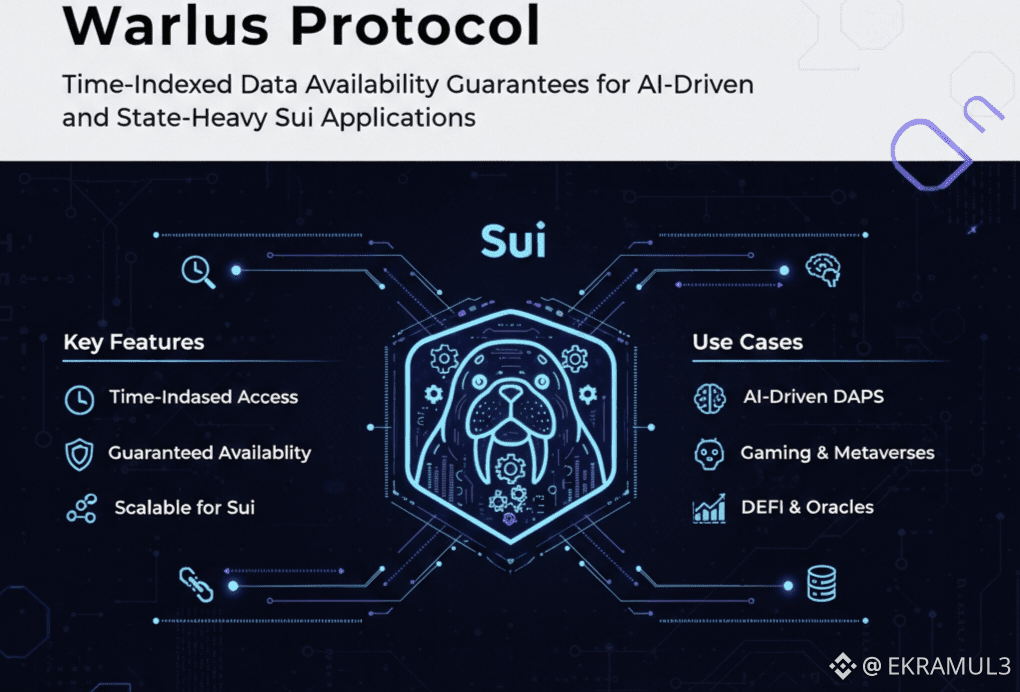
 One of the emerging realities of modern on-chain applications is that computation is no longer the bottleneck data persistence is. AI-assisted agents, stateful social graphs, dynamic NFTs, and long-lived gaming environments all produce information that must outlive the transaction that generated it. The Sui execution model already solves parallel compute and global shared state coordination. What it does not natively solve is time-bounded access to meaningful off-chain data that needs to remain retrievable long after the original write. Walrus Protocol fills that gap by introducing a time-indexed availability layer that transforms blob storage from a passive backend into a verifiable service that can be accounted for, scheduled, renewed, and settled on-chain.
Rather than assuming data will always be available because a node “ought to” keep it, Walrus ties availability to explicit time windows backed by WAL-denominated leases. During these windows, storage providers commit to serving encrypted blob fragments and must submit periodic proofs demonstrating that they still hold the assigned data. These proofs anchor to Sui as Move objects, allowing applications to treat availability not as an assumption but as a referenced fact with an expiry horizon. This is particularly valuable for AI workloads where datasets evolve over time, and models may need to reference specific versions months later without worrying about silent data loss.
For state-heavy Sui applications, the benefit is architectural: developers can externalize large state that would be prohibitively expensive or inefficient to keep on-chain while still preserving programmability. Game state snapshots, multi-turn chat histories, media-heavy timelines, identity credentials, model checkpoints, or analytics logs can be mapped to time-indexed availability guarantees rather than indefinite storage. When the guarantee window approaches expiry, applications can renew the lease automatically, extend commitments selectively, or let irrelevant data lapse creating an equilibrium where storage cost maps to continued utility instead of forcing a one-size-fits-all notion of permanence.
AI systems really thrive with this kind of detail. Training pipelines need to grab exact versions of datasets every time, no surprises. On the other hand, inference layers might just want to stash some cached embeddings or feature vectors for a bit they don’t need to keep that stuff forever. Walrus changes the game here. Developers decide how long each blob sticks around, based on what matters for their workflow, compliance, or just plain user needs. Data isn’t stuck as either “gone tomorrow” or “here forever.” With Walrus, you get a whole range availability is something you control, you can check on it, and you aren’t paying extra for storage you don’t need.
The WAL token coordinates all of this activity. Lease payments are streamed to storage providers over time, rather than front-loaded. Providers stake WAL to signal reliability, and the protocol penalizes failure to submit retrieval proofs. For applications, this transforms blob storage into a metered execution resource rather than an opaque external dependency. For operators, it creates recurring revenue indexed to duration and usage rather than speculative supply inflation. For the ecosystem, it introduces a feedback loop where continued retrieval demand reinforces token utility without requiring speculative financial narratives.
Most importantly, time-indexed availability unlocks a new design frontier for Sui: data can now behave like a first-class settlement primitive. Instead of assuming availability, applications can enforce it. Instead of relying on centralized cloud fallbacks, developers can price it. And instead of storing everything forever, users can assign time value to data the same way they assign gas cost to compute. For a network already optimized for parallel execution, this is the missing half of the operating system: computation without persistent memory is impressive; computation with verifiable long-lived memory becomes infrastructure.


