

Dusk Network is one of those projects that becomes more impressive the deeper you go, because it isn’t built on trends—it’s built on fundamentals. While a lot of chains talk about privacy as an optional feature, Dusk treats confidentiality as core infrastructure. The network is positioned as a leading platform for confidential smart contracts and regulatory compliance, which is a rare combination in Web3. Most ecosystems choose either full transparency for speed and composability, or privacy at the cost of usability and compliance. Dusk aims to bridge that gap, and it does so by leaning into the most powerful tool modern cryptography has offered blockchain: zero-knowledge proofs.
Zero-knowledge proofs are not just a buzzword here. They are the mechanism that allows a blockchain to prove something is true without revealing the underlying data. In real terms, that means users and institutions can transact while keeping sensitive details hidden from everyone else on the network. Dusk can keep transfers private by masking both the assets and the amounts involved. This is a massive leap compared to typical public chains where every transaction becomes permanent public information, easily tracked and analyzed. With privacy built into the design, Dusk becomes a real contender for serious financial and institutional use cases, where confidentiality is not a “nice-to-have” but a requirement.
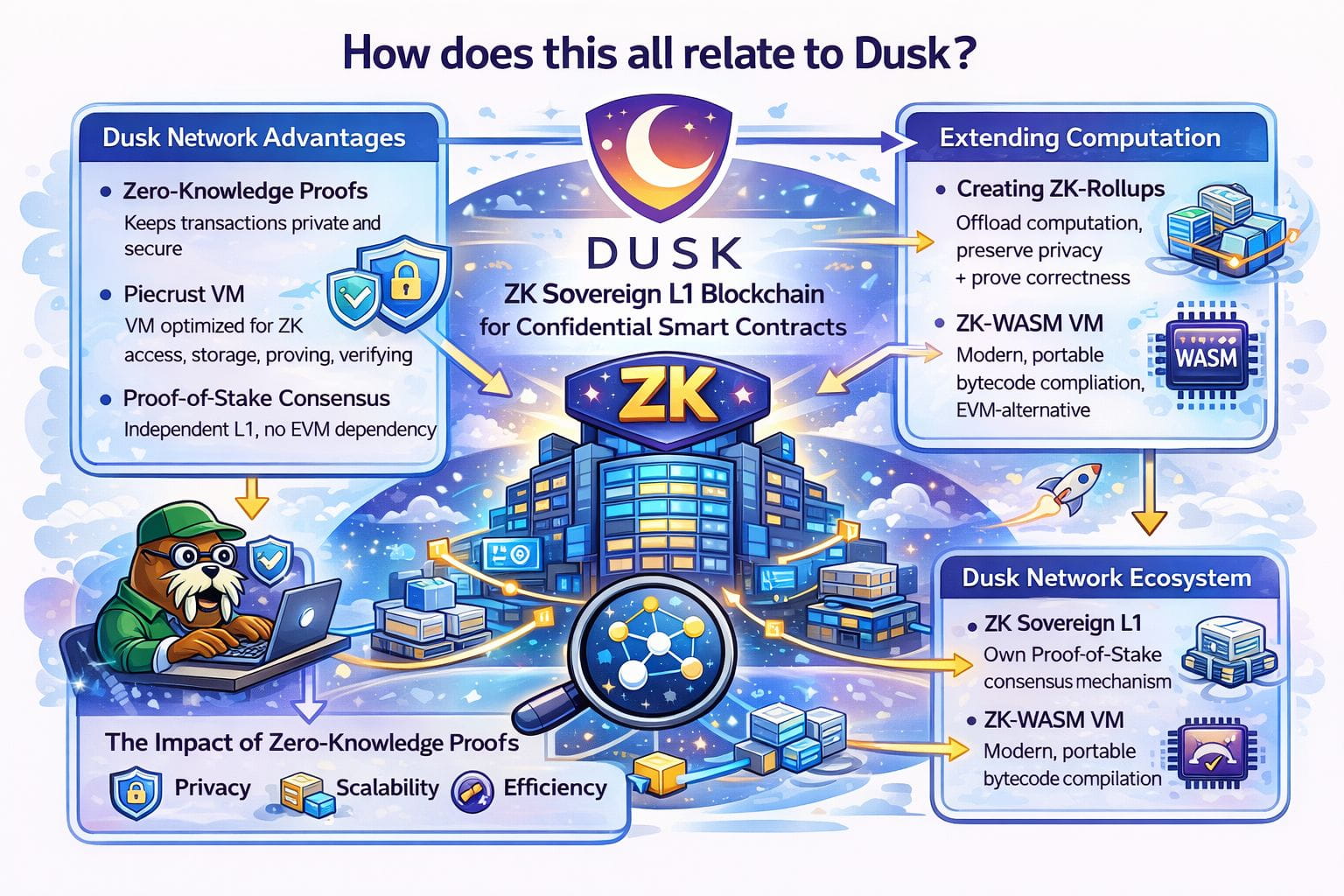
What makes this even more exciting is that Dusk doesn’t stop at using ZKPs like an add-on. At the heart of the network sits the Piecrust VM, a virtual machine designed to be as optimized and efficient as possible for accessing, storing, proving, and verifying zero-knowledge proofs. That detail matters more than people realize. Many chains attempt to retrofit ZK capabilities into environments that were never designed for it. The result is often complexity, inefficiency, and trade-offs that limit real adoption. Dusk takes the opposite direction: it designs the execution environment with ZK in mind from the very beginning. That means ZK proofs aren’t a side feature; they are woven into the rhythm of the network itself.
Another key point that sets Dusk apart is its identity as a sovereign Layer 1. This is not a ZK-rollup relying on another chain for settlement, and it is not a ZK-EVM clone chasing compatibility at any cost. Dusk operates with its own Proof-of-Stake consensus and does not depend on third parties to finalize transactions.
This independence is important because it gives the network full control over its security assumptions, its upgrade path, and its performance. It also avoids the classic limitations of EVM-based ecosystems. EVM compatibility can be useful, but it comes with legacy constraints and design trade-offs. Dusk chooses to move forward instead of staying locked to the past, which is why its smart contracts compile into modern and portable WebAssembly bytecode. WASM is a powerful direction for long-term scalability and developer flexibility, and combining that with ZK-first design is where Dusk starts to feel like it’s building infrastructure for the next era, not the last one.
Now here’s where the ecosystem story gets really interesting. Dusk isn’t just a closed system—it’s a platform that can be extended. For third-party builders, there’s a clear pathway to expand computation and scalability through ZK-rollups and ZK-VMs that connect back to the network. This approach would allow heavy computation to happen externally while still providing verifiable correctness to the main chain. That’s the future of scalable privacy: offload what’s expensive, prove what’s true, and keep the core chain efficient and secure. In this context, a ZK-WASM VM becomes a fascinating possibility, because it could act as a bridge toward solutions that feel “ZK-EVM equivalent” in capability while staying aligned with Dusk’s more modern execution stack. The big difference is that instead of copying EVM constraints, Dusk can support provable computation in a way that is cleaner, more forward-looking, and more adaptable.
When you zoom out, the broader message is clear: zero-knowledge proofs are reshaping blockchain because they unlock privacy, scalability, and security at the same time. And Dusk sits right at the intersection of those forces. It’s building a chain where confidential smart contracts can actually thrive, not as experiments, but as real products that institutions and everyday users can rely on.
ZK-enabled dApps are still early across the industry, but that’s exactly why Dusk matters: it’s one of the networks designed to make them practical and common, by making ZK a native capability rather than a complicated layer on top. If you’re watching where Web3 is going—toward privacy-preserving finance, compliant RWAs, and real adoption—Dusk is one of the names that deserves serious attention, because it isn’t just participating in the ZK revolution. It’s building the rails for it.
