While traders argue over speed and fees the next market advantage may come from understanding where crypto data actually lives.
Why I stopped looking at TPS charts and started studying data flows?
Over the last few months I analyzed dozens of Layer 1 and Layer 2 projects and something became clear to me. Transaction speed is no longer the differentiator it once was. According to Coin Metrics 2024 network usage report average daily transactions across major blockchains have grown modestly year over year but data generation from applications has grown exponentially faster. My research led me to a simple but uncomfortable question is if blockchains are optimized for moving value who is optimized for storing the digital world being built on top of them? NFTs, AI agents, gaming inventories, social graphs and analytics dashboards all generate data continuously. In my assessment this is the pressure point most market narratives ignore. Walrus enters the picture not as another execution chain but as infrastructure designed for this exact problem. Built to operate on Sui, Walrus focuses on decentralized blob storage rather than transaction settlement. That distinction matters more than it sounds. Sui's parallel execution model which Mysten Labs publicly demonstrated can finalize transactions in under one second creates an environment where coordination can happen quickly without forcing data itself onto the chain. I often think of Walrus as a shipping port rather than a highway. Highways move cars fast but ports handle containers efficiently. Crypto has plenty of highways now. What it lacks are ports that can handle scale without breaking decentralization.
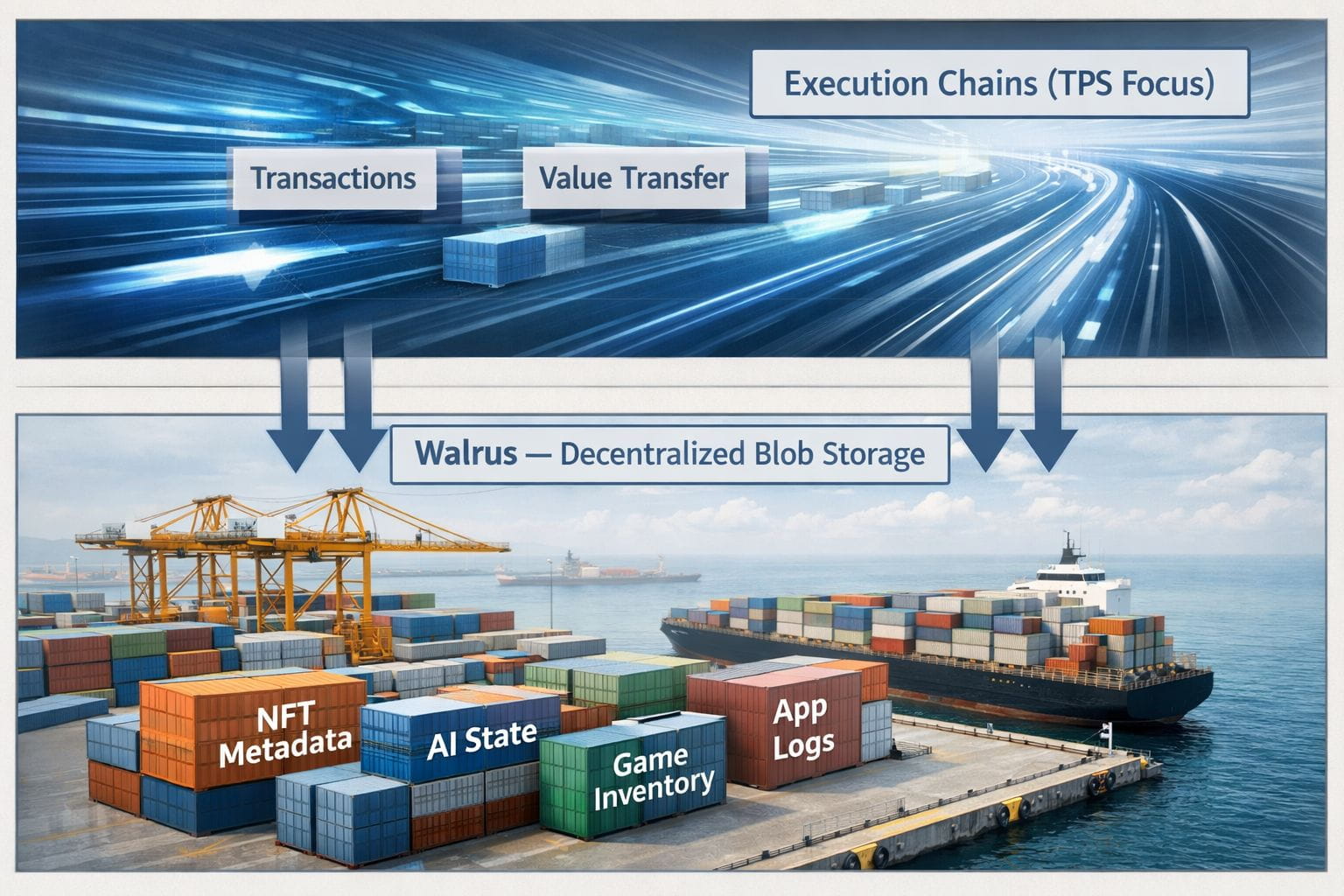
How Walrus redefines decentralized storage in practice?
Most traders are familiar with Filecoin and Arweave so I approached Walrus with skepticism. Filecoin's network statistics show more than 18 exabytes of committed storage capacity as of late 2024 and Arweave has stored over 200 terabytes of permanent data according to its own dashboards. These numbers are impressive but they tell only part of the story. What stood out in my analysis is that Walrus is optimized for active frequently changing data. Instead of replicating entire files across many nodes. Walrus uses erasure coding to split data into fragments. Research published by Google Cloud and MIT shows that erasure coded systems can reduce storage overhead by 40 to 60 percent compared to full replication while maintaining similar reliability. To explain it simply imagine breaking a glass into pieces and distributing them across different locations. You don't need every shard to reconstruct the glass just enough of them. That's how Walrus keeps costs low while remaining resilient. Cost efficiency is not theoretical here. According to public benchmarks discussed by Sui developers blob storage costs on Walrus are designed to be significantly lower than storing equivalent data directly on-chain. This matters when Ethereum gas fees as reported by Etherscan averaged between $3 and $15 during most of 2024. Even Layer 2s inherit these costs indirectly through data availability requirements. A conceptual table comparing Walrus, Filecoin and Arweave by update frequency, retrieval latency and cost per gigabyte would make this distinction obvious. Another useful visual would be a chart showing how storage costs scale over time for replication heavy systems versus erasure coded systems as application data grows.
Where Walrus fits into today's AI and modular blockchain narrative?
The crypto market in 2025 is obsessed with modular design. Execution layers, settlement layers and data availability layers are no longer abstract concepts. Ethereum's own roadmap discussions increasingly emphasize data availability as the main constraint on scaling. AI accelerates this shift dramatically. IBM research published in 2023 famously noted that nearly 90 percent of the worlds data was created within the previous two years. AI agents running on-chain or in mixed setups always need up to date data. If they don't have decentralized storage they end up turning to big cloud companies and that is just asking for trouble. One outage or clampdown and everything stops. Honestly, Walrus is not just another DeFi project. It sits right where AI and Web3 meet. Think about it game studios, AI startups, analytics tools. They all want storage that's cheap, fast and can't just get blocked or tampered with. They need something that keeps up with their pace. This is not the use case Arweave was built for and it stretches Filecoin's original design.
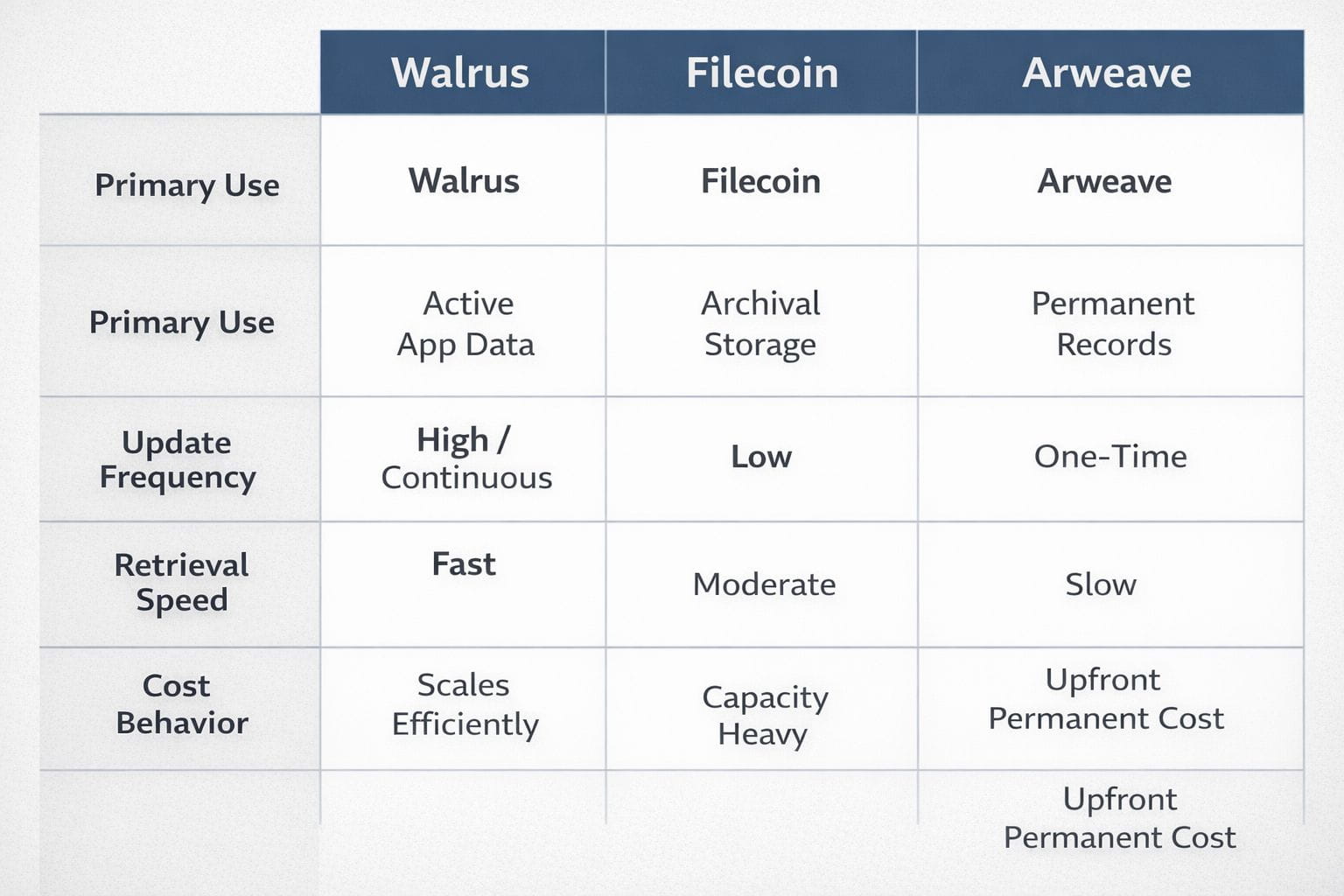
Funding trends support this thesis. Crypto media outlets reported that Walrus related development attracted approximately $140 million in backing from firms Crypto and Standard Crypto. Venture capital does not guarantee success but it signals where long term infrastructure demand is expected to emerge. A useful chart here would compare growth rates of transaction volume versus application data volume across Web3 sectors. Here is another idea imagine a table that lays out different app categories DeFi gaming, AI, social platforms right next to how much storage they actually use. Suddenly you can see exactly where Walrus fits in the bigger picture.
Now about the risks people seem to brush off. Even with solid fundamentals. I'm still wary. Adoption does not just happen overnight especially when storage infrastructure runs so deep. Developers tend to stick with what they know unless you give them a really good reason to switch. We have all seen great tech get ignored just because no one bothered to move. Let's talk about token economics for a second. WAL has to pay storage providers enough so they don't just break even they need to cover hardware, bandwidth and all those day to day costs even when the market tanks. If the rewards drop too low, you can bet the network will start to feel it. I think Walrus gets this at least on paper. But honestly it all comes down to how well they pull it off. Then there is the whole regulatory mess. Decentralized storage does not care what kind of data you put on it which sounds great until you realize regulators in different countries see that very differently. Walrus tries to make things easy for enterprises, but with global data laws all over the place. It's still a wild card.
Stepping back from the noise
When I step away from charts and headlines the pattern becomes clear. Crypto has largely solved how value moves. What it has not solved is where the growing digital world lives. In my assessment Walrus is quietly targeting that gap. It does not promise instant dominance and it avoids flashy metrics. Instead it addresses a structural problem that becomes more pressing as AI, gaming and data heavy applications expand. Markets often misprice infrastructure until it becomes unavoidable. Walrus may not dominate headlines today but if decentralized data truly becomes the backbone of Web3 ignoring it could prove far more expensive than most traders expect.