
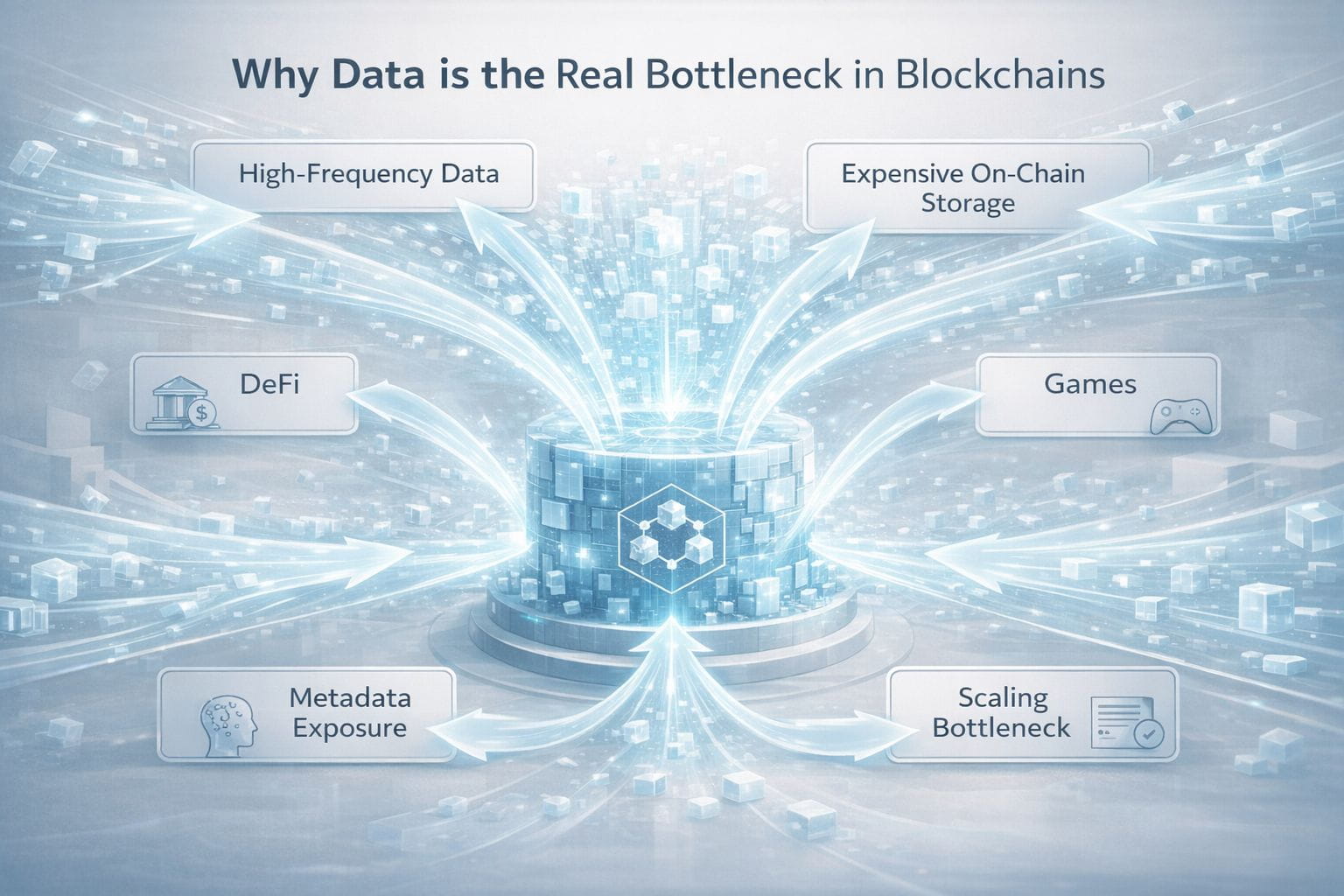
After analyzing dozens of storage and scaling projects. Walrus stood out to me not because it's loud but because it's built for how blockchain applications actually behave in the real world. When I first started digging into Walrus. I didn't expect much. Storage projects are everywhere in crypto and most of them repeat the same promises with different branding but as I went deeper into the documentation network discussions and how Walrus is positioned on Sui. My assessment changed. Walrus is not trying to be a generic "decentralized Dropbox." It is quietly building infrastructure for active application level data that modern blockchains struggle to handle. In my research I noticed something important. Most users think blockchains fail because they are slow or expensive but for builders the bigger problem is data. Smart contracts, games, AI agents and DeFi protocols generate massive amounts of data that must remain accessible, cheap and censorship resistant. Walrus is targeting that exact pain point and that focus alone makes it worth attention.
Why Walrus feels different once you look under the hood?
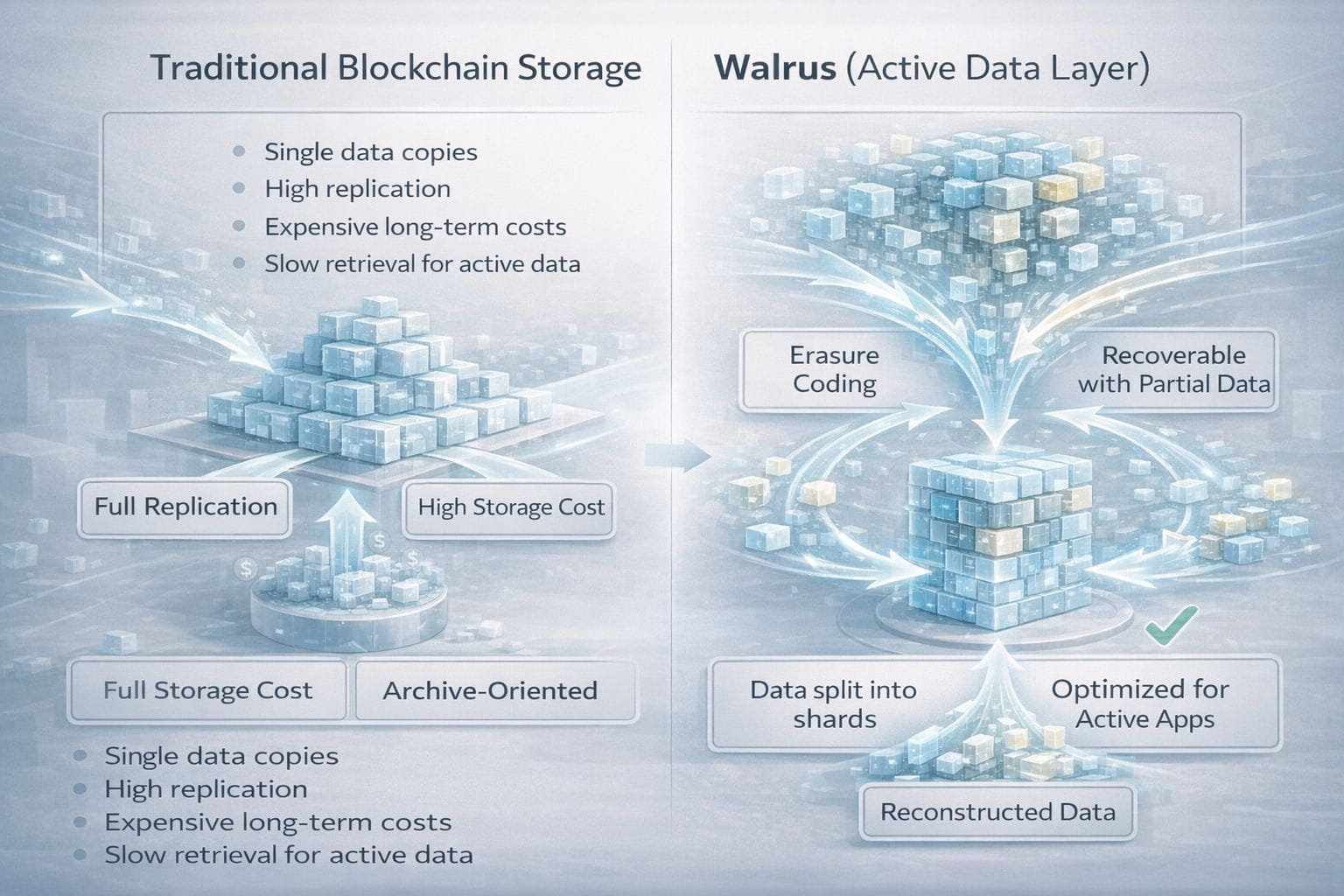
One of the first data points that caught my attention was Sui's performance layer. Public benchmarks and developer updates frequently cite Sui's ability to process over 100k transactions per second under ideal conditions with sub second finality in many cases. That kind of throughput changes what is possible for storage heavy applications. Walrus is designed to sit inside that environment rather than fight against it. Walrus uses erasure coding and blob style storage which sounds complex until you think of it like this. Instead of keeping a full copy of a file in one place. Walrus breaks data into pieces spreads them across the network and allows recovery even if some pieces go missing. Filecoin uses a similar concept but Walrus is optimized for active data rather than long term archives. According to Filecoin Foundation statistics retrieving frequently accessed data can still introduce latency something Walrus explicitly aims to minimize. Cost efficiency is another area where my analysis raised eyebrows. Traditional cloud storage providers like AWS S3 charge roughly $0.023 per gigabyte per month for standard storage based on public pricing pages. Decentralized alternatives often struggle to compete at scale. Walrus claims a lower long term cost model by combining efficient encoding with a network optimized for reads not just writes. While exact figures will evolve early comparisons suggest meaningful savings for applications that move data constantly rather than storing it passively. Privacy also plays a role here. Most blockchains expose metadata by default. Walrus integrates selective disclosure techniques aligned with Sui's object based architecture. This matters because according to Chainalysis reports metadata leakage is one of the top concerns for institutions exploring on-chain infrastructure. Walrus is not solving privacy with slogans. It's solving it structurally.
What the market may be underestimating about WAL?
In my assessment the market often misprices infrastructure tokens early because they don't have a simple narrative. WAL is not a meme and it's not a quick yield DeFi token. It's closer to picks and shovels infrastructure similar to how Arweave was initially overlooked before its usage exploded. Arweave's network storage reportedly surpassed 200 terabytes of permanent data according to network dashboards driven largely by apps rather than individual users. Walrus could follow a similar path but in a different category. Instead of permanent archives it targets active application data. That distinction matters. Active data creates recurring demand not one time uploads. If even a small number of high throughput Sui applications adopt Walrus as their default data layer. WAL demand dynamics could shift quickly. There are uncertainity and ignoring them would be irresponsible. Walrus is early and early infrastructure projects face adoption uncertainty. Competing solutions like Filecoin, Arweave and even Ethereum Layer 2 data availability solutions such as EigenDA and Celestia. According to Celestia's public roadmap updates modular data availability is becoming crowded fast. Walrus must prove that its application first approach is not just different but better. Another uncertainty is token economics. Without sustained application usage staking and governance incentives alone are not enough. I have seen too many infrastructure tokens fail because usage did not materialize. Walrus needs real builders real apps and real data flows. The technology is promising but execution will decide everything.
How I would approach WAL from a traders perspective?
From a trading standpoint. I don't treat WAL like a short term momentum coin. My strategy would be structured around accumulation zones and ecosystem milestones. If WAL starts moving between a low support zone and some mid range resistance. I would rather buy in near those levels that have held up before instead of chasing after sudden price jumps. With infrastructure tokens patience almost always wins out over trying to catch the perfect moment. When I'm digging into this stuff. I focus on on-chain data first. Things like growth in stored blobs more active storage requests and new apps actually using the network those tell you more than just random spikes in trading volume. If the price pushes past a big resistance level and you are seeing real on-chain activity go up not just hype flying around that is a much better sign of real strength. A big deal here. Let's be clear about what invalidation looks like is if Sui adoption flatlines for a few quarters or rivals take over the data layer. I will rethink my whole thesis. No trade idea is untouchable especially in crypto. If I sketched this out. I would throw in a price chart with possible accumulation zones resistance lines and how volume shifts over time. I would also add a table comparing Walrus Filecoin and Arweave think data types retrieval speed, cost who actually uses them. That way you see how they really stack up. A second table could map Sui network applications to their data needs and show where Walrus fits naturally.
My Final thoughts after stepping back
After stepping back and reviewing everything my conclusion is simple. Walrus is not trying to win headlines is it's trying to win developers. In crypto, that is often where the real value quietly forms. The combination of Sui's performance. Walrus's active data focus and a growing demand for privacy aware infrastructure creates a setup that deserves attention. Will WAL outperform every storage token? That remains uncertain but in my assessment, Walrus is solving a real measurable problem that many blockchains still ignore. For traders and builders willing to look beyond surface narratives that alone makes it worth watching closely.

