
Dusk Foundation’s listing on Binance marks a major turning point for a blockchain project that has quietly focused on one of the hardest problems in crypto: how to combine privacy with regulation. While many networks chase mass adoption through hype or consumer-focused narratives, Dusk has taken a slower and more deliberate route, building infrastructure specifically designed for institutions, regulated markets, and real-world assets. The Binance listing brings that vision into the spotlight and signals growing confidence in privacy-preserving technology that still plays by the rules.
At its core, Dusk is a Layer-1 blockchain built for confidential financial applications. Traditional public blockchains expose transaction details, balances, and smart contract data to anyone who looks. That transparency works for some use cases, but it creates serious problems for banks, funds, and enterprises that must protect sensitive data. Dusk addresses this gap by making privacy a native feature of the network, not an optional add-on. Transactions and smart contracts can remain private by default, while cryptographic proofs ensure everything is still verifiable and correct.
The technology behind Dusk is centered on zero-knowledge cryptography. This allows parties to prove that a transaction or computation is valid without revealing the underlying data. In practical terms, it means institutions can issue, trade, and settle assets on-chain without exposing client identities, deal sizes, or strategic information. At the same time, the system supports selective disclosure, so data can be revealed to regulators or auditors when legally required. This balance between confidentiality and compliance is what gives Dusk its regulatory edge.
Dusk runs on a Proof-of-Stake consensus model, where validators secure the network by staking the native DUSK token. The network is designed to be energy-efficient while maintaining strong security guarantees. Unlike privacy solutions that rely heavily on external layers or complex integrations, Dusk embeds its privacy logic directly into the protocol. This reduces attack surfaces, simplifies development, and makes confidential smart contracts easier to deploy and audit.
The DUSK token plays a central role in the ecosystem. It is used for staking, transaction fees, and network security, and it functions as the primary asset for interacting with smart contracts on the chain. Token utility is tightly linked to network activity: as more applications are built and more assets are tokenized, demand for DUSK increases through usage rather than speculation alone. The token supply is capped, with emissions structured to reward validators and long-term participants while supporting sustainable network growth.
One of Dusk’s strongest value propositions lies in real-world use cases. The network is optimized for the tokenization of regulated assets such as bonds, equities, funds, and other financial instruments. These assets require privacy, legal clarity, and controlled access — areas where most public blockchains fall short. Dusk enables confidential issuance and trading, private settlements, and automated compliance workflows, making it suitable for institutions that want the benefits of blockchain without sacrificing regulatory obligations.
Beyond traditional finance, Dusk’s confidential smart contracts open doors to a wide range of applications. Private auctions and sealed-bid processes can be conducted on-chain without leaking sensitive information. Corporate governance systems can count votes while keeping individual choices private. Payroll systems can operate transparently at a system level while protecting employee salaries. These are practical, real-world problems that benefit directly from privacy-preserving infrastructure.
The team behind Dusk Foundation brings together experience in cryptography, distributed systems, and enterprise technology. Rather than focusing on flashy marketing, the project has emphasized research, engineering, and long-term partnerships. This approach has helped Dusk gain credibility with institutions and developers who prioritize reliability and compliance over short-term trends. The foundation structure also reflects a long-term vision, with clear separation between protocol development, ecosystem growth, and governance.
From a market perspective, the Binance listing significantly improves liquidity, accessibility, and visibility for DUSK. Listings on major exchanges often act as catalysts, not just for price discovery but for ecosystem growth. Increased trading volume makes the token more attractive to institutional participants, while broader exposure brings new developers and partners into the ecosystem. While market performance can fluctuate, the real signal to watch is on-chain adoption: staking participation, smart contract deployments, and real-world asset issuance.
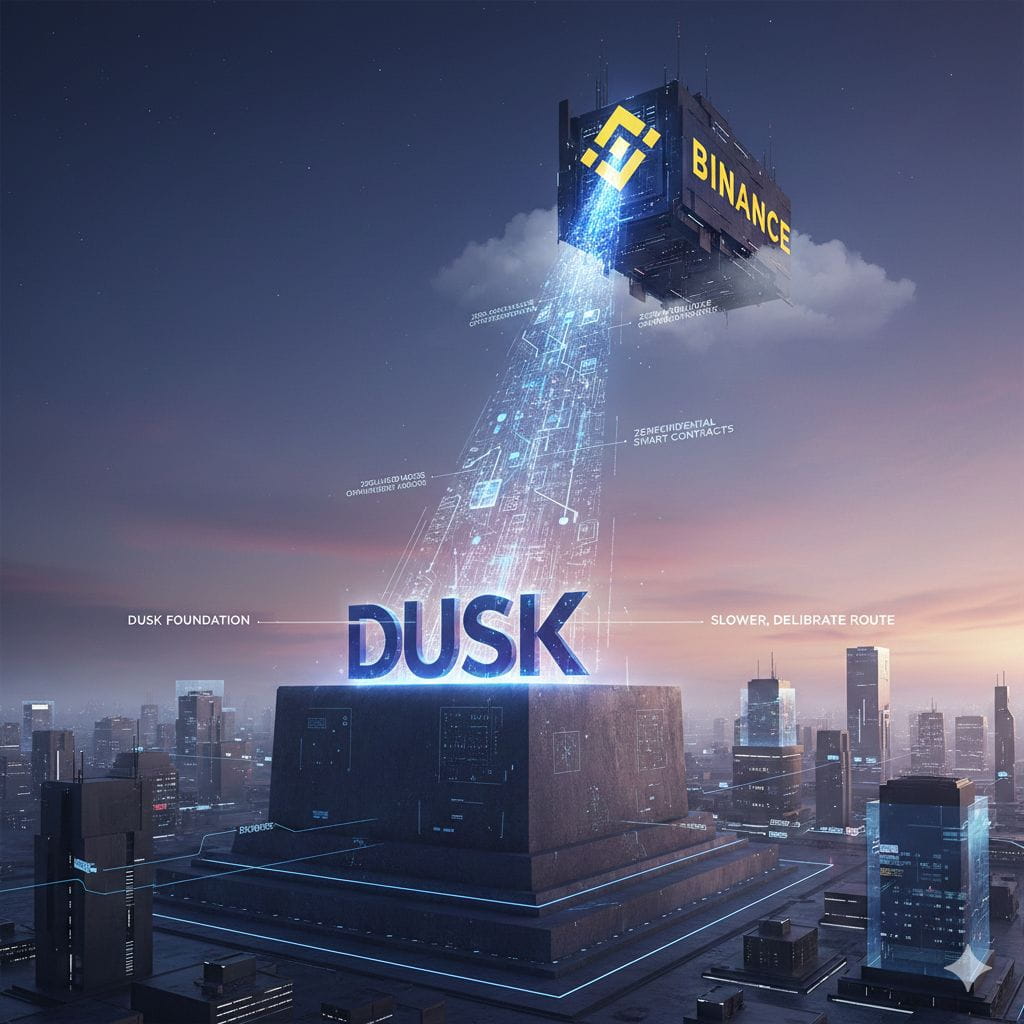
Looking ahead, Dusk’s roadmap focuses on expanding developer tooling, improving performance, and deepening integrations with compliance and custody providers. As global interest in real-world asset tokenization grows, networks that can meet regulatory standards while preserving privacy are likely to play a critical role. Dusk positions itself as infrastructure rather than a consumer app, aiming to become a backbone for confidential finance rather than a speculative playground.
The Binance listing is not the end of the journey for Dusk Foundation — it is a validation checkpoint. It confirms that the market is starting to recognize the importance of privacy-first, regulation-aware blockchains. The real challenge now is execution: onboarding institutions, delivering production-grade applications, and proving that confidential finance at scale is not just possible, but practical. If Dusk succeeds, it could help define how regulated markets operate on-chain in the years ahead.

