
@Walrus 🦭/acc $WAL is a next-generation decentralized storage and data availability protocol built on the high-performance Sui blockchain, designed to transform how large digital files and unstructured data are stored, verified, and used across Web3 applications. Instead of relying on centralized servers controlled by big tech companies, Walrus distributes data across a global network of independent storage nodes. When a user uploads a file often called a “blob” such as a video, image, PDF, or even large AI datasets the data isn’t simply copied. It is encoded using advanced erasure coding techniques, often referred to as the RedStuff algorithm, which breaks the original file into many smaller encoded fragments. These fragments are distributed across many different nodes so that even if some nodes go offline or fail, the original file can still be reconstructed from a subset of the fragments. This design makes the system both resilient and cost-efficient, reducing storage overhead compared to traditional full-replication systems while maintaining high availability and fault tolerance.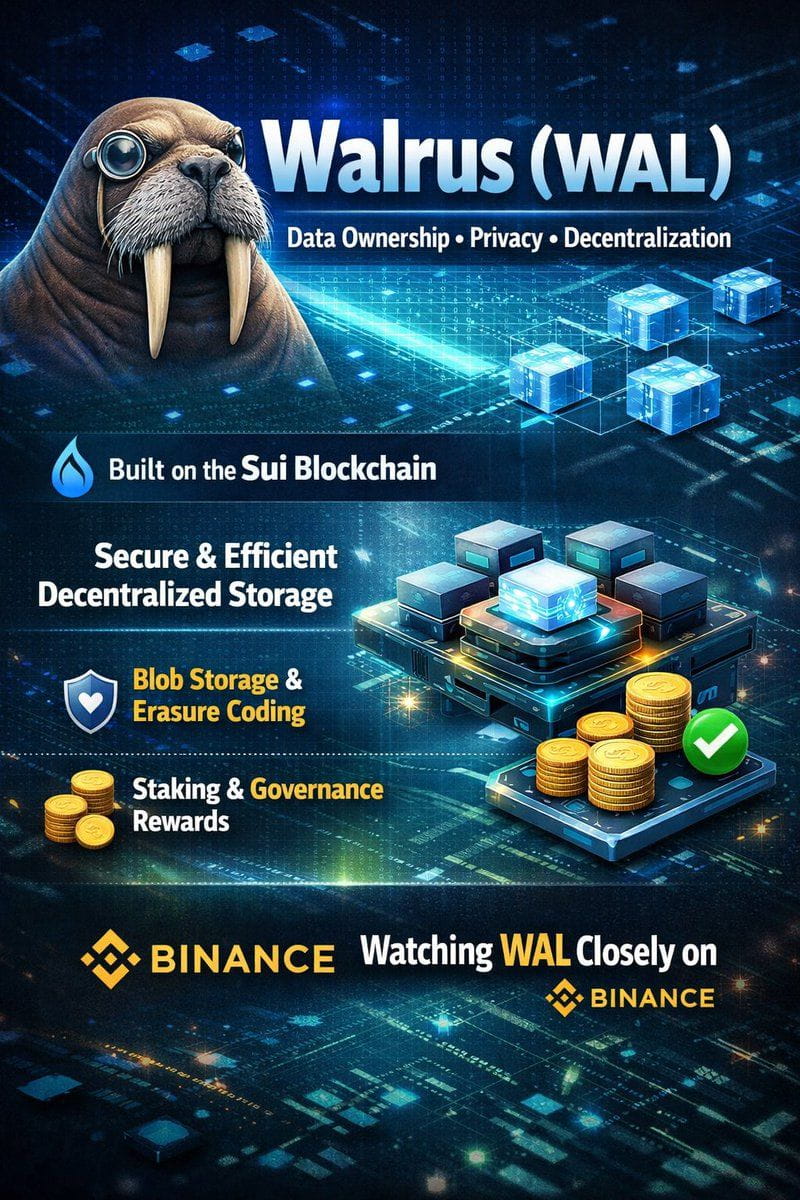
Walrus separates control and storage functions: metadata, payments, and coordination are handled on the Sui blockchain through smart contracts, while the actual file content is stored off-chain across node operators. These smart contracts register storage, track availability proofs, manage payments, and help regulate who stores what and for how long. By tying storage capacity and stored blobs to on chain objects, the network enables programmable storage, meaning developers can build smart contracts that interact directly with stored files deleting them, updating them, or making them part of complex application logic. This makes Walrus attractive for developers building decentralized applications (dApps), decentralized websites, AI infrastructure, NFT ecosystems, and more.
At the heart of the ecosystem is the native WAL token, which acts as the economic engine for the network. Users pay WAL to upload and maintain data; these tokens are distributed over time to storage node operators and stakeholders as rewards for maintaining uptime and serving data. WAL is also used in a delegated proof-of-stake consensus model, where token holders can delegate their tokens to trusted nodes to help secure the network and earn staking rewards. Poorly performing node operators face penalties or slashing, aligning incentives between users, validators, and developers. In addition to payments and staking, WAL holders participate in governance, voting on protocol parameters such as pricing, reward rates, and slashing rules, giving the community influence over the project’s evolution.
The Walrus protocol was originally developed by the team behind Sui and is now governed by the Walrus Foundation, which has attracted significant backing from major crypto investors in its bid to accelerate decentralized storage adoption. A private funding round raised hundreds of millions of dollars, reflecting confidence in its potential to address bottlenecks in data storage and bring Web3 closer to mass adoption. Unlike legacy cloud solutions that can be expensive and controlled by centralized entities, Walrus offers a path toward censorship-resistant, cost-effective, and programmable storage, which is critical for sectors like AI, entertainment, gaming, and enterprise data services.
Overall, Walrus aims not just to store files, but to make data a programmable, decentralized asset that developers and users can trust without sacrificing performance or security. This positions WAL as a key infrastructure token in the growing Web3 landscape, bridging decentralized storage, blockchain economics, and real-world application demands.