
Founded in 2018, @Dusk began as a focused answer to a simple but demanding question: how do you build a blockchain that can serve regulated institutions and financial markets while preserving the confidentiality those same institutions require? The project’s architects set out to combine the familiar financial primitives settlement finality, auditability, custody and compliance with cryptographic privacy so that tokenized securities, private payments and other regulated uses could live on-chain without exposing sensitive transaction details to the public. The team framed the effort as a modular Layer-1: a settlement and data layer that keeps confidential state and a set of execution tools that let developers and institutions run EVM-style logic or privacy aware contracts on top. 
From a technical standpoint Dusk is distinctive because it pairs two broad design choices: committee-based, stake-weighted consensus engineered for deterministic settlement, and zero-knowledge cryptography for confidentiality. The consensus family is presented in the project literature under names such as Succinct Attestation and Segregated Byzantine Agreement. In practice this means the network forms small, randomly selected committees (provisioners) each round to propose, validate and ratify blocks; aggregated signatures and compact attestation proofs are used to keep communication overhead low and provide fast, final settlement without the kind of probabilistic reorg risk familiar from proof-of-work chains. On the privacy side, the protocol embeds zk-proofs and related transaction models so that balances, amounts and some execution details can be kept confidential while still permitting selective disclosure to auditors or regulators when legally required. These mechanisms were laid out in the project’s whitepaper and developer documentation, which also describe novel transaction models and leader extraction primitives designed specifically for privacy-preserving payments and confidential smart contracts. 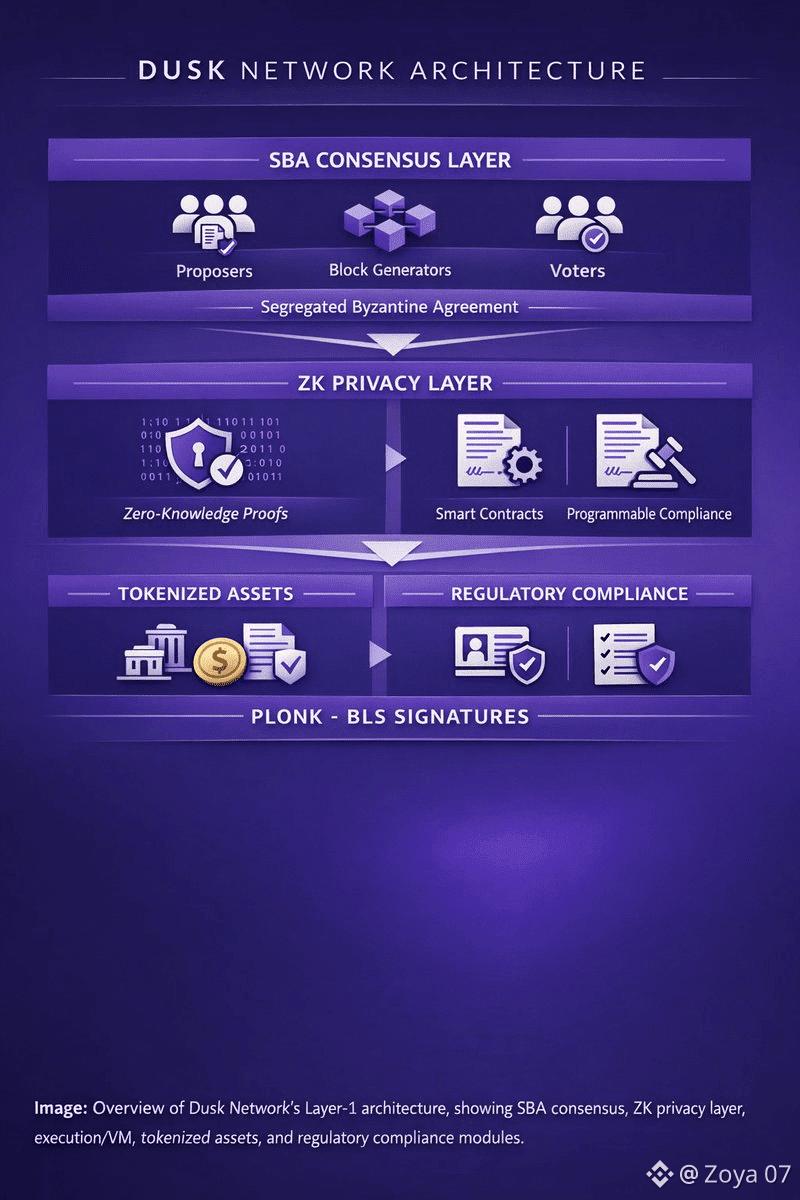
If you look under the hood of Dusk’s architecture you find a few named pieces that help explain how those goals are achieved. DuskDS is described as the data and settlement layer responsible for consensus and availability; it is meant to deliver near-instant, deterministic finality so that market settlements don’t leave participants waiting or worried about later chain reorganizations. Complementing that, the stack includes execution components often discussed as DuskEVM or confidential contract frameworks that let Solidity-style developers or those building traditional financial rails interact with private state. The whitepaper and docs also introduce specialized transaction models (examples given in the literature include designs like Phoenix and hybrid models) that allow confidential spending, confidential contract execution and a path for “selective disclosure” so compliance checks can be made without publishing full transaction histories. The overall picture is intentionally modular: keep settlement and data availability strictly auditable and fast, while making privacy a first-class feature of contract execution. 
Tokenomics and network economics were designed to support this institutional focus. The native asset, commonly traded under the ticker DUSK, functions as the staking and economic instrument that secures the protocol; circulating and max supply figures are published on market data aggregators and exchanges, and the token is used for staking by provisioners who participate in consensus as well as for fees and certain governance-adjacent functions. Public market pages show hundreds of millions of tokens in circulation and a fractional portion of a larger maximum supply, reflecting typical Layer-1 issuance schedules and allocation to early backers, teams and ecosystem incentives. Those pages are also useful if you want live price, volume and market cap context when evaluating adoption, though of course secondary market metrics don’t by themselves prove technological maturity.
On the product and market side Dusk’s narrative centers on tokenized real-world assets (RWAs), compliant decentralized finance and confidential but auditable securities. That means the project pitches itself to custodians, exchanges and regulated marketplaces that want the benefits of on-chain settlement composability, settlement certainty, 24/7 markets while staying within legal regimes that demand audit trails or privacy protections for customers. The documentation and outreach material repeatedly emphasize use cases such as confidential issuance of security tokens, programmable compliance rules that can be enforced without leaking personal data, and low-latency settlement for institutional trading. Those are precisely the scenarios where deterministic finality and selective disclosure carry meaningful commercial value.
No technology is without trade-offs. Zero-knowledge constructions and specialized privacy transaction models add cryptographic complexity and engineering cost. Proof generation, verification costs and the careful design needed to allow selective disclosure all increase the bar for developers relative to “transparent” smart contract platforms. The whitepaper and technical commentary point out these trade-offs: privacy and compliance require novel protocols and more sophisticated developer tooling, and there is a practical engineering burden to get the implementations both performant and correct. That said, the Dusk team’s approach aims to mitigate these costs through compact proofs, committee-based consensus that minimizes communication overhead and modular tooling so teams can adopt only the pieces they need.
As for milestones and the state of the network, the project’s communications in mid-2024 announced a mainnet launch date (the team set a live-network target for September 20th as part of a phase that brought Dusk’s privacy and settlement layers into production readiness). Developer repositories and documentation continue to be the best single source for implementation specifics and the evolving roadmap: if you want to trace the exact technical changes protocol releases, consensus parameter adjustments, the introduction of DuskEVM modules or updates to the confidential contract primitives the project’s docs, GitHub repository and whitepaper are where the block-level or commit-level changes get recorded and described.
Taken together, Dusk is an explicit experiment in reconciling two worlds that often seem opposed: the requirements of regulated finance and the cryptographic desire for privacy. It approaches that reconciliation by designing consensus for fast, final settlement, by baking zk-cryptography into its transaction and contract models, and by keeping the system modular so institutions can plug into only what they need. Whether that formula gains broad adoption will depend on a mix of engineering execution, regulatory clarity in jurisdictions where tokenized assets matter, and the degree to which custodians, exchanges and institutional investors trust the privacy-plus-audit model enough to move real capital onto chain. For readers who want to dig deeper into the protocol mechanics, the whitepaper and the official developer documentation provide the canonical technical descriptions, while market pages give live token and economic data.