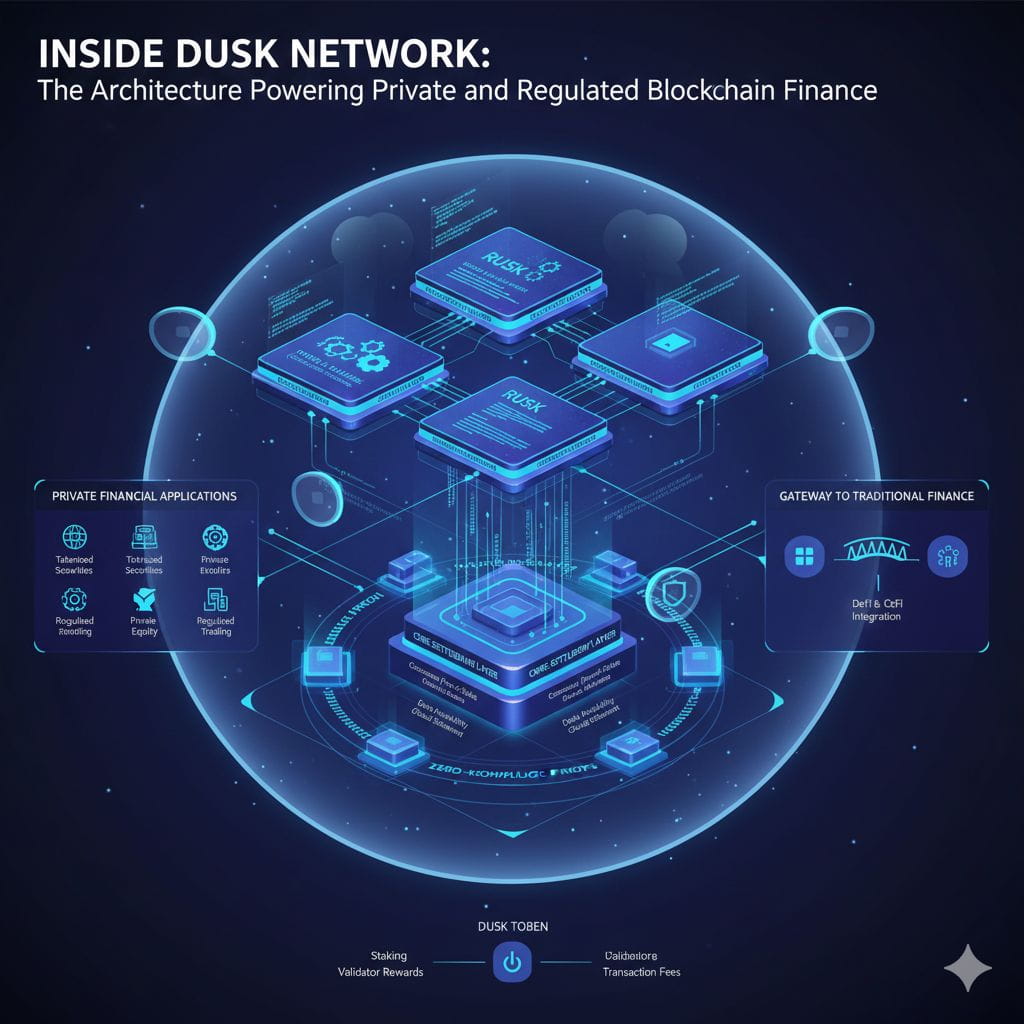
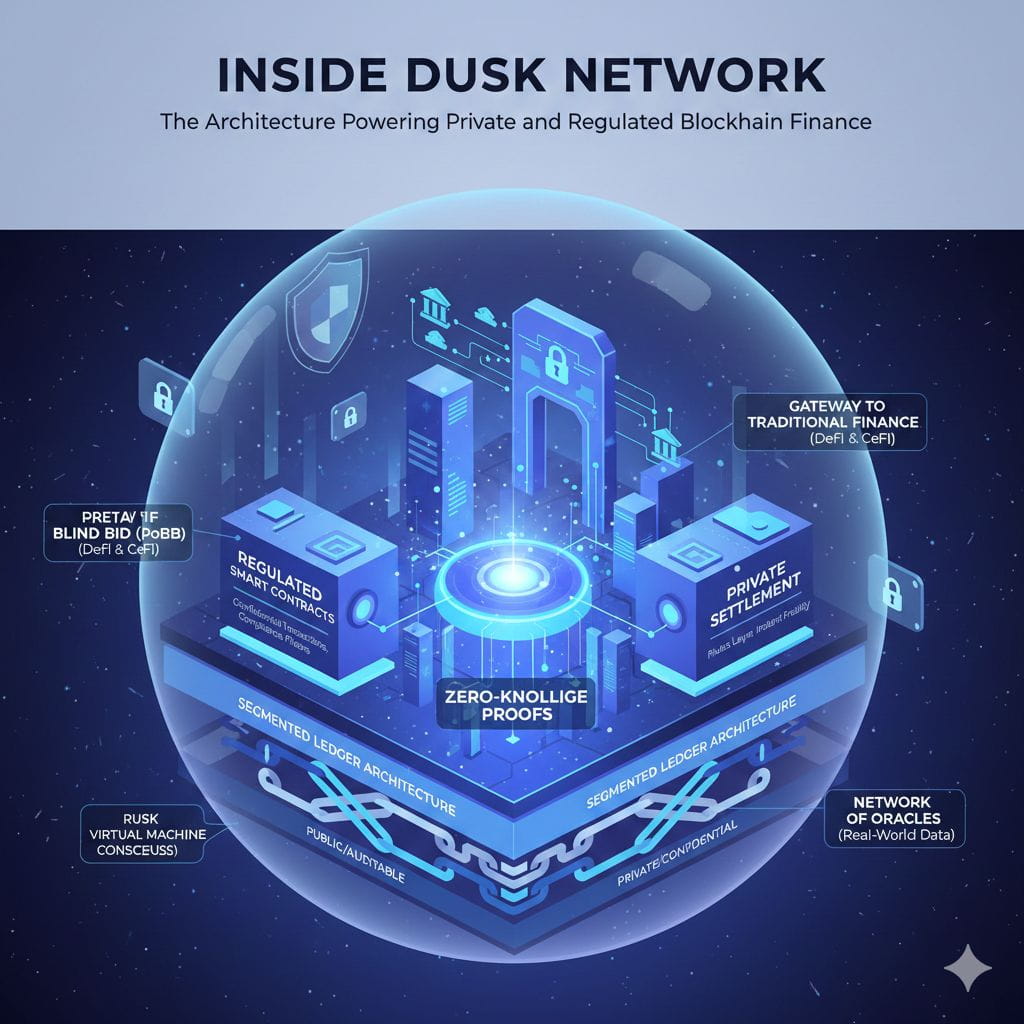
Dusk Network is engineered with a very specific objective in mind: to support financial markets that require privacy, compliance, and reliability at the protocol level. Unlike many blockchain platforms that treat privacy and regulation as optional layers, Dusk embeds these requirements directly into its architectural design. The result is a purpose-built Layer-1 blockchain where confidential transactions, regulated financial instruments, and institutional-grade applications can coexist on a public network.
At the heart of Dusk’s architecture is a modular Layer-1 framework designed to separate concerns and reduce systemic complexity. The base layer is responsible for consensus, data availability, and settlement, ensuring that the network remains secure, decentralized, and verifiable. By isolating these core functions, Dusk avoids the bottlenecks and rigidity seen in monolithic blockchains, allowing the protocol to scale and evolve without compromising stability.
One of the defining elements of Dusk’s architecture is its approach to execution environments. Rather than locking developers into a single virtual machine, Dusk supports multiple execution layers that can run in parallel above the core settlement layer. This design allows different types of smart contracts and applications to operate under distinct rulesets while sharing the same secure foundation. It also makes the network adaptable to future standards, regulatory changes, and emerging developer needs.
Privacy is not implemented as a secondary feature but as a native capability within Dusk’s architecture. The network uses advanced cryptographic systems, including zero-knowledge proofs, to enable confidential smart contracts and private transactions. This allows financial activity to remain shielded from public view while still being provably correct. Institutions can transact, issue assets, or manage ownership structures without exposing sensitive data, yet auditors and regulators can verify compliance through cryptographic proofs when required.
The consensus layer of Dusk is built around a proof-of-stake mechanism that prioritizes both security and efficiency. Validators are selected based on their stake in the network, aligning economic incentives with honest behavior. This system reduces energy consumption while maintaining strong fault tolerance. The architecture also allows token holders to participate indirectly by delegating stake, further decentralizing network security.
Another important architectural feature is how Dusk handles data availability. Financial systems often require guarantees that transaction data can be accessed and verified even if individual participants go offline. Dusk’s design ensures that all necessary data is available at the protocol level while still respecting privacy constraints. This balance is critical for regulated markets, where data must be both protected and reliably retrievable.
Smart contract functionality on Dusk is designed specifically for financial logic. Unlike general-purpose platforms that prioritize flexibility over safety, Dusk’s architecture enforces stricter execution rules to reduce attack surfaces and unintended behavior. This is especially important for applications dealing with high-value assets, compliance logic, and legally binding financial agreements. Developers benefit from an environment optimized for correctness rather than experimentation.
The DUSK token is deeply integrated into the network’s architecture. It is used to pay for computation, secure the network through staking, and incentivize validator participation. Transaction fees and staking rewards are embedded into the economic layer of the protocol, ensuring that network usage directly supports its security and sustainability. Over time, governance mechanisms allow token holders to influence architectural upgrades and economic parameters.
From a real-world perspective, Dusk’s architecture is designed to support use cases that traditional blockchains struggle to handle. Tokenized securities, private equity instruments, regulated trading platforms, and institutional settlement systems all require confidentiality and compliance by default. Dusk enables these applications to operate on a decentralized network without leaking sensitive information or violating regulatory standards.
The team behind Dusk approached architecture as a long-term commitment rather than a quick implementation. Drawing from backgrounds in cryptography, distributed systems, and financial infrastructure, the team designed the protocol to meet institutional expectations from day one. This focus on foundational correctness has shaped every architectural decision, from consensus to execution to privacy.
Market interest in Dusk has grown alongside awareness of its architectural strengths. While price action reflects broader market cycles, the network’s value proposition is tied to its technical design rather than speculative trends. As regulatory clarity improves globally, infrastructure that already accounts for compliance is likely to become increasingly valuable.
Looking ahead, Dusk’s architecture positions it well for future expansion. The modular design allows new execution environments, improved privacy systems, and performance enhancements to be added without disrupting existing applications. This flexibility ensures that the network can adapt to evolving financial standards and technological advances.
In essence, Dusk Network’s architecture represents a shift in how blockchain infrastructure is built for finance. By treating privacy, compliance, and modularity as first-class design principles, Dusk offers a foundation capable of supporting real-world financial systems on-chain. Rather than chasing mass adoption through simplicity alone, it focuses on delivering the structural integrity required for decentralized finance to operate at institutional scale.