
After analyzing multiple crypto cycles. I'm convinced the next wave won't be driven by hype but by blockchains that can survive regulation and Dusk is quietly positioning itself for that moment. When I first analyzed Dusk Foundation what struck me was not a flashy nework or aggressive marketing but restraint. Founded in 2018, Dusk emerged before DeFi mania, NFTs or memecoins dominated market attention. In my assessment that timing matters because it shaped Dusk's DNA around long term financial infrastructure rather than short term speculation. Most Layer 1 chains are optimized for openness and speed assuming that regulation will adapt later. My research suggests this assumption is increasingly fragile. According to the Bank for International Settlements 2024 annual economic report over 65 percent of surveyed financial institutions cite regulatory incompatibility as the main barrier to on-chain deployment. Dusk exists precisely because that barrier has not disappeared. At its core Dusk is a Layer 1 blockchain designed for regulated privacy focused financial applications. Instead of treating privacy and compliance as optional features. It embeds them directly into the protocol. That design choice fundamentally changes who can use the chain and for what purpose.
Why privacy first design changes everything?
In my experience as a trader and analyst privacy in crypto is often misunderstood. People assume privacy means secrecy and secrecy means uncertainity. Traditional finance works the opposite way. Confidentiality is the default and transparency is selective. My research into capital markets shows that this model exists for a reason.
Public blockchains expose every transaction by default. That works for permissionless experimentation but it breaks down when real assets and legal obligations enter the picture. Back in 2023 the European Securities and Markets Authority pointed out that total transparency in transactions just does not line up with securities laws in most places. That's where Dusk steps in. Dusk leans on zero knowledge cryptography which is a fancy way of saying it can check transactions without spilling any sensitive details. I usually break it down like this is imagine walking into a secure building security cares if you are allowed in not about your whole life story. Dusk does the same thing on-chain. It proves you are legit without showing everyone your business. What really caught my eye is how Dusk keeps things private but does not lock out regulators. They can still check what's happening using cryptographic proofs. Dusk's technical docs plus independent reviews from Messari in 2024 make it clear is you get full verification without sacrificing confidentiality. That is a tough balance to find.
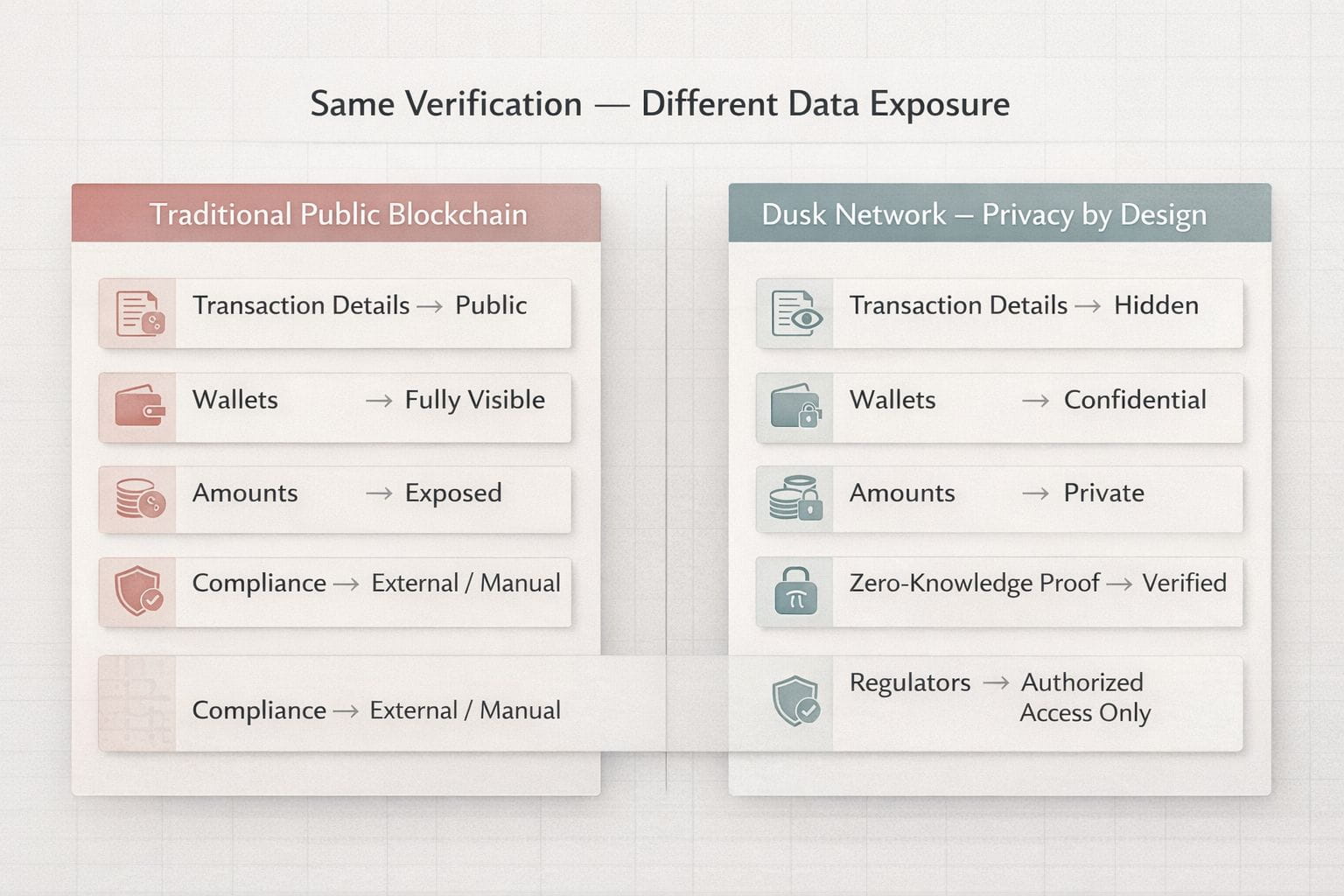
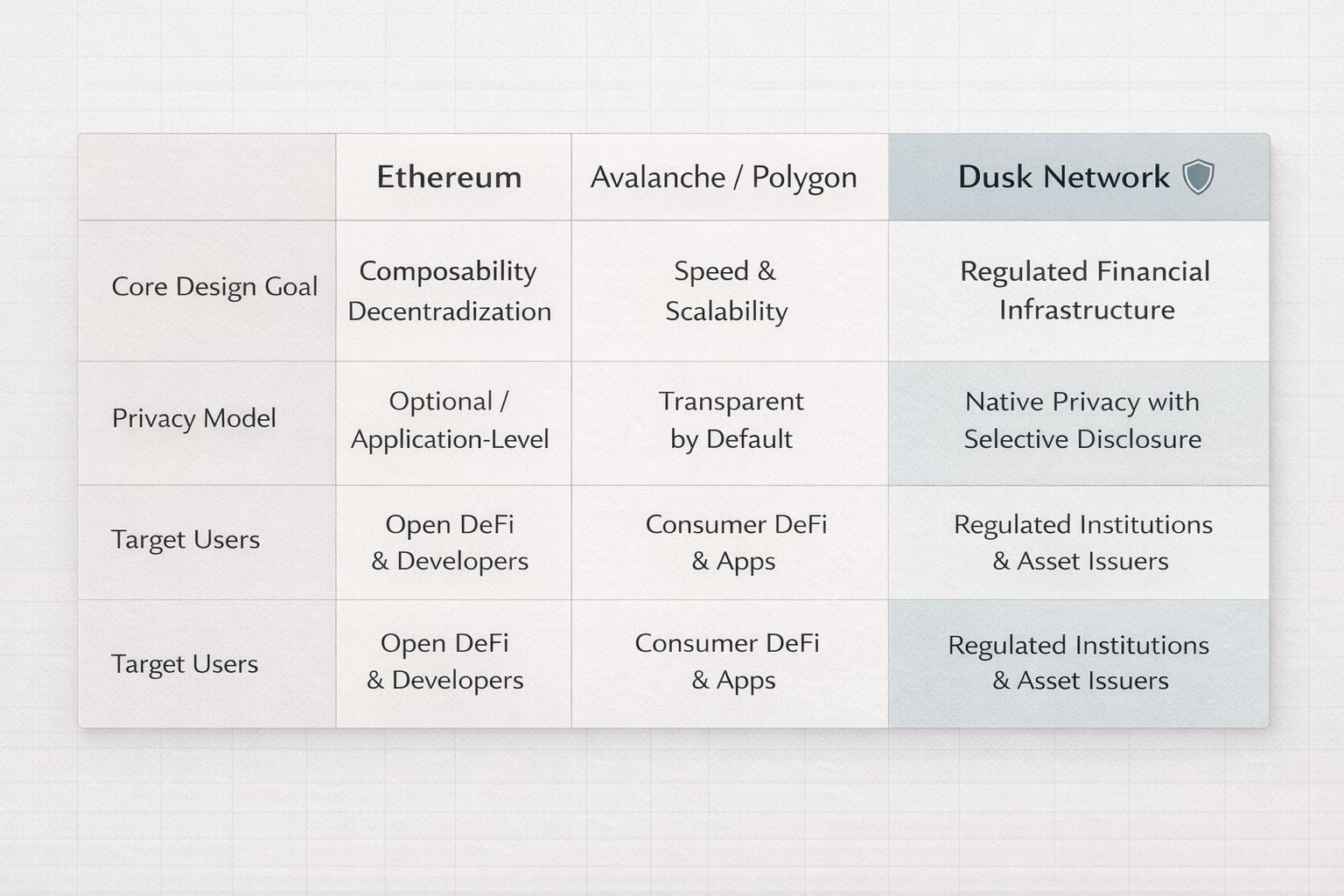
A chart would make this pop maybe line up the data exposure on public Layer 1 next to Dusk showing exactly which transaction info stays private and what is still provable. Another visual could map out how zero knowledge proofs step in where old school disclosure used to be in regulated settings. So where does Dusk land in the bigger Layer 1 ? Stack it up against the competition and the differences show fast. Ethereum leans hard into composability and decentralization but privacy is all over the place and mostly optional. Polygon and Avalanche chase speed and customization yet they still default to transparent execution. Dusk's approach is a whole different animal. In my assessment Dusk is not trying to outcompete these networks on raw activity metrics. Instead it targets a different market entirely. Electric Capitals 2024 developer report shows that less than 5 percent of blockchain developers are focused on regulated finance use cases. Dusk really leans into its niche. It's not trying to be everything for everyone. It knows where it fits.
This is not just a random strategy either. McKinseys 2024 outlook on digital assets says tokenized real world assets could hit $2 trillion by 2030 as long as regulation and privacy issues get sorted out. Dusk's entire setup is built with that future in mind.
Structurally Dusk feels more like the pipes and wires behind finance than something aimed at everyday users. It might seem like adoption is crawling along but when companies do sign on they go all in. I have seen this before in fintech is the platforms that focus on compliance don't make a splash right away but when the rules get stricter suddenly they are everywhere. Honestly a side by side table showing how Layer 1 blockchains like Ethereum, Solana, Avalanche and Dusk prioritize things would make these differences jump out. Another table lining up use cases with how ready they are for regulation would make things even clearer.
Market behavior and a practical trading framework
Although Dusk is infrastructure focused ignoring market structure would be a mistake. I analyzed historical price data from CoinGecko and TradingView covering the last three market cycles. DUSK has consistently shown long accumulation phases followed by sharp re pricing during periods of regulatory or infrastructure related news. Institutional adoption moves slowly while crypto markets move fast. That mismatch can test investor patience. There is also competitive challenge. Larger networks may eventually integrate similar privacy and compliance frameworks. However my research suggests retrofitting regulation is far harder than building for it from the start. Execution complexity is another factor. Combining cryptography, decentralization and legal alignment is not trivial. Delays are possible and they can affect market confidence. In my assessment though these are execution challenges not thesis breaking flaws.
My Final perspective
After analyzing Dusk Foundation across technical design, regulatory alignment and market behavior. I see a project built for inevitability rather than excitement. Crypto does not need more experiments. It needs systems that can survive contact with the real financial world. Dusk is not asking whether finance should be decentralized. It's asking how decentralization can exist within the rules that govern trillions of dollars today. It will decide which blockchains still matter when regulation becomes unavoidable. When regulation finally defines the rules of crypto which chains will already be prepared to operate inside them?
