
Last summer, I was digging into a portfolio position tied to tokenized assets, trying to bridge part of my traditional holdings into a decentralized setup. On paper, it looked efficient. In practice, the privacy gaps were impossible to ignore. Every transaction was visible to anyone watching the chain, yet proving compliance without laying everything bare felt awkward at best. Having spent years around trading and infrastructure, I’ve seen how this exact tension keeps institutions cautious. It left me questioning whether blockchains could ever support sensitive financial flows without becoming open books or regulatory headaches.
The underlying snag is simple. Public ledgers are great at transparency, but finance depends on confidentiality paired with verifiability. Traders don’t want to reveal position sizes or counterparties, while regulators still need confidence that rules are being followed. Without native ways to hide details while proving correctness, adoption stalls. Developers hesitate to build compliant products, and real settlement activity stays locked in slow, expensive legacy rails.
A useful analogy is a sealed envelope in a courtroom. The contents stay hidden from the gallery, but the judge can confirm the seal is intact and legitimate without opening it. That’s the promise of zero-knowledge proofs: proving something is true without exposing the underlying information.
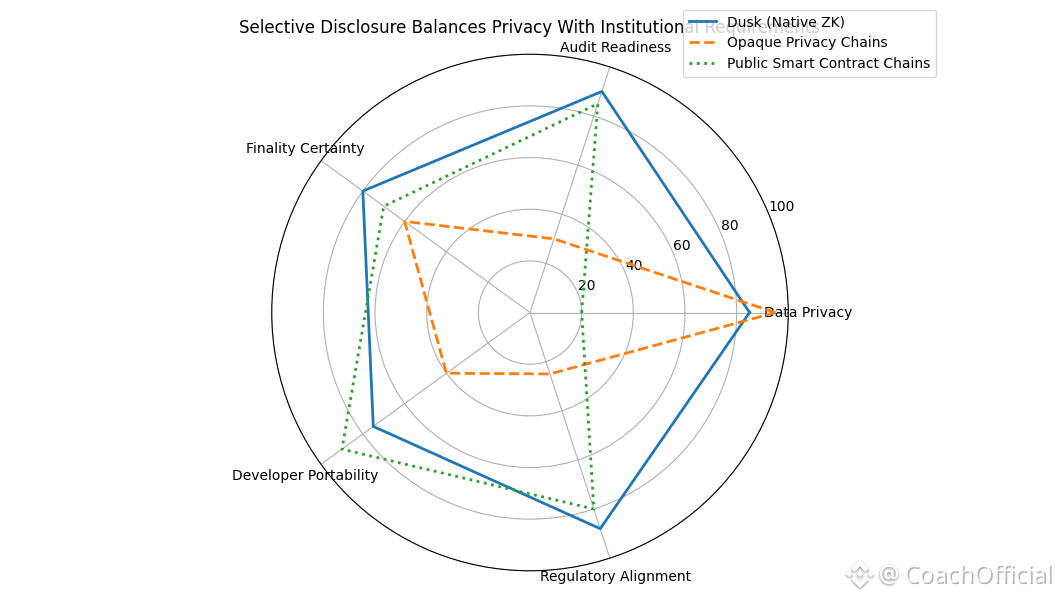
This is where Dusk Network positions itself. Its architecture weaves zero-knowledge technology directly into the base layer, targeting regulated financial use cases rather than generic experimentation. Transactions can remain private while still producing cryptographic proofs that auditors or counterparties can verify. A core component is the Rusk virtual machine, which runs these proofs efficiently. Using PLONK circuits, it can batch multiple verifications into compact proofs, keeping overhead manageable even as complexity grows. The Phoenix module handles confidential transfers by hiding amounts and ownership while enforcing correctness through range proofs to prevent double-spending.
Recent development milestones matter here. The DuskEVM upgrade, live on testnet in late 2025, brings Ethereum-compatible tooling, lowering friction for developers migrating existing applications. Earlier mainnet updates enabled third-party contracts from day one, signaling a move beyond closed pilots. For data-heavy workflows, Dusk can lean on complementary infrastructure like Walrus Protocol, which handles large blobs off-chain using erasure-coded shards across distributed nodes. Core settlement proofs stay on-ledger for compliance, while bulk data avoids bloating the chain.
The DUSK token fits into this setup without theatrics. It pays for execution and proof verification, and it’s staked by provisioners to participate in consensus. In practice, that means confidential settlements consume gas, while staking directly supports network security and governance decisions. Utility is tied to uptime and usage, not narrative embellishment.
From a market standpoint, the project sits around a $120 million capitalization, with daily volumes often in the same range during volatile periods. That places it firmly in niche territory, not dominance, but it reflects sustained interest in privacy-focused infrastructure.
Short-term trading tends to follow sentiment cycles. Privacy narratives or integrations, like the one with Chainlink in late 2025, can drive sharp moves, followed by equally sharp pullbacks when the broader market cools. I’ve seen similar assets double quickly only to retrace just as fast. Long-term, the more interesting question is infrastructure adoption. If features like Hedger for confidential DuskEVM trades attract real volume, and if partnerships with regulated venues like NPEX scale into hundreds of millions in on-chain securities, demand could build steadily rather than explosively.
There are real risks. Competing privacy-focused platforms such as Secret or Aztec have larger developer communities and could iterate faster. Regulatory clarity cuts both ways; frameworks like MiCA might validate Dusk’s approach or impose constraints that slow deployment. A serious failure mode would be a flaw in the PLONK circuits during a high-value settlement, undermining trust overnight. Even auxiliary pieces like Walrus depend on sustained node participation; if incentives weaken, data availability assumptions could be tested.
Ultimately, infrastructure shifts in finance rarely arrive with fireworks. They creep in through integrations that work, audits that pass, and systems that don’t break under pressure. Whether Dusk’s confidential settlement model becomes foundational will depend less on hype and more on how quietly and reliably it fits into real financial workflows, one settlement at a time.
@Dusk #Dusk $DUSK
