
A few months ago, I was mapping out a possible move into tokenized assets, trying to connect traditional market logic with on-chain execution. I’ve spent years pulling apart infrastructure designs, so I started sketching what a compliant trade would actually look like. That’s when the cracks showed. Most privacy tools felt unfinished—either too open, risking leaks, or so sealed off that they raised red flags for compliance. It drove home a familiar frustration: many systems chase speed or scale, but sidestep the harder problem of making privacy usable without breaking decentralization or rules.
The challenge itself isn’t complicated. Finance needs discretion. Open ledgers do the opposite by default, exposing everything and forcing institutions into awkward compromises. To work around that, teams push activity off-chain or bolt on cryptography that adds latency, complexity, or compliance uncertainty. The result is friction everywhere. Trades and settlements that should be routine become fragile, slowed by tools that don’t quite fit real-world requirements.
I keep coming back to a poker table analogy. Players keep their cards hidden, but the casino still enforces the rules. No one sees your hand, yet everyone trusts the outcome. That balance—privacy without loss of oversight—is what serious financial systems need, and it’s harder to get right than it sounds.
That’s where Dusk Network takes a different approach. Its layer-1 design is built around compliant privacy from the ground up, using a segregated consensus model. Block generators propose transactions blindly, while a separate set of provisioners validate and finalize them. This structure, known as Proof of Blind Bid, reduces manipulation and front-running by hiding bids during leader selection. On top of that sits the Rusk virtual machine, which runs confidential smart contracts natively. Tokenized securities, for example, can move without exposing amounts or counterparties, while still embedding compliance logic like KYC or reporting triggers.
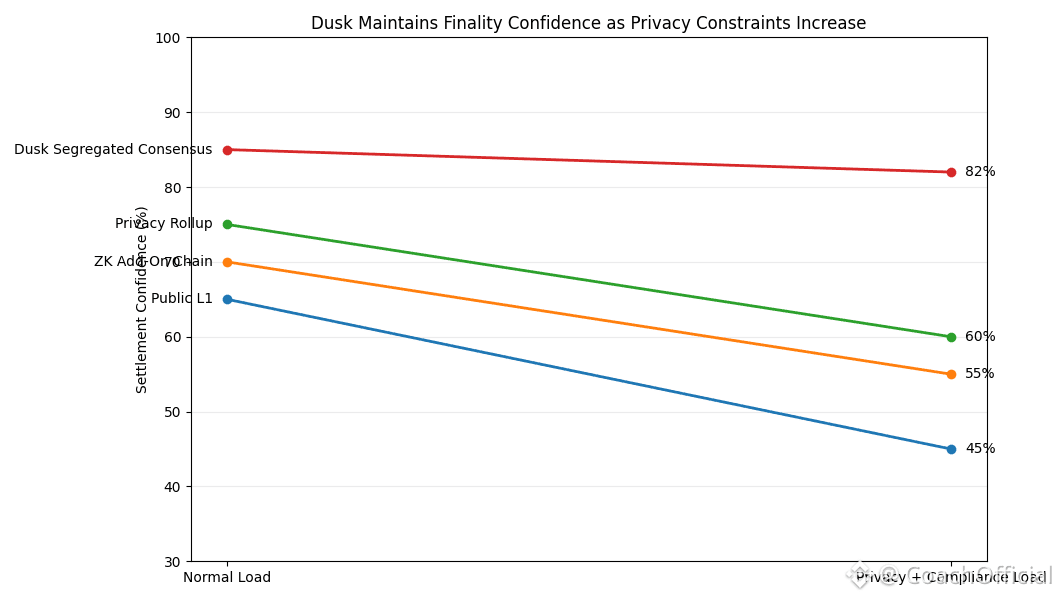
One detail that stood out to me is how the blind bidding works in practice. Nodes submit encrypted bids to participate in block generation, so stake size isn’t publicly telegraphed ahead of time. Another is how Rusk handles privacy without pushing everything into external layers. Zero-knowledge proofs are part of execution itself, not an afterthought. Since the January 7, 2026 mainnet launch, this has moved beyond theory. The partnership with NPEX, which manages around €300 million in assets, signals a push toward live tokenized securities. Early network stats show roughly 200 provisioners active, with throughput hovering near 100 transactions per second so far—still early, but stable, and without visible congestion yet.
The DUSK token fits into this system without drama. It pays for gas on Rusk, staking secures the network by backing provisioners and generators, and governance votes flow through it for upgrades or parameter changes. There’s no extra narrative layered on top. If the network is used, the token is used. If it isn’t, the token doesn’t pretend otherwise.
From a market angle, capitalization sits around the $100 million mark, with daily volume closer to $50 million recently. That suggests interest after mainnet, but nothing resembling mania.
Short-term trading tends to mirror privacy or RWA narratives. We saw that recently with a sharp rally followed by a quick pullback once attention shifted. I’ve watched this pattern repeat across similar projects. Long-term value here depends on whether Rusk attracts more regulated players and whether participation scales smoothly. If provisioner counts grow and throughput expands, fees and staking demand could rise steadily. That kind of value build is slow, and usually ignored by momentum traders.
There are real risks. Established privacy chains like Monero or Zcash already have mindshare, and Ethereum’s own upgrades could absorb parts of this niche. Regulation cuts both ways too. A tighter stance on privacy tech could complicate integrations. One failure mode I keep in mind is coordination risk: if a large chunk of provisioners were compromised or knocked offline, finality could stall, damaging trust when the network is still young.
Projects like this don’t resolve themselves in a quarter or two. They either earn trust slowly or fade when assumptions meet reality. Whether Dusk’s segregated consensus becomes a lasting financial rail will show up quietly—in uptime, in settled volume, and in whether institutions keep building once the novelty wears off.
@Dusk #Dusk $DUSK
