
Last summer, I spent some time digging into tokenized securities for a portfolio allocation. On paper, it looked like a clean bridge between traditional assets and crypto rails. In practice, it was anything but. Most platforms either exposed far too much information or waved compliance away as someone else’s problem. For anything remotely regulated, that was a dead end. Having spent years looking at infrastructure and not just price charts, it was frustrating to see how often onchain finance still ignores the basic realities institutions deal with every day: privacy, audit trails, and accountability living side by side. Too much of the space still feels built for experimentation, not for serious capital.
The problem itself is pretty simple. Blockchains are bad at nuance. Financial systems need discretion without secrecy turning into a black box. Trade sizes, identities, and strategies shouldn’t be public by default, but regulators still need a way to verify that rules are being followed. When that balance doesn’t exist, institutions stay out and users are left with awkward workarounds that add friction and risk. It’s not really about raw speed or cheap fees. It’s about whether onchain tools can function without forcing people to choose between privacy and legality.
I usually think of it like a bank vault. You store valuables in private boxes that no one else can see. At the same time, the bank keeps records that prove the system is operating correctly without opening every box. That’s the standard finance is used to. Onchain systems that want real adoption need something similar, not full transparency or total darkness.
This is the gap Dusk Network is trying to fill. Its layer-1 design is built around privacy-preserving smart contracts meant for regulated assets. The mainnet went live on January 7, and from the start it leaned into zero-knowledge proofs to keep transaction data confidential while still finalizing blocks quickly through its Succinct Attestation consensus. One concrete example is the Phoenix transaction model, which encrypts outputs and handles crossovers between layers without revealing values. Another is DuskEVM, introduced recently, which brings Ethereum compatibility while allowing compliance logic, like KYC checks, to live directly inside contracts.
Early network activity shows how early this still is. Daily transactions have been low since launch, roughly in the hundreds, even though the architecture is built to handle far more. Validator participation is growing, with early staking nodes producing a steady flow of blocks, but it’s clearly a network in its infancy rather than one under real load yet.
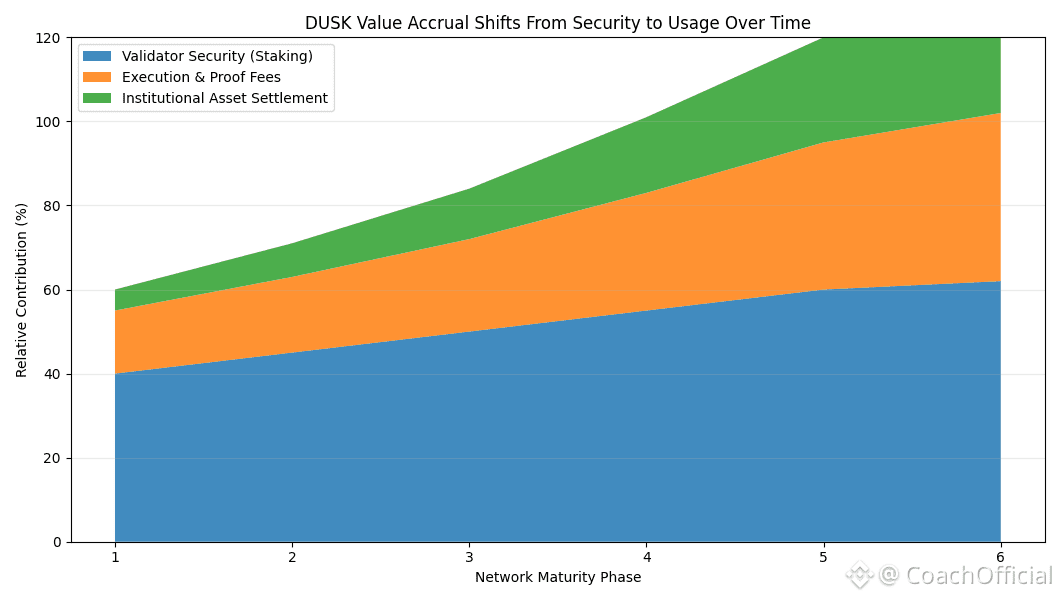
The $DUSK token itself is fairly plain by design. It’s used for staking to secure the network and earn rewards, and it pays for transaction and contract execution fees. Those fees flow through the DUSK Contract, which acts as the gateway for state changes. In practical terms, staking locks up supply to support finality, and fees compensate validators. There’s no complicated story layered on top of that, which I actually see as a positive.
From a market standpoint, the project sits around a $100 million valuation, with trading volume spiking recently during privacy-related rotations. Liquidity is there, but it’s clearly sentiment-driven right now rather than usage-driven.
Short-term trading has been wild. A massive run-up tied to the mainnet launch and cross-chain RWA narratives pulled in a lot of attention, and just as quickly, that kind of momentum can reverse. I’ve traded enough of these cycles to know how fast enthusiasm fades once headlines move on. The longer-term question is whether partnerships like the one with NPEX, which is tokenizing hundreds of millions of euros in assets, translate into consistent onchain activity. If that happens, demand for DUSK through fees and staking becomes structural instead of speculative.
There are real risks here. Established privacy chains like Monero, as well as Ethereum-based zero-knowledge rollups, have bigger ecosystems and mindshare. Regulation cuts both ways too. A shift in how privacy tech is treated could either validate this approach or make adoption harder overnight. One failure scenario I can’t ignore is a cryptographic flaw. If something breaks in Phoenix’s zero-knowledge layer during a high-value settlement, confidence could evaporate fast, triggering unstaking and freezing activity when trust matters most.
Building infrastructure like this is slow and usually unrewarding in the short term. It grows through quiet integrations, not viral moments. Whether Dusk becomes a real rail for compliant onchain finance or just another well-designed experiment will depend less on announcements and more on whether real assets keep settling there months from now. Time, as usual, does the sorting.
@Dusk #Dusk $DUSK
