
Founded in 2018, Dusk began as a focused experiment: build a Layer-1 blockchain that keeps financial data private while still letting regulators and auditors verify the facts they need. From the start the project married two threads that many blockchains treat as opposites confidentiality and compliance and it designed both protocol primitives and governance ideas around that tradeoff. At the technical level Dusk’s stack separates settlement and data availability from execution so that sensitive details can be hidden while proofs and audits remain verifiable; at the product level it aims to be the rails where tokenized real-world assets, regulated securities and institutional DeFi can live without exposing participant bookkeeping to the public. Dusk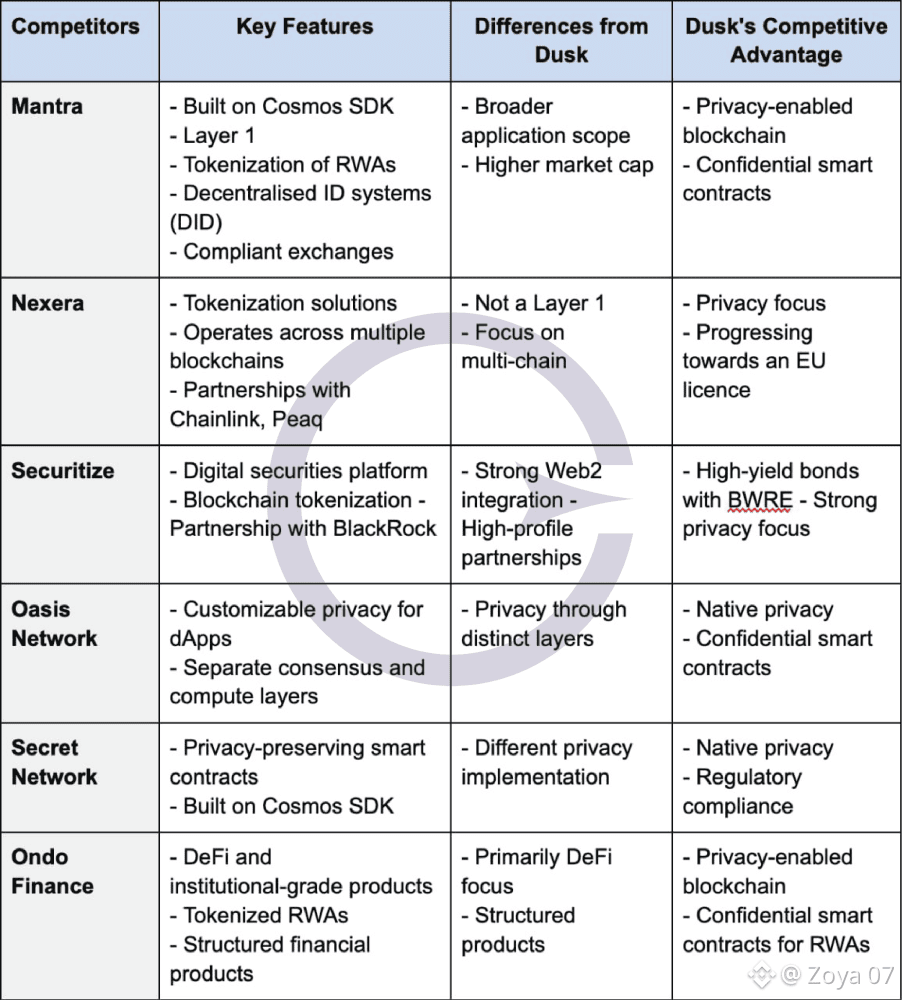
The network’s most visible technical promise is native confidential smart contracts. Rather than relying on external mixers or overlay privacy layers, Dusk builds privacy into the contract model itself so that business logic can run while inputs, outputs or state remain encrypted or revealed only to authorized parties. That approach makes it possible, for example, to issue a token that behaves like a security, let market participants trade it on-chain, and still show regulators a cryptographic audit trail on demand a balance that many financial firms find attractive. The project documentation and use-case materials emphasize this “confidential smart contract” capability as a core differentiator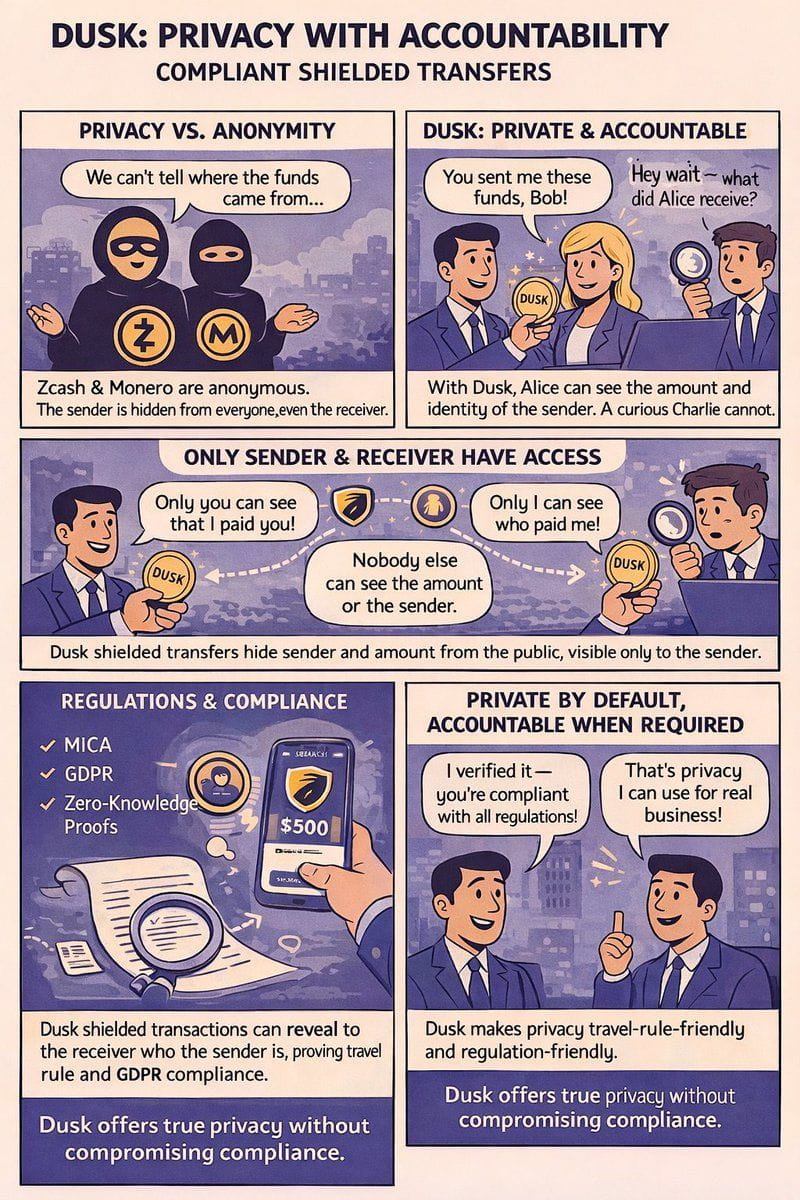
Under the hood the network secures itself with a committee-based proof-of-stake called Succinct Attestation. Instead of long probabilistic finality and frequent reorgs, Succinct Attestation is designed for deterministic finality once a block is ratified, which is a crucial property for settlement systems where a trade that is later reversed creates legal and operational headaches. The consensus design also targets low latency and throughput characteristics that suit market infrastructure, while keeping the barrier to participate manageable so a wide set of validators can help decentralize security. You can find the technical description in Dusk’s core documentation and protocol repositories.
Token design and economics were built to align long-term network security with real utility. DUSK began with an initial tradable supply and an emission schedule designed to reward validators and bootstrap ecosystem efforts; documentation and token pages note an initial supply in the hundreds of millions and a cap that ultimately reaches one billion tokens as emissions continue over time. The protocol uses locked stake to secure the network and allocate rewards, and the foundation has signalled ecosystem allocations for developer grants and market-facing integrations to accelerate real-world issuance. These allocations and the emission schedule are central to how the network aims to support sustained operations, validator incentives and developer activity. 
The project’s roadmap moved from research and testnets into production in recent years. After several testnet phases and major code upgrades in 2024–2025, Dusk executed a phased mainnet rollout: early onboarding and genesis preparations in late 2025 and a live mainnet activation in early January 2026. Those milestones marked the transition from an academic-style protocol to an operating Layer-1 capable of producing immutable blocks, handling validator on-ramping, and supporting the first set of real-world pilot issuances and settlement flows. Public communications and independent trackers also note incremental upgrades that prepared the network’s data layer and execution compatibility in parallel with the mainnet launch.
One of the more practical and recent shifts has been the addition of EVM compatibility through what the team calls DuskEVM. By providing a drop-in EVM execution environment while keeping Dusk’s settlement and privacy guarantees intact, the network lowers the friction for developers to port Ethereum smart contracts and tooling. This is an important commercial step: teams building tokenized assets, custody integrations, or DeFi tooling can reuse battle-tested smart contracts and developer tools while benefiting from Dusk’s privacy and settlement features. Announcements and analysis pieces from late 2025 and early 2026 describe DuskEVM and related upgrades as a major adoption lever.
Beyond core tech, the ecosystem story matters. Dusk has focused on courting asset managers, exchanges and infrastructure providers that need privacy plus auditability: custody providers that must reconcile client positions, securities issuers who must comply with KYC/AML and securities law, and market operators who need clear settlement finality. To support that demand the project invested in developer grants, tooling for regulated issuance (the Confidential Security Token standard and related libraries), and integrations with oracles and interoperability bridges where necessary. Public posts from the foundation and research write-ups document grant programs, partnerships and the messaging to regulated markets.
No technology arrives without tradeoffs and risks. Implementing confidentiality increases complexity for wallets, auditors and user experience because private state and selective disclosure require new UX patterns and legal controls. The security model depends on correct zero-knowledge proofs, prover networks, and the ongoing health of the validator set; any bugs in the privacy or consensus layers could have outsized consequences for funds custody and regulated processes. Market adoption also depends on custody, custodial-grade key management, and clear legal frameworks in jurisdictions that host tokenized securities. These operational and legal hurdles are the clearest near-term constraints on rapid enterprise adoption
For developers and teams watching the space, Dusk’s combination of confidential contracts, deterministic settlement and now EVM compatibility makes it a distinctive option for regulated token projects. If you are building an asset that requires selective disclosure, on-chain settlement, and compatibility with existing Ethereum tooling, Dusk presents a technical path that reduces the need for off-chain reconciliation while keeping auditability. If you are evaluating networks for issuance, focus on the maturity of Dusk’s node software, the clarity of the tokenomics and vesting schedules, the availability of custody partners, and the project’s demonstrated ability to successfully evolve its protocol without disrupting existing settlements those practical touchpoints determine whether a privacy-first Layer-1 is a good fit for your organization.
