
A few months ago, I tried a small test trade in tokenized bonds through a DeFi setup. Nothing big, just enough to see how real-world assets actually behave on-chain. What stood out wasn’t price risk, but friction. Transaction details were visible enough that anyone watching the ledger could piece together positions, while meeting KYC rules meant handing over far more information than felt reasonable. Having traded infrastructure tokens and built a few simple bots over the years, that imbalance bothered me. Every option felt wrong: go fully private and invite regulatory trouble, or accept exposure that kills discretion and slows execution with off-chain checks. It wasn’t a blow-up, just a steady reminder that most tooling still isn’t designed for institutions that need both speed and restraint.
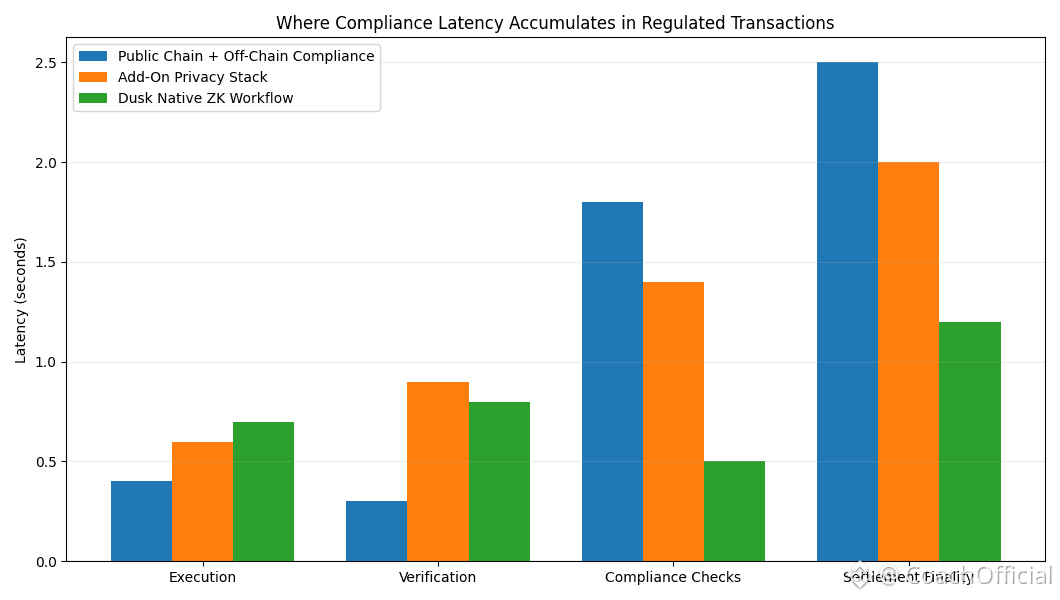
That experience points to a deeper problem. Most blockchains are built around transparency by default. That’s great for audits and censorship resistance, but awkward for regulated finance, where the goal isn’t to hide everything, but to reveal only what’s necessary. Issuing securities, managing client funds, or settling regulated trades all require proof of compliance without turning every detail into public data. When that balance isn’t native, costs rise through external verification, settlements slow down, and users hesitate because of data exposure. Developers try to patch this with add-on privacy layers, but those usually feel bolted on—fast in one place, fragile or slow in another. The result looks innovative on the surface, but struggles once real regulatory pressure shows up.
I tend to compare it to medical records. Doctors need access to specific details. Regulators need audit trails. Patients expect privacy. If the system can’t separate those views cleanly, everything bogs down in paperwork and delays. Finance isn’t much different. Without a built-in way to separate visibility from verification, workflows never quite run smoothly.
This is where Dusk takes a noticeably different path. Instead of chasing every DeFi trend, it narrows its focus to regulated financial use cases and builds privacy directly into the base layer. Zero-knowledge proofs aren’t an add-on; they’re part of how the system works from the ground up. Transactions and smart contracts can stay confidential while still being provable. The design deliberately trades broad, hype-driven scalability for predictability in compliance-heavy environments. That trade-off matters if you’re an institution that values reliability more than viral activity, especially when dealing with securities-style rules.
Under the hood, the network runs a consensus model called Proof of Blind Bid. Validators stake and compete to produce blocks through encrypted bids, which helps prevent front-running and strategy leakage while keeping participation open. The Rusk virtual machine, updated in practice, late last year, executes confidential smart contracts using PLONK-based zero-knowledge proofs. Computation happens privately, but verification is enforced on-chain, so settlements stay discreet without losing enforceability. Alongside this, the Phoenix transaction model allows asset transfers where amounts and owners are hidden by default, yet proofs can be revealed to regulators when required. It’s not the absolute fastest setup, but it’s clearly tuned for consistency under scrutiny.
The DUSK token itself stays mostly utilitarian. It pays for transaction execution, with fees scaling based on computational load to discourage spam. Validators stake it within the blind in practice, bidding process to secure consensus and earn rewards from emissions and fees. Governance also runs through it, giving holders a say in upgrades like recent oracle integrations that support private contracts. There’s no elaborate token story here; its role is tied directly to keeping the network running and decisions decentralized.
Since mainnet activation in early January, circulating supply sits around 500 million tokens. Trading volumes have hovered in the tens of millions per day, boosted partly by broader privacy-sector rotations. Futures interest has picked up too, which reflects speculation more than organic network usage at this stage.
Short-term trading around projects like this is familiar: sharp moves driven by narratives around RWAs, listings, or privacy themes, followed by equally sharp pullbacks once attention shifts. I’ve seen assets run hard and then give much of it back when momentum fades. The longer-term question is different. If workflows like NPEX’s planned deployments actually move hundreds of millions in regulated assets on-chain, demand would come from repeated settlements, fees, and staking rather than hype. That kind of value builds slowly, transaction by transaction.
There are real risks. Competing privacy systems, Ethereum’s expanding ZK stack, or institutions sticking with permissioned chains could all limit adoption. Technical strain is another concern. If proof generation becomes a bottleneck during a high-volume issuance, settlement delays could hurt confidence right when reliability matters most. Regulatory interpretation is still evolving too—auditable zero-knowledge may be welcomed, or it may face tighter scrutiny.
In the end, infrastructure like this doesn’t prove itself through announcements. It proves itself when regulated transactions quietly settle day after day without drama. Whether Dusk gets there depends less on market noise and more on whether institutions keep coming back for the second, third, and hundredth transaction.
@Dusk #Dusk $DUSK
