
A few months back, right around the holidays, I was wrapping up a cross-chain move for some stablecoins I had parked in a lending pool. Nothing urgent. Just shifting things around to squeeze a bit more yield. Still, it dragged longer than it should have. Fees moved halfway through, the bridge slowed down, and I kept checking confirmations because the network was clearly busy with trades, games, and whatever else people were piling into at the time. I’ve been around infrastructure tokens for years and have written my share of small scripts, so I wasn’t surprised. Just annoyed. Moving pegged dollars shouldn’t feel this unpredictable. That part stuck with me more than the delay itself.
Most of the time, this comes back to scope. A lot of chains try to do everything. Payments, NFTs, leverage, games, social layers, all at once. On paper, that sounds efficient. In practice, basic transfers pay the price. When block space fills up with speculative activity, fees jump and confirmations stretch out. Users notice it right away, especially when they’re not trying to do anything complex. Developers notice it too. Composability looks elegant, but it usually means payments are competing with whatever narrative is hot that week. Performance becomes uneven. This isn’t flashy friction. It’s the quiet kind that keeps these systems from replacing traditional rails, where predictability is taken for granted.
I usually think about it in terms of transport. A city bus makes stops everywhere and gets caught in traffic. You eventually get there, but timing is a guess. A dedicated freight lane gives up flexibility, but deliveries arrive when they’re supposed to. That trade-off matters more than people like to admit.
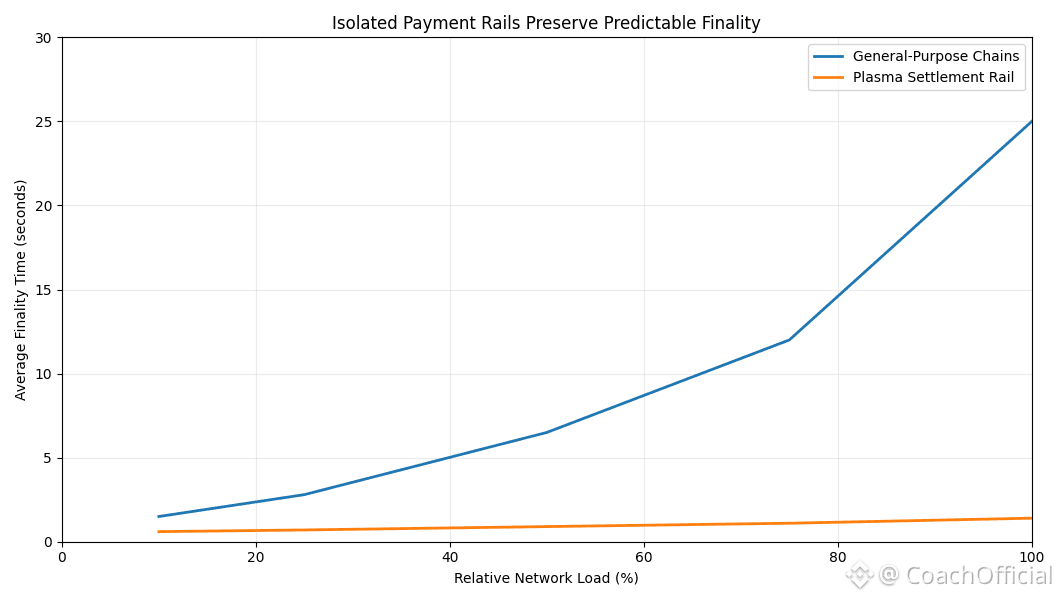
That way of thinking explains Plasma’s design choices. It narrows its focus to in practice, stablecoin settlement and avoids broader ambitions that introduce volatility elsewhere. The chain behaves like a conveyor belt built specifically for dollar-pegged assets, prioritizing deterministic settlement over maximum composability. That means excluding things like DeFi derivatives or gaming logic that can distort execution under load. In practice, stablecoins start behaving more like digital cash. Fees stay predictable. Confirmations stay fast. Security is tuned for preserving value, not experimenting. The EVM remains familiar, but with tight constraints to avoid bloat. Since the post-beta refinements in late 2025, bridge mechanics have been tuned so cross-chain settlements finalize in under a minute, even during congestion, by keeping stablecoin traffic isolated from demand spikes elsewhere.
On the technical side, that isolation shows up in a couple of very deliberate choices. The first is PlasmaBFT, a modified HotStuff-style consensus that pipelines proposal, pre-commit, and commit phases. This allows sub-second blocks while still tolerating Byzantine faults up to one-third of validators. Speed isn’t really the headline here. Determinism is. In controlled tests, throughput clears 1,000 TPS without the probabilistic delays you see on more generalized chains. On mainnet, after the January 2026 updates, average throughput has moved up to about 7.2 TPS, from 5.6 TPS the quarter before, as integrations like expanded Aave deployments came online. The second choice is the built-in paymaster system. It lets protocols sponsor gas for basic USDT and USDC transfers, capped at 100 transactions per wallet per hour. That cap matters. Simple transfers don’t fail over gas issues, and non-stablecoin contracts are rejected outright to keep execution stable.
XPL plays a narrow role by design. It covers fees for non-sponsored actions like validator operations or more complex settlements. Validators stake XPL to secure the chain, with roughly 45% of circulating supply currently locked, which raises the cost of coordinated faults. Finality increasingly depends on in practice, that stake, with slashing enforced if deterministic rules are broken. Governance runs through XPL as well, including recent votes adjusting inflation parameters. Emissions started around 5% annually and have tapered to roughly 3.5% after the 2026 adjustments, with a burn mechanism similar to EIP-1559 tied directly to transaction volume. Everything feeds back into one goal: predictable settlement, not speculative upside.
From a market standpoint, capitalization sits near $280 million, following a modest bump after the early January ecosystem unlock. Daily volume has been holding around $110 million, enough liquidity without getting overheated. On-chain usage shows direction rather than dominance. Stablecoin deposits have reached $8.2 billion across 28 variants, and cumulative transactions have passed 180 million since launch.
Short-term trading tends to react to events. The January 2026 unlock of 88 million tokens briefly pressured supply before things settled. Integrations like Tangem wallet support or Pendle expansions produced 20–30% swings, but those moves faded quickly. Long-term, the bet is about habit formation. If predictable settlement keeps attracting merchant payments or remittance flows, value builds through fees and sustained staking demand. Infrastructure rarely rewards impatience. It works when people come back again and again because nothing breaks.
There are real risks. Broader chains like Solana offer comparable speeds with far more composability, which could pull developers away if Plasma’s narrow scope feels too limiting. Stablecoin issuers may default to more familiar layers for regulatory comfort. One failure scenario that keeps coming up is a large liquidity event. If validator participation drops below 40% after an unlock-driven unstaking wave, settlement times could stretch from seconds to minutes, freezing transfers and damaging trust in the determinism pitch. Regulatory uncertainty in 2026, especially around stablecoin oversight in the US and EU, adds another variable.
In the end, projects like this don’t prove themselves loudly. They prove themselves through repetition. If users start treating it like infrastructure instead of an experiment, the limited scope starts to matter. That only shows up over time, one settlement at a time.
@Plasma #Plasma $XPL


