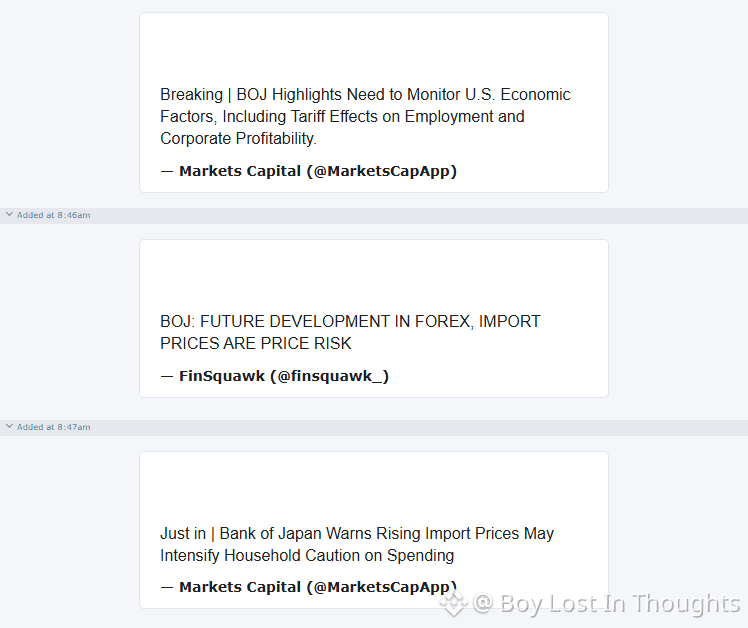
The Bank of Japan (BOJ) projects a continued moderate economic expansion with underlying inflation moving towards its 2% target, sustained by a strengthening wage-price cycle.
📈 Key Economic and Price Outlook
General Forecast:
Japan's economy is projected to continue growing moderately, driven by a virtuous cycle from income to spending.
Core inflation is expected to dip temporarily but return sustainably to the 2% target by the second half of 2027.
Real GDP Growth:
Fiscal 2025: Projection is somewhat higher due to stronger overseas growth and GDP data revisions.
Fiscal 2026: Projection is somewhat higher, mainly reflecting the effects of the government's economic measures.
Fiscal 2027: Projection is somewhat lower as the effects of government economic measures dissipate.
CPI Inflation (Core, ex-fresh food):
Near-term: Likely to decelerate below 2% in the first half of 2025 due to waning food price effects and government measures.
Medium-term: Underlying inflation to rise gradually, reaching a level consistent with the 2% price stability target in the second half of the projection period (2027).
Overall: Projections are more or less unchanged from the previous report.
Potential Growth Rate:
Expected to rise moderately over the period, supported by advances in digitalization, human capital investment, and increased business fixed investment.
💡 Detailed Analysis Highlights
Growth Mechanism:
Growth is supported by a virtuous cycle from income to spending, government measures, and accommodative financial conditions.
The economy remains susceptible to global trade and other policies.
Sectoral Outlook:
Corporate Sector: Business fixed investment to stay on an increasing trend, focusing on labor-saving tech, digitalization, and R&D.
Household Sector: The labor market will tighten further, supporting steady wage increases. Private consumption is expected to return to a moderate increasing trend.
Risk Assessment:
Risks to both economic activity and prices are judged to be generally balanced.
⚠️ Primary Risks to the Outlook
Overseas Developments: Impact of global trade policies and growth trajectories of major economies (U.S., China).
Firm Behavior: Future wage- and price-setting behavior of companies.
Financial Markets: Developments in financial and foreign exchange markets.
Geopolitical Risks: Ongoing geopolitical tensions.💡 Detailed Analysis and Key Points
Sustained Growth Mechanism: The economy is expected to grow through a virtuous cycle where rising incomes fuel more spending. This is supported by accommodative financial policies and government economic measures.
Inflation Path to Target: Core CPI inflation is projected to dip below 2% in early 2025 due to fading food price effects and government subsidies. Subsequently, a tightening labor market and rising long-term inflation expectations are expected to push underlying inflation gradually up to the 2% price stability target by the second half of 2027.
Sectoral Drivers:
Corporate Sector: Business investment is expected to keep rising, focusing on labor-saving technology, digitalization, and R&D.
Household Sector: The labor market will tighten further, leading to continued steady wage increases. Private consumption, after a period of stability, is projected to resume a moderate growth trend, supported by government measures to reduce household energy costs.
Assessed Risk Balance: The BOJ judges that risks to both economic activity and prices are broadly balanced at this time.
⚠️ Important Risks to the Outlook
While the baseline is positive, the BOJ identifies several key uncertainties:
Overseas Economic Developments: The impact of global trade policies and the pace of growth in major economies like the U.S. and China remain critical.
Firm Behavior: The future wage- and price-setting behavior of Japanese companies is crucial for sustaining the inflation cycle.
Financial Markets: Developments in financial and foreign exchange markets could impact the outlook.
Geopolitical Risks: Ongoing geopolitical tensions continue to warrant attention.